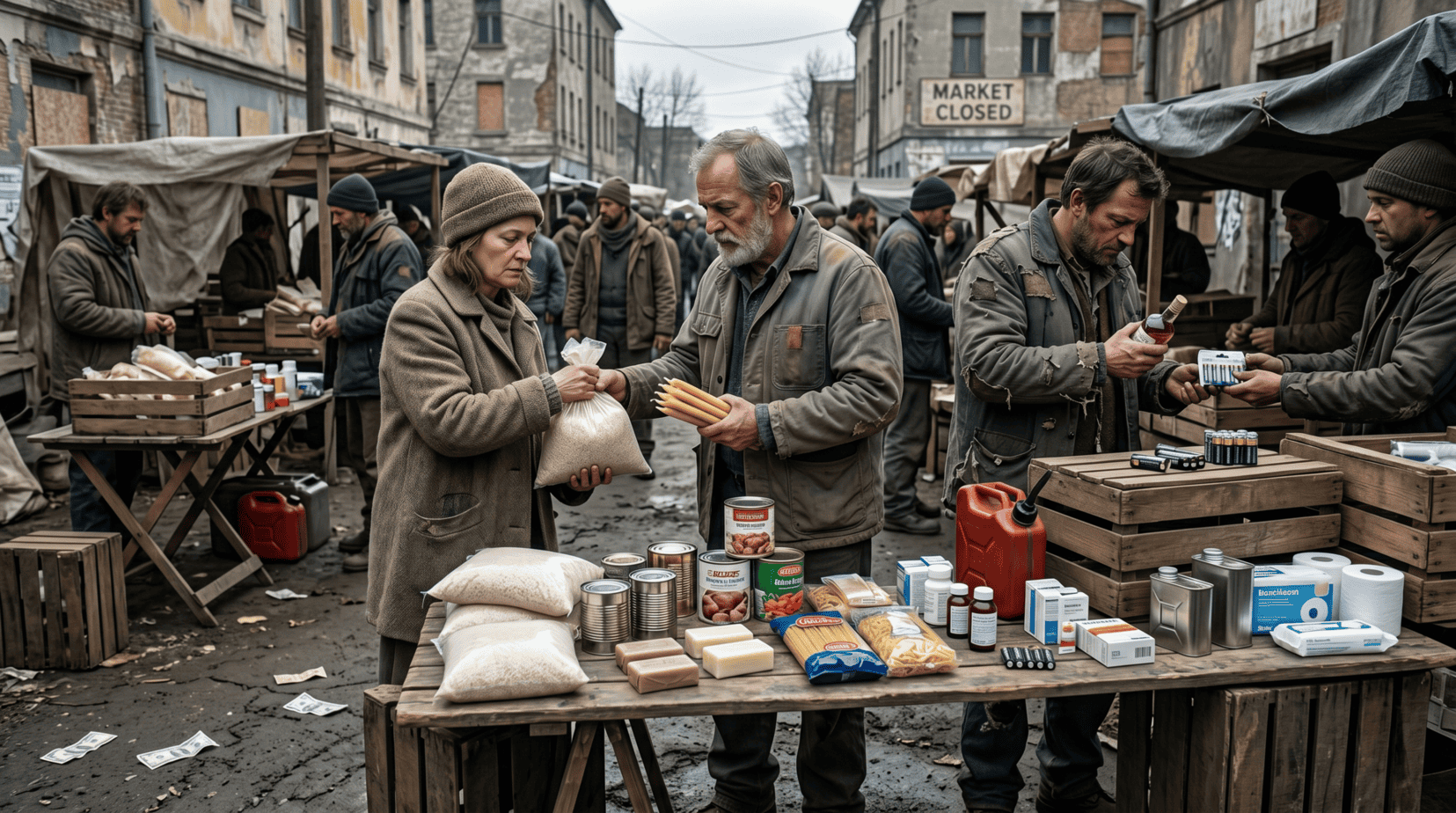
Most people have never had to think seriously about what happens when money stops working. Not just inflation chewing away at purchasing power, or a bank account temporarily frozen during a dispute, but a full-scale situation where the currency in your wallet becomes about as useful as scrap paper.
That is the reality that kicks in during a barter economy collapse, and it has happened more often throughout history than most people are comfortable acknowledging.
From the Weimar Republic’s wheelbarrows of worthless marks to the near-total economic disintegration in Venezuela, history has consistently shown that when monetary systems fail, human beings adapt by falling back on direct exchange. They trade what they have for what they need. No central bank required. No credit score and no SWIFT transfer. Just goods in hand and a willingness to negotiate.
Understanding a barter economy collapse is not about embracing doom. Millions of ordinary families across the world have lived through exactly these situations, and the ones who fared best were the ones who had thought ahead, stocked practical items, and developed skills their communities actually valued.
This article breaks down the mechanics of what happens during an economic collapse, which goods have historically functioned as money when paper currency failed, and what you can realistically do today to prepare for a scenario where your debit card means nothing and your pantry means everything.
Understanding What Triggers a Barter Economy Collapse
A barter economy collapse does not arrive overnight. The conditions that lead to currency failure typically build over years, occasionally decades, before the moment where the monetary system becomes too broken to function. The most common triggers include hyperinflation, where a government prints money faster than its economy produces value; supply chain collapse, where essential goods vanish from shelves regardless of how much money people hold; and systemic banking failures, where access to funds evaporates along with trust in financial institutions.
Venezuela represents the most studied modern example of a barter economy collapse. Between 2016 and 2019, inflation spiraled so severely that gas station attendants began accepting rice, cooking oil, and cigarettes as payment instead of bolivars. A single candy bar held more practical trade value than a stack of the national currency. Drivers would pay for a full tank of gas with a handful of corn flour because the official currency had become functionally meaningless. For a deeper look at how this unfolded economically, see the International Monetary Fund’s analysis of Venezuela’s hyperinflationary period.
The Great Depression in the United States produced similar dynamics, though on different terms. Rural communities reverted to trading labor for food, eggs for dental work, and homegrown produce for clothing repairs.
The mechanisms of barter economy collapse are remarkably consistent across different eras and geographies: trust in currency collapses, people pivot to tangible goods, and communities reorganize around whoever controls items of real, immediate utility.
Food and Water: The Foundation of Any Post-Collapse Trade System
When a barter economy collapse takes hold, the most immediately valuable commodities are the ones that keep people alive. Food rises to the top of any trade hierarchy almost instantly. During the Siege of Sarajevo in the 1990s, a single cigarette could purchase bread. A can of meat was the equivalent of several days’ wages. The hierarchy of need in a collapsed economy is brutal in its simplicity: people will trade almost anything for food when hunger sets in.
Long-shelf-life foods carry the most trade value because they can be stored, transported, and portioned without requiring refrigeration or cooking fuel. Canned goods, dried beans, rice, oats, and freeze-dried meals have all historically functioned as informal currency during extended crises. Salt, which seems almost comically mundane in a grocery store context, has served as literal money for most of human history and retains enormous barter value in any prolonged disruption because of its role in food preservation. Roman soldiers were famously paid partly in salt, which is the root of the word “salary.”.
For emergency food storage guidance, FEMA offers a comprehensive preparedness resource at.
Water purification tools carry similar weight. Water itself is obviously essential, but clean water is the actual commodity in a crisis. Portable water filters, purification tablets, and even the knowledge of how to build a basic gravity-fed filtration system can all be traded during an extended barter economy collapse.
A good water filter is the kind of item that becomes priceless the day the municipal system stops functioning. For a high-quality option to consider stocking, the LifeStraw Personal Water Filter is widely used by preppers and survival communities.
Alcohol, Tobacco, and the Psychology of Vice Goods in Crisis
There is something deeply predictable about the way vice goods function during collapse scenarios. Every major economic and social crisis in recorded history has produced the same pattern: alcohol and tobacco become shadow currencies almost immediately. This is not cynicism about human nature; it is an empirical observation backed by centuries of evidence.
vDuring World War II, cigarettes functioned as the dominant currency in prisoner-of-war camps. After the fall of the Soviet Union, cigarettes and vodka circulated as de facto money across communities where the ruble had lost credibility.
The reason vice goods work so well as barter items is threefold. First, they are physically addictive, meaning demand remains high regardless of circumstances. Second, they are infinitely divisible, meaning a single bottle of whiskey or a carton of cigarettes can be split into dozens of small trades. Third, they serve secondary purposes beyond their primary use: alcohol can disinfect wounds, clean equipment, and provide warmth in the form of that small internal fire that gets people through cold nights during a barter economy collapse. Hard liquors with long shelf lives, such as whiskey, vodka, and rum, are the most practical options for stockpiling.
Cannabis, in jurisdictions where it is legal, has begun appearing in discussions of modern crisis barter goods as well. Its shelf life, portability, and demand among a significant portion of the population make it a functionally similar trade item to tobacco. Coffee and tea also deserve mention here.
Caffeinated beverages occupy an unusual psychological space during crises: they are comforting, habitual, and represent one of the few small pleasures available in genuinely difficult circumstances. A pound of real ground coffee during an extended grid-down scenario would likely be worth far more than its grocery store price tag suggests.

Medical Supplies and Prescription Medications as Crisis Currency
Nothing creates desperation quite like illness in an environment where pharmacies are closed, supply chains are severed, and the formal healthcare system has broken down. Medical supplies become enormously valuable during any prolonged barter economy collapse, and the hierarchy within medical goods is worth understanding clearly.
Over-the-counter items sit at the more accessible end: pain relievers, antihistamines, antidiarrheal medications, and wound care supplies like bandages, antiseptic, and medical tape. These items are inexpensive today, store for years, and become genuinely precious when access to a functioning pharmacy is no longer guaranteed.
Antibiotics represent a higher tier of medical barter value. The challenge, of course, is that prescription antibiotics require prescriptions under normal conditions, and their misuse outside appropriate medical supervision carries real risks. That said, in a true collapse scenario where medical care is unavailable, the person who has a course of amoxicillin when someone else has a serious bacterial infection holds extraordinary trade leverage.
Fish antibiotics, which are technically the same compounds as human versions and sold without a prescription in many places, have long been discussed in preparedness communities for this reason, though responsible use always requires knowledge of dosing and contraindications.
A well-stocked first aid kit functions both as personal protection and as a portable asset in a barter economy collapse. The Adventure Medical Kits Trauma Pak is one of the more practical options that bridges the gap between basic first aid and more serious wound management. Beyond physical medical supplies, knowledge itself carries medical trade value. Anyone who can set a bone, stitch a wound, identify medicinal plants, or deliver a baby becomes a community resource whose skills translate directly into goods and security.
Precious Metals and Their Complicated Role in a Barter Economy Collapse
Gold and silver are the classic survivalist answer to currency collapse, and their reputation is not entirely without merit. Precious metals have served as stores of value across essentially every civilization in human history, and they have maintained purchasing power through the collapse of dozens of national currencies.
During the Venezuelan hyperinflation crisis, gold priced in bolivars appreciated by millions of percent while the national currency became functionally worthless. The historical case for precious metals as a hedge against barter economy collapse is backed by thousands of years of consistent evidence.
That said, the role of gold and silver in a genuine barter economy collapse is more nuanced than preppers sometimes acknowledge. In the immediate aftermath of a collapse, when grocery stores are empty and hospitals are overwhelmed, most people will not accept an ounce of gold for a can of food. They need food, not gold.
Precious metals begin to function more effectively as exchange media once a barter economy has stabilized somewhat, meaning weeks or months into a crisis rather than hours or days. Silver, because of its lower unit value, tends to be more practical for everyday transactions in a collapsed economy.
Pre-1965 US silver coins, sometimes called “junk silver,” are widely recognized and trusted and can be broken into small denominations suited to modest trades. For context on how precious metals function during monetary crises, the historical record maintained by the World Gold Council is instructive.
For those looking to build a small precious metals reserve as part of a broader preparedness strategy, the American Silver Eagle 1 oz coin is probably the most recognizable and trusted option in the United States market. The key principle is small denominations: large gold bars are impractical for day-to-day trading in a collapsed environment.
Tools, Seeds, and Practical Skills That Become Priceless
One of the most consistently overlooked categories of barter value during a barter economy collapse is practical tools and the knowledge to use them. A manual hand drill, a set of quality knives, a wood-handled hatchet, a functioning manual grain grinder, or a solid pair of work boots can all command significant trade value in an environment where hardware stores are closed indefinitely and electricity is unreliable. Tools represent compressed labor potential: whoever holds them can produce things, repair things, and build things that other people need.
Seeds are often mentioned in prepper communities as a barter item, and the logic is sound when applied correctly. Heirloom seeds, meaning non-hybrid varieties that produce viable seeds for the following season’s planting, represent renewable food production capacity. A packet of heirloom vegetable seeds that costs a few dollars today could trade for significant quantities of food a growing season into a collapse, particularly in communities where people have garden space and some agricultural knowledge but lack reliable seed stock. The Survival Garden Heirloom Seeds collection available through various retailers offers a broad spectrum of open-pollinated varieties suited for long-term storage.
Skills that have been increasingly outsourced to professionals carry extraordinary weight in a post-collapse barter context. Carpentry, electrical knowledge, basic automotive repair, animal husbandry, leather working, soap making, food preservation and canning, herbal medicine, blacksmithing, and midwifery are all examples of capabilities that transform a person from a simple consumer of goods into a producer of things others desperately need. In many historical collapse scenarios, the skilled tradespeople and farmers fared far better than the wealthiest members of the pre-collapse economy, simply because they controlled something that could not be confiscated or inflated away.
Fuel, Fire, and Energy: Controlling the Power of Warmth and Mobility
Energy is civilization. When fuel becomes scarce during a barter economy collapse, transportation grinds to a halt, heating and cooking become enormous challenges, and anyone with reliable access to fuel, firewood, or alternative energy sources commands extraordinary leverage in the trade economy. Gasoline and diesel have obvious value, though their shelf life without stabilizers is limited to about six months under normal storage conditions. Fuel stabilizers like Sta-Bil can extend this significantly, and propane and kerosene store essentially indefinitely when properly sealed.
Firewood becomes a primary currency in cold climates during any prolonged grid-down scenario. During the Venezuelan blackouts of 2019, neighborhoods organized informal systems for sharing cooking fires, and those with access to reliable fuel sources commanded significant trade advantages. Propane canisters, lighter fluid, matches, and lighters all carry high barter value relative to their low pre-crisis cost. A single Bic lighter, which costs almost nothing today, can be traded for food in a survival scenario because fire-making capacity is something people discover they do not have when they actually need it.
Solar panels and hand-crank generators occupy a premium tier of energy-related barter goods because they represent renewable power generation rather than a finite fuel supply. The ability to charge communication devices, power lights, or run a small refrigerator becomes enormously valuable to a community during a prolonged barter economy collapse. Even modest portable solar chargers that power phones and radios can command significant trade value, because information, communication with family members, and access to emergency broadcasts are all things people will trade for. The Goal Zero Yeti portable power station is the kind of long-term investment that serves both personal use and potential trade scenarios.
Hygiene Products and Sanitation Supplies in Economic Collapse
The barter value of hygiene products during a collapse scenario is something that catches first-time preppers genuinely off guard. When people think about what they would miss most in a grid-down scenario, clean running water and working sewage systems are not always the first answers, but they should be.
Soap, toothpaste, toilet paper, feminine hygiene products, diapers, and basic sanitation supplies all become valued trade goods almost immediately when supply chains break down, partly because they affect quality of life so directly and partly because their absence creates genuine health risks through disease transmission.
Venezuela’s collapse illustrated this clearly in ways that went beyond the currency itself. A pack of condoms reportedly reached the equivalent of seventy US dollars in Caracas at the height of the crisis, because the formal market for such products had collapsed while the biological demand for them certainly had not. Disposable razors, shampoo, deodorant, and even simple bar soap took on outsized trade value because they represented basic dignity in extraordinarily difficult circumstances. People trade hard for dignity, which is something the purely analytical assessments of barter economy collapse sometimes miss.
Bleach and other household disinfectants deserve particular attention here. Beyond their sanitation uses, diluted bleach is one of the most reliable and inexpensive methods of emergency water purification. A gallon of bleach today is practically free; in an extended crisis, it is a multi-purpose tool that can prevent disease and purify drinking water.
Similarly, hand sanitizer, N95 masks, and basic personal protective equipment demonstrated their enormous value during the COVID-19 disruptions of 2020, offering a real-world preview of what happens to hygiene supply chains when demand suddenly spikes beyond normal capacity.
Communication, Security, and Information as Trade Commodities
Information has always been valuable, but during a barter economy collapse, it becomes a literal survival tool. Knowing which roads are safe to travel, where functional medical care can be found, which communities are trading fairly versus preying on vulnerable travelers, and where food is available can mean the difference between survival and serious harm.
People who operate functioning ham radios, who have knowledge of regional conditions, or who serve as trusted information brokers within their communities occupy a genuinely important niche in any post-collapse trade economy.
Security, too, functions as a tradable service in collapse environments. Communities that cannot protect themselves from predatory actors seeking to take resources by force often find themselves stripped of their trade goods rapidly.
Historical examples across multiple collapse scenarios, from post-war Europe to present-day failed states, consistently show that individuals and families with the capacity to defend themselves and their goods fare substantially better in a barter economy collapse than those relying purely on goodwill. This is not an argument for aggression; it is an acknowledgment that the ability to protect one’s household and trade goods is itself a form of wealth.
Reliable firearms and ammunition have historically served both as defense tools and as high-value barter items during collapse scenarios. For research and preparedness context on this topic, the Mises Institute maintains a significant body of economic literature on collapse dynamics and informal market formation.
Two-way radios and hand-crank emergency weather radios are practical communication tools that carry both personal utility and barter potential. The ability to communicate across short distances without relying on cellular networks becomes critical when those networks are overwhelmed or offline. A good handheld HAM radio offers even broader communication range and the ability to receive emergency broadcasts from distant areas, giving the operator a consistent information advantage within any local trade community.
Building a Barter Economy Collapse-Ready Stockpile Without Going Broke
Preparing for a barter economy collapse does not require spending tens of thousands of dollars or building an underground bunker. The most practical approach is incremental and systematic, prioritizing the items that serve dual purposes: goods that you will actually use in your current daily life and that would carry trade value in a crisis scenario.
Buying an extra case of canned goods, an additional pack of lighters, an extra bottle of over-the-counter pain reliever, or a few gallons of bleach over the course of several weekly shopping trips is a low-cost, low-stress way to build a functional reserve without triggering anxiety about worst-case scenarios.
The rotation principle is critical here. A stockpile of food that expires and gets thrown away is a waste of money and preparation effort. First-in, first-out inventory management means eating from your oldest stored goods and replacing them with fresh stock, ensuring that your supply is always within its usable date range. The same principle applies to medications, batteries, and fuel. Treating preparedness as an ongoing lifestyle practice rather than a one-time purchase creates a more resilient household and a less overwhelming path to genuine readiness.
Community relationships are arguably the most valuable preparedness resource of all, and they cost nothing financially. Neighbors who know each other’s skills and resources, who have discussed mutual aid informally before any crisis, and who trust one another enough to trade honestly in difficult circumstances create a far more resilient local economy than any individual stockpile can.
The academic research on how communities navigate economic collapse consistently shows that social capital, meaning the quality and breadth of trust-based community relationships, predicts outcomes better than individual material preparation. For detailed academic reading on how informal economies emerge during monetary collapse, the research catalogued by the National Bureau of Economic Research provides rigorous analysis.
For those looking to build a comprehensive home preparedness kit as a starting point, the SurviveX Large Pro First Aid Kit offers a solid foundation of essentials in a single package.
My Two Cents: What This All Actually Means
After spending time in the research on barter economy collapse, what strikes me most is not how exotic or extreme these scenarios are, but how ordinary they look from the inside. The people living through Venezuela’s hyperinflation were not post-apocalyptic characters in a dystopian novel. They were teachers, mechanics, nurses, and parents who found themselves in an economy where the rules changed faster than they could adapt. The ones who fared best were not the ones with the most cash. They were the ones with practical skills, trusted relationships, and enough stored goods to avoid desperation trading.
The truth is that a barter economy collapse does not require a Hollywood-scale catastrophe to unfold. A prolonged regional power outage, a targeted supply chain disruption, or a rapid inflation event can all create localized versions of exactly this dynamic. And preparation for those scenarios does not have to look like paranoia. Stocking useful goods, building meaningful community relationships, and developing practical skills are all things that improve daily life regardless of whether a crisis ever arrives.
The worst thing that can happen is that you live a perfectly stable and comfortable life, eat your stockpiled food, never trade a can of beans for anything, and simply lived a bit more self-sufficiently than average. There are far worse outcomes.
Author Bio
Bob Rodgers is a lifelong outdoorsman, herbalist, and seasoned prepper with over 20 years of real-world survival experience. As the founder of PreppersWill.com, he shares practical advice on self-reliance, off-grid living, and disaster preparedness, no hype, just hard-earned lessons from decades of hands-on prepping.
Other resources:
What you should know about survival foods with decades of shelf life
The Foods that helped the pioneers survive crop failures and hard times
Survival Foods of the Native Americans
If you plan to build a storage room and equip it with everything needed > Start Here!
