Most people treat a blackout as a temporary hassle, the kind of thing you assume the utility company will sort out before the food in the fridge starts to spoil. You light a few candles, check your phone, maybe grumble about the inconvenience, and expect normal life to resume shortly.
What rarely crosses anyone’s mind is how deeply the modern financial system depends on that steady flow of electricity. Your paycheck, your savings, and the balance you check on your banking app are not stacks of bills waiting patiently in a vault. They exist as digital entries stored in data centers, verified across networks, and updated in real time by infrastructure that quietly assumes the grid will always be there.
Bank outages during blackouts are not fringe scenarios or worst-case fantasies. They are a predictable consequence of a fully digital economy that relies on power and telecommunications at every level. When electricity fails for more than a brief window, access to your own money can become limited, delayed, or temporarily unavailable.
For a short outage, that friction may feel manageable. When the blackout stretches into days, the situation changes in ways most families are not prepared for.
Bank Outages During Blackouts: The First 24 Hours
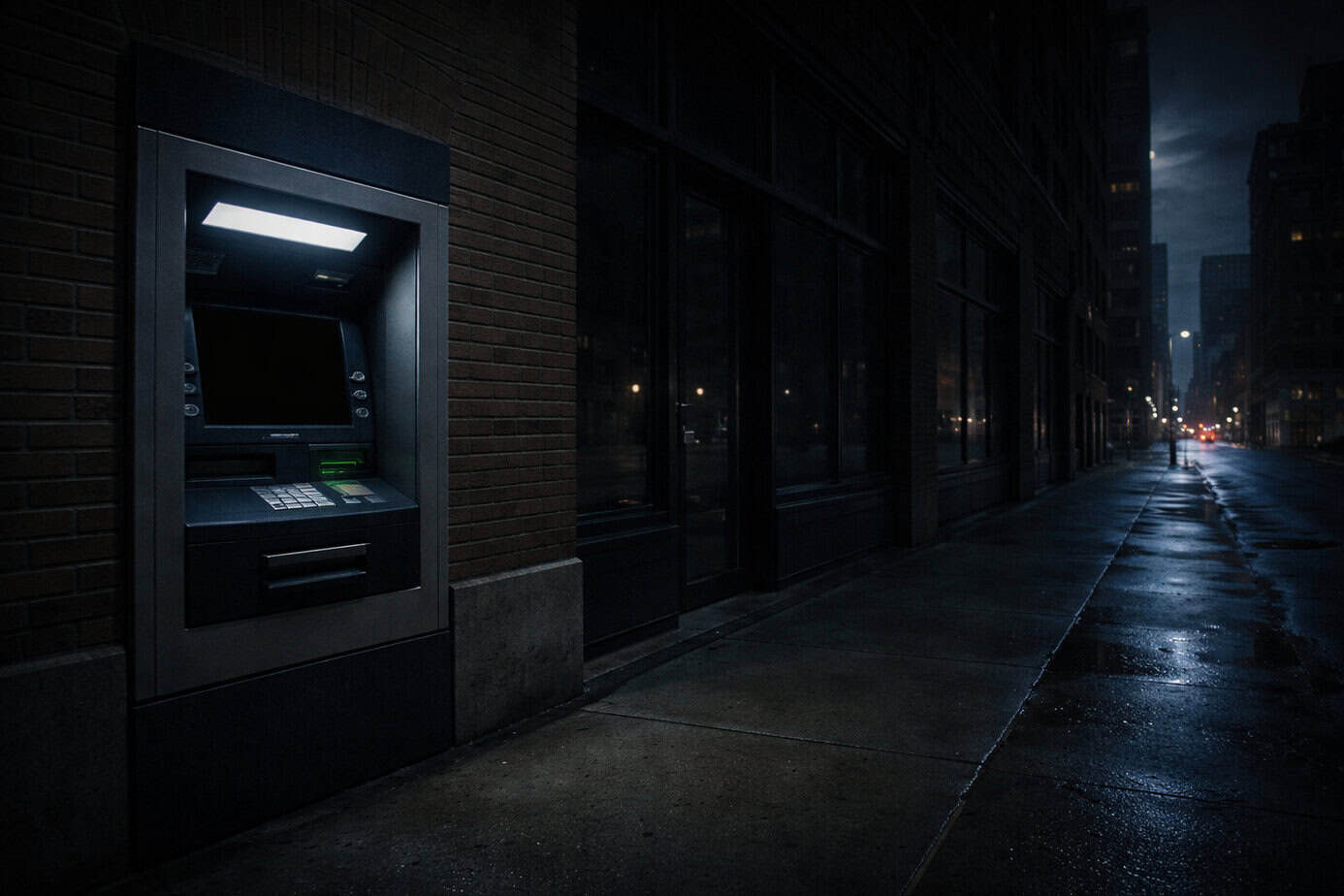
When a blackout stretches beyond a couple of hours, the impact on everyday life becomes tangible in ways most people never anticipate. Lights going out and phones losing signal are obvious, but one of the first hidden consequences many families discover is difficulty accessing cash or completing simple financial transactions. In those early hours, bank outages during blackouts often manifest as ATMs going offline, debit and credit card transactions failing, and mobile banking apps either freezing or refusing to connect.
ATMs rely on both power and network connectivity to verify transactions, dispense cash, and communicate with the bank’s central systems. When the grid fails and local electrical infrastructure falters, even machines with backup generators may only operate for a short window before fuel runs low, forcing them into a shutdown state or a “service unavailable” mode. This disruption can leave families stranded without access to physical currency just when they need it most.
Digital banking apps and online portals aren’t immune either. They depend on data centers, internet service providers, and mobile networks that in many regions go dark quickly during extended outages. Even if a bank’s core systems have auxiliary power, regional communications forests can disconnect, making the banking interface inaccessible for users.
In the first 24 hours of a significant power outage, bank systems work in a degraded mode at best. Customers often experience delayed transaction confirmations, failed transfers, or total lack of access, and this initial disruption is where the phrase “money isn’t useful if you can’t access it” becomes painfully real for most people.
How Modern Banks Actually Work (And Why Power Is Everything)
To understand why bank outages during blackouts happen, you have to understand what a modern bank actually is. It is not a building with a vault full of neatly labeled cash drawers. It is a network. A living, breathing digital organism that runs on electricity, fiber optic cables, server farms, backup generators, and real-time verification systems that never really sleep.
When you swipe your debit card at a grocery store, that transaction does not stay local. It travels. First to the point-of-sale system. Then to the payment processor, then through card networks, and then to your bank’s core system where your balance is verified and adjusted. All of that occurs in seconds, and every step depends on powered hardware and stable communications.
Even a simple balance check on your phone sets off a chain reaction behind the scenes. Your app connects to a server, which queries a database, which confirms the most recent transactions, which may involve pending authorizations still being reconciled across networks. None of that exists in a physical form you can access without electricity.
Banks do build redundancy into their systems. Large institutions maintain backup power, mirrored data centers, and failover systems in different geographic regions. But redundancy is designed to bridge short interruptions, not sustain a prolonged regional grid failure. If a blackout lasts long enough, the weak points are not the bank vaults but the infrastructure feeding those digital systems.
That’s the part most people miss. The banking system isn’t fragile in the sense that it collapses easily. It’s fragile in the sense that it is deeply interconnected. And when the grid falters, those interconnections become pressure points.
When the lights go out for more than a few hours, access to your money is no longer a guarantee. It becomes dependent on which layers of that digital organism are still alive and which have gone dark.
Bank Outages During Blackouts: Lessons From Real U.S. Disasters
If you want to see how bank outages during blackouts actually unfold, you do not have to imagine some distant collapse scenario. You can look at recent American history.
When Hurricane Katrina hit in 2005, large portions of the Gulf Coast lost power for extended periods. Flooding damaged infrastructure, telecommunications failed, and many bank branches were physically inaccessible. ATMs were knocked offline either because they had no electricity or because network connections were severed. Even people with money safely deposited in insured accounts found themselves unable to withdraw cash when they needed it most. FEMA’s own after-action reporting from Katrina details how prolonged power outages and infrastructure damage severely disrupted financial services and electronic payments across the region.
Fast forward to Superstorm Sandy in 2012. Large sections of New York and New Jersey experienced days without power. Gas stations could not process card payments and some banks closed branches due to flooding and grid failure. Customers reported ATM shortages as machines either ran out of cash or could not connect to networks.
Then came the 2021 Texas grid collapse. While the financial system did not collapse, rolling outages and infrastructure strain created moments where digital access became unreliable. Grocery stores went cash-only in some areas and card readers failed intermittently. People who had assumed they could tap their way through any emergency suddenly had to search for physical currency.
The pattern is consistent and the banking system does not implode overnight, but access narrows. It becomes uneven. Some branches operate on generators while others shut their doors. Some ATMs function for a while while others go dark immediately. Digital systems degrade in ways that frustrate users long before they fail completely.
What these disasters reveal is not weakness in a single bank, but the reality that electricity underpins the entire financial ecosystem. When the grid suffers sustained damage, friction appears quickly. And for families who do not keep cash reserves, that friction turns into real-world hardship within days.

ATMs, Debit Cards, and the Illusion of Access
There’s a quiet assumption most Americans carry around: if things get tight, you can just swing by an ATM. That machine on the corner feels permanent, like a utility pole or a stoplight. It’s always there. It always works, until it doesn’t.
During bank outages during blackouts, ATMs are often the first visible sign that access to money is not guaranteed. These machines do not hold endless stacks of cash. Most carry a limited amount, replenished on a schedule by armored transport services that rely on fuel, functioning roads, and working logistics systems. In a regional emergency, those supply chains slow down fast.
Even when the machine itself has backup power, it still needs network connectivity to verify balances and approve withdrawals. No connection means no transaction. Some machines shift into an offline mode for a short time, but that functionality is limited and tightly controlled to prevent fraud.
Withdrawal limits add another layer because banks cap daily ATM withdrawals as a fraud-prevention measure. In normal times, that feels reasonable. In a prolonged outage, it can feel suffocating and if thousands of people rush to pull cash at once, machines empty quickly. Replenishment becomes irregular and lines form quickly.
The Federal Deposit Insurance Corporation has acknowledged in consumer preparedness guidance that electronic payment systems can be disrupted during disasters, reinforcing the need for households to keep some cash on hand for emergencies.
Debit cards and credit cards create a similar illusion. As long as the payment processor can ping your bank and receive approval, the transaction goes through. But remove electricity or sever data lines, and those plastic cards become little more than laminated rectangles.
This is where psychology enters the picture. The moment people realize access is uncertain, behavior shifts. A manageable inconvenience can escalate into urgency. Not because the system has collapsed, but because confidence begins to wobble. And in banking, confidence is everything.
Bank Outages During Blackouts and the Risk of Digital Lockout
There is a difference between a temporary inconvenience and a digital lockout, and during bank outages during blackouts, that line can blur quickly. In the early phase of a grid failure, systems slow down, transactions lag and apps struggle to refresh. After that, access can become restricted in ways most customers have never experienced.
Banks operate layered security systems that monitor unusual behavior. When power outages hit a region, transaction patterns change overnight. Large numbers of customers attempt withdrawals at once and online logins spike. Out-of-area transactions increase as people relocate or travel to find working infrastructure. Fraud detection algorithms can flag these shifts automatically, triggering temporary account holds or additional verification steps. In a stable environment, that protects customers. During a blackout, it can feel like the door just slammed shut.
There is also the risk of technical overload. If power disruptions coincide with cyber incidents or infrastructure strain, institutions may temporarily limit services to stabilize systems. The U.S. Cybersecurity and Infrastructure Security Agency has warned that financial services are a critical infrastructure sector and are particularly vulnerable during periods of grid instability or disaster, when systems are under abnormal stress.
History gives us real-world examples of access restrictions beyond pure power failure. In 2022, the Canadian government froze certain bank accounts during protests, demonstrating how digital financial systems can be restricted swiftly under extraordinary circumstances. In 2023, regional U.S. bank failures triggered temporary transaction delays and sudden withdrawal surges as customers reacted in real time.
The point is not that banks are eager to deny access. It is that digital systems are tightly controlled environments. When stress rises, controls tighten. During extended blackouts, that tightening can compound the simple problem of lost electricity into something broader: the inability to move, withdraw, or verify your own funds at the moment you need them most.
Access in the modern system depends on three things: power, connectivity, and institutional stability. Remove one for long enough, and friction begins. Remove two, and lockout becomes a real possibility.
What Happens if the Blackout Lasts Weeks?
A few hours without power is an inconvenience while a few days is disruptive, but a few weeks is something else entirely.
When you stretch the timeline, bank outages during blackouts stop being temporary service interruptions and start becoming structural stress tests. Backup generators run on diesel, but that diesel requires trucking. Trucking requires fuel distribution networks, functioning roads, and coordinated logistics. If the blackout is widespread enough, fuel becomes rationed and prioritized. Hospitals and emergency services come first. Financial institutions are important, but they are not at the top of every emergency fuel list.
Data centers are built for resilience. Many have redundant power feeds, battery arrays, and onsite fuel, but even hardened facilities depend on supply chains. Prolonged outages can force institutions to scale back nonessential services, limit transactions, or temporarily shut down branch operations to preserve core processing capacity.
On the ground, the effects compound. ATMs that survived the first few days empty out and the armored carriers struggle to replenish machines if refueling becomes unreliable. Stores that initially accepted cards may shift entirely to cash only if network reliability continues to degrade. Some small businesses may simply close until systems stabilize.
There is also a quieter risk: settlement delays. Financial transactions do not just happen between you and your bank. They are cleared and settled across networks. The Federal Reserve has documented how payment systems rely on stable operational environments and contingency planning to maintain settlement functions during disruptions. If those environments are strained long enough, transfers can slow or queue, even if balances appear intact on paper.
For families, the experience becomes deeply practical. Bills cannot be paid online and direct deposits may be delayed if employers are also impacted by outages. Mortgage autopay systems can stall and insurance payments hang in limbo. The digital rhythm of normal life starts to skip beats.
This is where preparation stops being theoretical. A week or two without reliable banking access does not mean the financial system collapses. It means access becomes uneven, unpredictable, and slow. And unpredictability is what creates stress in households that rely entirely on digital transactions.
The longer the blackout, the more the question shifts from “When will it come back?” to “What do we do in the meantime?”
Bank Outages During Blackouts in Cities vs Small Towns
It is tempting to assume that rural communities would handle bank outages during blackouts better than dense cities. After all, small towns often have tighter social networks, local banks, and a culture that still leans more heavily on cash. Cities, by contrast, run on digital speed: tap to pay, direct deposit and app-based everything.
In large metropolitan areas, the dependency on electronic payments is absolute. Grocery chains, parking garages, transit systems, and gas stations are often fully integrated into centralized payment networks. When power and connectivity drop, entire neighborhoods can shift to cash-only within hours. The problem is that urban residents are also less likely to keep meaningful cash reserves at home. High population density means ATM lines form quickly, machines empty quicker and tension builds faster too.
But small towns are not immune and many community banks rely on the same core processing systems used by national institutions. Even if the local branch has a generator humming behind the building, it still depends on network connectivity to verify balances and process transactions. If regional telecommunications infrastructure goes down, that rural bank may be just as unable to move money as a downtown branch in a major city.
Supply chains are another equalizer because rural stores depend on electronic ordering systems and card payments just like urban ones. If digital payments fail for an extended period, inventory shortages follow. Cash may buy you time, but if deliveries slow down, shelves still thin out.
Where smaller communities sometimes have an advantage is social cohesion. Informal credit, neighbor-to-neighbor trade, and long-standing relationships can bridge short-term disruptions. In cities, anonymity makes that harder. When people do not know each other, trust is thinner.
Ultimately, geography does not determine resilience as much as preparation does. A well-prepared family in an apartment can weather a blackout better than an unprepared household on ten rural acres. Bank infrastructure is national. The grid is regional. Access to your money depends less on zip code and more on how many layers of backup you have built into your own life.
FDIC Insurance Won’t Help You That Week
There is a comforting phrase many Americans lean on when conversations about financial risk come up: “It’s FDIC insured.” And that protection is real. The Federal Deposit Insurance Corporation covers deposits up to legal limits if a bank fails. But during bank outages during blackouts, insurance is not the same thing as access.
FDIC coverage protects against insolvency, but it does not guarantee that you can withdraw cash during a grid failure. It does not keep ATMs powered., it does not restore cellular networks and if your bank’s systems are temporarily offline because regional infrastructure is down, insurance does nothing to speed that up.
The FDIC itself explains that deposit insurance covers customers if an insured bank fails, up to $250,000 per depositor, per insured bank, for each account ownership category. That is a solvency guarantee, not a liquidity guarantee in the middle of a blackout.
Liquidity is the real issue during extended outages. Liquidity means usable money right now, the physical currency in hand. Not a digital balance waiting to be accessed once systems come back online.
This distinction matters because many families assume that if their money is insured, it is safe in every practical sense. Safe from loss, yes. Immediately usable in a power-down scenario, not necessarily.
During short outages, this gap may be barely noticeable. During longer blackouts, the difference between insured and accessible becomes painfully clear. You can be fully protected under federal law and still unable to buy groceries because the payment network is down.
Understanding that difference is not alarmism. It is clarity. And clarity is what allows you to plan realistically instead of relying on comforting but incomplete assumptions.
Bank Outages During Blackouts and Human Behavior
Systems matter, but people matter more. During bank outages during blackouts, the technical disruption is only half the story. The other half is how ordinary people react when access to money feels uncertain.
The first phase is confusion as the ATMs display error messages. Card terminals decline transactions that should have gone through. Mobile apps refuse to load. Most assume it is a glitch and they try again.
The second phase is urgency. Word spreads quickly, especially in dense communities. Social media posts mention machines being down. Group texts light up and when someone says a nearby ATM still works, and within an hour there is a line. People who had no intention of withdrawing cash suddenly feel the need to do so, just in case.
Economists have long studied the psychology of bank runs, noting that they are often driven less by hard financial data and more by shifting confidence. The Federal Reserve Bank of St. Louis explains how depositor behavior can accelerate stress on banks when fear spreads faster than facts. Even in situations where the underlying institution is solvent, perception alone can create pressure.
Now layer that psychology onto a prolonged blackout. The problem is not that banks have failed. The problem is that access feels unstable. When access feels unstable, behavior changes.
Stores that were accepting cards yesterday may post cash-only signs today. Gas stations might limit purchases, lines grow longer and frustration sharpens. Small inconveniences start to feel existential because money is tied directly to security, food, and mobility.
Most people are not irrational. They are responding to signals and when the signal is uncertainty, behavior tightens. Spending slows in some areas and spikes in others. Cash becomes more valuable than convenience.
Understanding this human layer is critical. The grid can fail for purely mechanical reasons, but once confidence begins to erode, the situation can shift from logistical problem to social tension quickly.
Preparation, then, is not only about supplies. It is about staying calm when others accelerate. In any prolonged disruption, the households that avoid panic decisions are usually the ones that weather the storm best.
How Much Cash Should a Family Really Keep?
This is where the conversation gets practical and once you understand how bank outages during blackouts can limit access, the obvious question becomes how much physical cash makes sense without going overboard.
There is no universal number that fits every household. A family in a high-cost city with a large mortgage and two vehicles will have very different short-term needs than a couple in a small town with lower monthly expenses. The better approach is to think in terms of time rather than dollar amounts.
Start with a simple calculation. What does your household spend in one week on essentials only? Groceries, fuel, basic medical supplies, and emergency incidentals. Strip out subscriptions and nonessentials and focus on survival-level spending. Multiply that by two and that figure is a reasonable baseline for a two-week disruption.
The Federal Reserve has reported that a significant percentage of Americans struggle to cover even a $400 emergency expense with cash on hand, which highlights how thin most liquidity buffers are. In a prolonged blackout, that vulnerability becomes visible fast.
Denominations matter too because large bills are harder to use if stores cannot make change. Smaller bills allow flexibility and in a stressed environment, a stack of twenties and tens is far more practical than a handful of hundreds.
Storage requires discretion. Cash should be secure, protected from fire and water damage, and not widely discussed. The goal is not to advertise preparedness but to quietly ensure your household has breathing room if digital systems stall.
This is not about abandoning banks or hoarding currency. It is about redundancy. Digital money works beautifully when the grid is stable but physical currency fills the gap when it is not.
Most families do not need thousands sitting in a shoebox. They need enough to cover essentials long enough for infrastructure to stabilize. That buffer buys time, and time, in any crisis, is leverage.
Bank Outages During Blackouts: Smart Workarounds Most People Ignore
If you accept that bank outages during blackouts can restrict access for days or even weeks, the next step is building layers so you are not dependent on a single point of failure. Most people rely on one bank, one debit card, and one digital ecosystem. That works beautifully right up until it doesn’t.
The first overlooked workaround is diversification across institutions. Keeping secondary accounts at a different bank or credit union adds geographic and operational redundancy. Smaller regional institutions may rely on different processing networks than national giants. If one system experiences strain, the other might remain functional. This is not about spreading fear. It is about spreading risk.
Another underused strategy is maintaining a modest emergency fund in a local credit union. Credit unions are member-owned cooperatives and often operate with closer community ties, which can translate into more flexible in-person solutions during regional disruptions. The National Credit Union Administration outlines how federally insured credit unions maintain contingency planning similar to banks, but local relationships can sometimes make a difference in access during short-term crises.
Home power resilience also matters more than people think. A small generator or battery backup does not keep the entire banking system alive, but it can keep your communication devices charged long enough to monitor account activity, receive alerts, or coordinate with employers and service providers once networks begin to stabilize. Even partial connectivity can help you move faster than someone waiting entirely in the dark.
Then there are alternative transaction methods. Prepaid fuel storage, purchased legally and stored safely, reduces immediate dependence on card-based gas purchases. Maintaining a pantry buffer reduces the need for emergency grocery runs. Community-level trade networks, whether informal barter arrangements or neighborhood mutual aid groups, can fill small gaps without requiring digital payments.
Some families also hold a portion of savings in tangible assets such as precious metals. While gold and silver are not everyday transaction tools, they represent a hedge outside the banking grid. They are not a replacement for cash, but they are another layer in a diversified resilience strategy.
None of these steps are extreme. They are practical redundancies. The modern financial system is efficient but interconnected and when power disruptions ripple through it, households with multiple access points experience inconvenience. Households with only one experience vulnerability.
Protecting Your Money at Home Without Becoming a Target
Once you decide to keep cash on hand as a buffer against bank outages during blackouts, another question follows quickly: how do you protect it without creating a new risk?
Cash at home solves one problem and introduces another. It is immediately accessible during a prolonged outage, but it is also vulnerable to theft, fire, water damage, and loose talk. The goal is resilience, not bravado.
Start with physical security. A quality fire-rated safe that is bolted down provides baseline protection against burglary and house fires. Fire departments routinely report that unsecured valuables are among the first losses in residential fires, while properly rated safes significantly improve survival of contents. The U.S. Fire Administration emphasizes the importance of fire-resistant storage for important documents and valuables as part of household preparedness planning.
Location matters as much as equipment and a visible safe in a master bedroom closet is the first place many burglars check. Discretion and thoughtful placement reduce risk. Some households divide emergency cash into two or three smaller caches rather than storing everything in one obvious spot. That way, even if one location is compromised, the entire buffer is not lost.
Operational security matters even more. Casual conversations about “how much cash we keep at home” travel faster than people realize. Children repeat things, friends talk and contractors overhear. The quieter you are about your preparations, the safer they remain.
Insurance is another overlooked layer. Standard homeowners policies may limit coverage for cash losses. Reviewing policy details and considering additional riders for valuable property can close that gap. Preparation is not just about having resources. It is about ensuring they survive the very event you are planning for.
Keeping emergency cash does not require paranoia. It requires common sense. You are not preparing for chaos on every street corner. You are preparing for temporary disruption where digital systems stall and physical currency fills the gap.
Handled responsibly, a home cash reserve is a stabilizer, not a liability. And like every other layer of preparedness, it works best when it is quiet, boring, and already in place before anyone else realizes they need it.

Could Bank Outages During Blackouts Trigger a Bank Run?
It is a fair question, and one that makes people uncomfortable. If bank outages during blackouts limit access long enough, could that frustration spill over into something bigger, like a bank run?
To answer that, you have to understand how modern banking works at its core. U.S. banks operate on a fractional reserve model. They do not keep every deposited dollar sitting idle in a vault. Deposits are used to fund loans and investments, while a portion is held in reserve to meet normal withdrawal demand. Under ordinary conditions, this system functions smoothly because not everyone withdraws funds at once.
The Federal Reserve explains that reserve requirements and liquidity rules are designed to ensure banks can meet typical withdrawal patterns and maintain stability. The system depends heavily on confidence. As long as customers believe their money is accessible, most leave it in place.
During a prolonged blackout, the risk is less about insolvency and more about perception. If customers cannot access ATMs, cannot complete transactions, and hear reports of others struggling to withdraw funds, confidence can wobble. Social media amplifies that wobble. A few viral posts about “banks locking people out” can move faster than any official clarification.
That does not mean a blackout automatically triggers a nationwide run. Large U.S. banks are heavily regulated, stress-tested, and supported by federal backstops. But localized withdrawal surges are entirely possible. We saw hints of this behavior during the 2023 regional bank failures, when customers rapidly moved funds based largely on fear and headlines.
The real danger during extended power outages is the combination of limited access and rumor. If people interpret temporary technical issues as signs of deeper failure, behavior can escalate quickly. The banking system is built to withstand economic shocks. It is less comfortable with sudden swings in public confidence.
For everyday families, the takeaway is not to panic at the first sign of disruption. It is to recognize how quickly narratives can shift. Prepared households do not contribute to panic withdrawals because they are not desperate for immediate access.
Bank runs begin with fear, but resilience begins with preparation.
Concluding
The calm prepper does not assume the worst. The calm prepper assumes friction. The grid will fail somewhere again. Storms will knock out power. Infrastructure will strain. When that happens, families who built redundancy will experience inconvenience. Families who relied on uninterrupted digital access will experience shock.
At the end of the day, this is not about predicting disaster. It is about accepting that modern efficiency has trade-offs. Electricity powers convenience. When electricity falters, convenience disappears. Planning for that reality is not extreme, it is responsible.
Author Bio
Bob Rodgers is a lifelong outdoorsman, herbalist, and seasoned prepper with over 20 years of real-world survival experience. As the founder of PreppersWill.com, he shares practical advice on self-reliance, off-grid living, and disaster preparedness, no hype, just hard-earned lessons from decades of hands-on prepping.
Suggested resources for preppers:
Food preps when you lack money
The #1 food of Americans during the Great Depression