When disasters strike in the United States, the official message is simple: go to a public shelter. Schools, churches, and community centers quickly become temporary housing for evacuees. For many people, that sounds like the safest option available.
But the truth is that shelters come with serious downsides that rarely get discussed openly. When large numbers of stressed, displaced people are packed into the same building with limited resources, problems can escalate quickly. Overcrowding, illness, theft, and lack of privacy are just a few emergency shelter risks that people often discover only after they arrive.
Organizations like the American Red Cross provide critical disaster assistance, and shelters do save lives in many situations. At the same time, even guidance from the Federal Emergency Management Agency explains that evacuation shelters are meant to meet only basic short-term needs.
Understanding emergency shelter risks helps you plan better options ahead of time. For many prepared households, public shelters are not Plan A. They are the last fallback when every other option has failed.
Why Officials Always Tell You to Go to a Shelter
If you watch any hurricane, wildfire, or major storm coverage in the United States, the message from authorities is almost identical: evacuate and go to a shelter. It’s repeated on television, radio, emergency alerts, and social media. On the surface, it sounds like the obvious solution. If people must leave their homes, shelters provide a place to gather where aid organizations can distribute food, water, and medical help.
From the government’s perspective, centralized shelters make disaster response easier to manage. Agencies like the CDC and groups such as the American Red Cross can concentrate resources in one location rather than trying to track thousands of displaced individuals scattered across a region. Volunteers know where people are, medical teams can reach them faster and supplies can be delivered in bulk.
Logistically, it makes sense.
But this approach also creates the very conditions that lead to many emergency shelter risks. When hundreds or even thousands of evacuees arrive at a school gym or convention center within a few hours, the facility can become crowded almost immediately. Resources that looked sufficient on paper suddenly have to stretch much further than expected.
Officials rarely highlight these downsides because shelters still serve an important purpose. In fast-moving disasters like hurricanes or wildfires, the priority is getting people out of danger quickly. A crowded shelter is still safer than being trapped in a flood zone or wildfire path.
However, once the immediate danger passes, the weaknesses of the shelter system start to show. Limited space, limited supplies, and large groups of stressed strangers living together create a long list of emergency shelter risks that many evacuees never anticipated.
Understanding why authorities push shelters so strongly helps explain the gap between official guidance and prepper thinking. Government agencies need a solution that works for the largest number of people during a crisis. Preppers, on the other hand, focus on avoiding those crowded environments altogether whenever possible.
Overcrowding: The Problem Every Emergency Shelter Faces
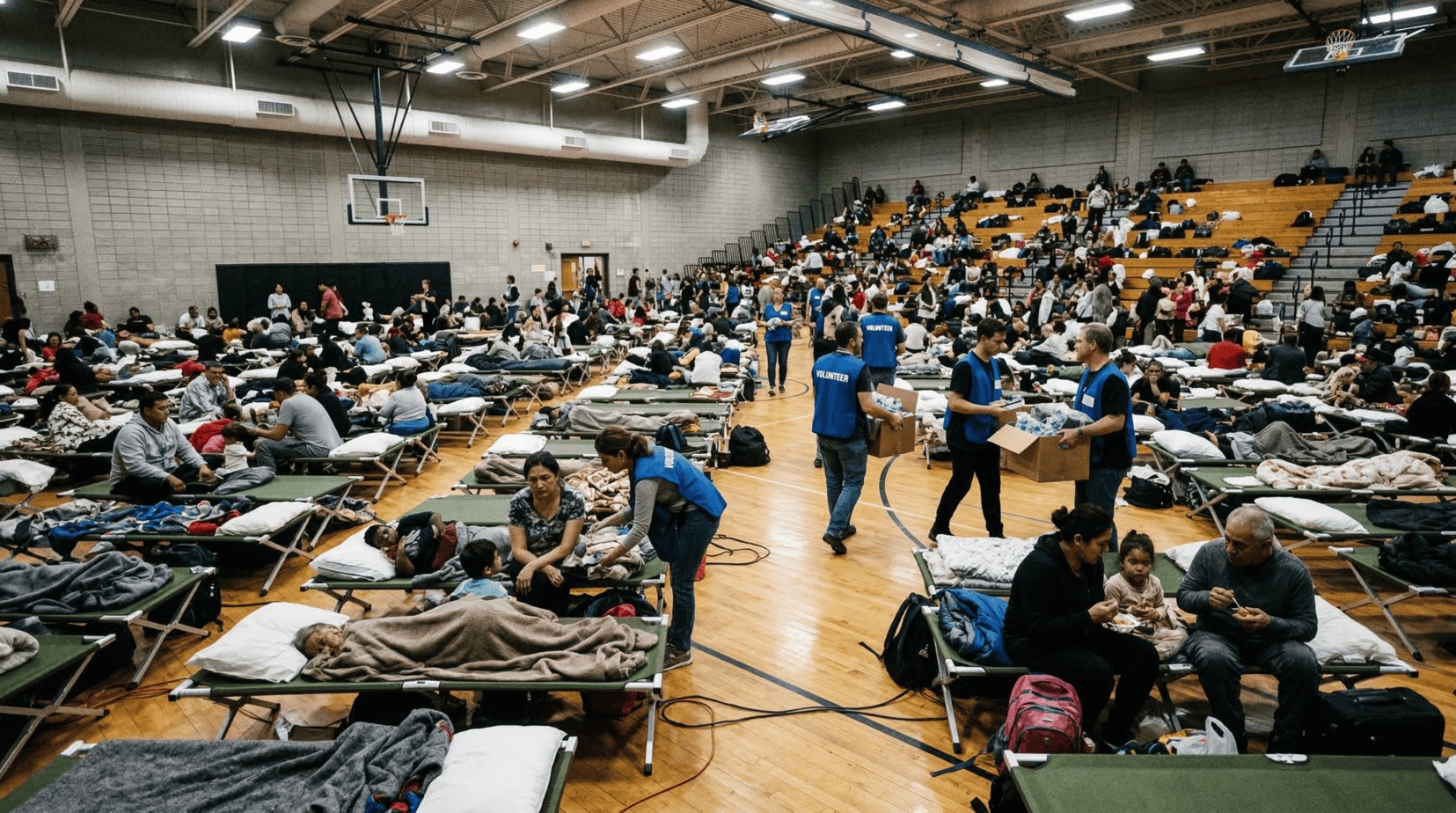
One of the most immediate emergency shelter risks people encounter is overcrowding. When evacuation orders go out, entire communities may arrive at the same shelter within a matter of hours. Schools, gyms, and convention centers can fill up quickly, and the available space shrinks fast once hundreds of cots are set up across the floor.
In many shelters, families end up sleeping only a few feet away from complete strangers. Privacy disappears almost instantly. Conversations, phone calls, crying children, and the constant movement of people make it difficult to rest. Even basic tasks like finding a quiet place to sit or organize your belongings become challenging.
Overcrowding also creates logistical problems. Bathrooms are shared by large groups, lines for food and water can stretch across the building, and volunteers have to work quickly just to keep up with demand. During major disasters, shelters may reach capacity and begin turning people away or redirecting them to other locations.
These conditions are not unusual. Emergency planning guidelines often assume high-density shelter environments where large numbers of evacuees share limited space. Public health agencies note that crowding in shelters can contribute to sanitation challenges, tension between occupants, and the faster spread of illness when people are packed together for extended periods.
For many experienced preppers, this is one of the most obvious emergency shelter risks. A crowded shelter may provide a roof and basic supplies, but the lack of space, privacy, and comfort can quickly turn an already stressful situation into something far more difficult to manage.
Disease Spread: One of the Most Serious Emergency Shelter Risks
Another major concern that often surprises evacuees is how easily illness spreads in crowded shelters. When hundreds of people share the same air, bathrooms, and sleeping areas, the conditions are almost perfect for viruses and infections to move from person to person. This is one of the most significant emergency shelter risks, especially during disasters that keep people in shelters for several days or longer.
Think about the typical shelter setup. People sleep close together on cots or mats. Many share limited bathroom facilities. Handwashing stations and sanitation supplies can run low if large numbers of evacuees arrive quickly. Add stress, poor sleep, and limited personal hygiene into the mix, and immune systems often take a hit.
Respiratory illnesses spread particularly fast in these environments. Coughing, sneezing, and close contact make it difficult to prevent exposure. Gastrointestinal illnesses can also become a problem when sanitation systems are overwhelmed or when food preparation areas handle large volumes of meals under pressure.
Public health officials have studied these problems for years. Research on disaster shelters has shown that outbreaks of influenza-like illness, norovirus, and other infections can occur when people live in crowded emergency facilities for extended periods.
For preppers, this is a critical piece of the emergency shelter risks conversation. A shelter may protect you from the immediate disaster outside, but inside you could be exposed to dozens or hundreds of strangers carrying illnesses you never expected to deal with during an emergency.

Crime and Personal Safety Concerns Inside Shelters
Another uncomfortable reality people discover quickly is that security inside shelters isn’t always as strong as they expect. When large groups of stressed strangers gather together, personal safety issues can emerge. This is one of the emergency shelter risks that rarely gets discussed in official messaging but often shows up in real disaster situations.
Most shelters are staffed by volunteers and relief workers who are doing their best to manage a difficult situation. However, they are not law enforcement, and they cannot watch every corner of a crowded building. With hundreds of people moving around, keeping track of personal belongings becomes difficult.
Theft is one of the most common problems. Phones, wallets, medication, and small bags can disappear quickly when people leave their cots unattended. In tight spaces where everyone is sleeping close together, it’s not always obvious who took what or when it happened.
There are also reports of harassment and conflicts between evacuees, particularly when stress levels are high and privacy is almost nonexistent. Arguments over noise, space, or food lines can escalate faster than anyone expects. Law enforcement may be present at larger shelters, but even then, they cannot monitor every interaction in a packed facility.
These concerns are not hypothetical. Studies examining evacuation shelters during disasters have documented safety concerns ranging from theft to interpersonal conflicts among shelter residents.
For anyone evaluating emergency shelter risks, personal security should be part of the conversation. A shelter may offer protection from the outside disaster, but it can also place you in close quarters with people you know nothing about, all dealing with the same stressful circumstances.
Sanitation, Noise, and the Psychological Toll
Another major issue that quickly becomes obvious inside crowded shelters is the strain on sanitation and the constant sensory overload. These factors combine to create some of the most exhausting emergency shelter risks, especially when people are forced to stay for several days.
Sanitation systems in temporary shelters are often stretched thin. Bathrooms designed for a few dozen people may suddenly serve hundreds. Lines form quickly, cleaning crews struggle to keep up, and supplies like soap, paper towels, or toilet paper can run low. Trash piles up faster than expected, especially when meals are distributed in disposable containers.
When sanitation slips, morale tends to follow. People become irritated, complaints increase, and small conflicts start to appear. Even individuals who normally stay calm can feel worn down when basic hygiene becomes difficult.
Then there’s the noise.
Large shelters rarely go quiet. Lights may stay on for safety reasons, volunteers move through the building, announcements come over loudspeakers, and families are constantly arriving or leaving. Children cry, people talk on phones, and generators or ventilation systems hum in the background.
Sleep becomes one of the biggest challenges. Many evacuees report getting only short bursts of rest, which makes everything else harder to handle. After a couple of nights with poor sleep, stress levels rise quickly.
Mental health professionals who study disaster response often point out that crowded shelter environments can intensify emotional strain, especially for people already dealing with trauma from evacuation or property loss.
All of this contributes to another layer of emergency shelter risks that people rarely consider ahead of time. Physical safety is only part of the equation. The constant noise, lack of privacy, sanitation problems, and emotional pressure can wear people down far faster than they expect.
Rules, Restrictions, and the Loss of Personal Freedom
Many people are surprised to discover that life inside a public shelter comes with a long list of rules. While these rules exist to maintain order, they also introduce another layer of emergency shelter risks that many evacuees never anticipate.
Shelters have to manage large groups of people safely, which means organizers often enforce strict policies. Curfews may be set for when lights go out or when residents must be inside the facility. Certain items may be prohibited, including cooking equipment, alcohol, weapons, and sometimes even outside food depending on the situation.
Movement can also be restricted. Some shelters require residents to check in and out if they leave the building. Others limit access to certain areas or enforce quiet hours to reduce disruptions. These rules are designed to help volunteers manage hundreds of people in a confined space, but they can feel surprisingly restrictive to those experiencing them for the first time.
There is also the issue of personal decision-making. In a shelter environment, individuals often have little control over schedules, meals, sleeping arrangements, or even lighting conditions. Volunteers and coordinators make decisions for the entire group because managing hundreds of individual preferences simply isn’t possible.
For many preppers, this loss of autonomy is a significant part of emergency shelter risks. Preparedness planning is largely about maintaining control over your environment during a crisis. Inside a public shelter, that control shifts almost entirely to the people running the facility.
The result is a setting where safety may exist in a basic sense, but personal independence becomes very limited. For individuals who value self-reliance or who are used to managing their own resources during emergencies, that adjustment can be difficult.
Pets, Medical Needs, and Family Challenges
Another problem many evacuees discover too late is that shelters are not always equipped to handle every personal situation. Families with pets, people with medical conditions, and those caring for elderly relatives can face additional emergency shelter risks that complicate an already stressful evacuation.
Pets are one of the most common issues. Many public shelters either prohibit animals entirely or allow only service animals. While some disasters lead to separate pet shelters being established, those facilities may be located miles away from the main shelter. That means families can be separated from their pets during an already chaotic situation.
Medical needs can create similar challenges. People who rely on refrigerated medications, oxygen equipment, mobility aids, or specialized care may find that shelters simply aren’t prepared to support those needs properly. Volunteers do their best, but emergency shelters are designed to provide basic support, not long-term medical care.
Children and elderly family members can also struggle in the shelter environment. Young kids may become overwhelmed by the noise and unfamiliar surroundings, while older adults may have difficulty sleeping on cots or navigating crowded spaces.
All of these situations increase emergency shelter risks because they add complexity to an environment that already has limited resources and space. A family managing medications, mobility concerns, or animal care is operating under much more pressure than someone traveling light with minimal needs.
This is one reason many preparedness plans emphasize having multiple evacuation options. When families rely on a single destination like a public shelter, they may discover too late that the facility simply isn’t designed to support their specific situation.
Safer Alternatives That Reduce Emergency Shelter Risks
Because of these challenges, many preparedness plans focus on avoiding shelters whenever possible. The goal is not to reject shelters entirely, but to have options that reduce emergency shelter risks before a crisis ever begins.
One of the most common alternatives is simply staying home if it’s safe to do so. In many disasters, sheltering in place inside a well-prepared home can be far safer and more comfortable than evacuating to a crowded public facility. With food, water, lighting, and backup power already in place, families can ride out many emergencies without leaving their property.
Another option is having a prearranged destination outside the immediate disaster zone. This might be the home of trusted friends or family members in another town. Even a short drive away from the affected area can make a major difference, especially if evacuation orders are limited to specific regions.
Some people also plan for temporary lodging like small motels, campgrounds, or RV parks. These options provide far more privacy and control than a large public shelter. While they may cost money, the tradeoff can be worth it when compared with the stress and uncertainty that often come with shelter living.
For more serious preparedness planning, some households establish dedicated bug-out locations. This could be a rural property, a cabin, or simply a place where they know they can safely stay if their primary home becomes unsafe. The key idea is having somewhere to go that doesn’t involve joining hundreds of other evacuees in a crowded building.
These types of plans significantly reduce emergency shelter risks because they maintain personal space, protect privacy, and allow families to manage their own resources. Instead of depending on large systems designed for mass emergencies, individuals retain more control over their safety and comfort.
In preparedness circles, that control is often considered the biggest advantage of planning ahead.
When a Shelter Truly Is the Only Option
 Despite all the concerns discussed so far, there are situations where a public shelter may still be the only realistic choice. Severe wildfires, fast-moving hurricanes, flash floods, or sudden evacuations can leave people with very little time to act. When roads are closed and hotels are full, shelters may be the only place left to go. In those moments, understanding emergency shelter risks can still help you navigate the situation more safely.
Preparation before arriving makes a big difference. Even if you expect to use a shelter as a last resort, bringing a small personal kit can help you manage some of the most common problems. Items like earplugs, a sleep mask, hand sanitizer, wipes, a refillable water bottle, and basic snacks can improve comfort when facilities are crowded.
Protecting personal belongings is also important. Keeping valuables in a small bag that stays with you at all times reduces the chance of theft or loss. In a crowded environment, simple habits like labeling your belongings and staying aware of your surroundings can go a long way.
Health precautions matter as well. Shelters can expose you to large numbers of people in close quarters, so basic hygiene becomes essential. Washing hands frequently, using sanitizer, and avoiding close contact with people who appear sick can help reduce some emergency shelter risks related to illness.
It’s also helpful to arrive early if possible. The first evacuees often have better access to sleeping areas, supplies, and available space before shelters reach capacity. Late arrivals sometimes face crowded conditions or may even need to move between facilities as space fills up.
None of these steps eliminate emergency shelter risks, but they can make the experience more manageable if a shelter truly becomes unavoidable. In emergency planning, the goal isn’t perfection. It’s being prepared enough that even your last-resort option is something you can handle with confidence.
Recommended resources for preppers and homesteaders:
How to make green cleaners for your household
Ingenious DIY projects for a Self-Sufficient Homestead