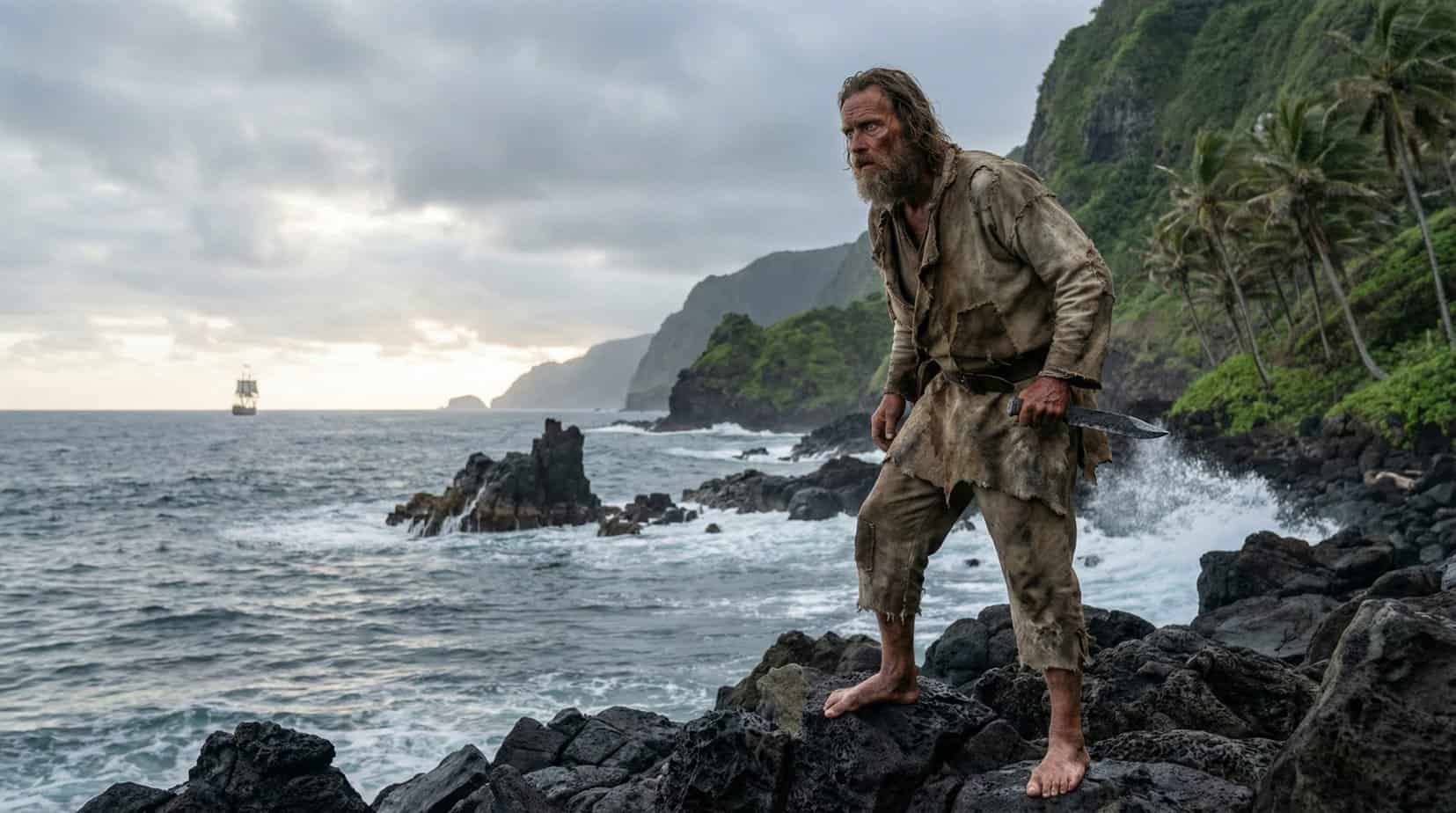
The ocean didn’t swallow Alexander Selkirk, and that is what makes his story so unsettling. There was no violent shipwreck, no sudden catastrophe, no dramatic plunge into the depths that could be blamed on bad luck or cruel weather.
Instead, he was left standing on a hostile shore, watching the ship that carried his life, his supplies, and his future shrink into the horizon until it disappeared completely.
There was no rescue plan waiting quietly in the background, no agreed-upon signal that would bring a ship back, and no certainty that anyone would ever return for him. Selkirk was marooned by choice, driven by stubborn conviction and an argument that escalated too far, too fast. When the sails vanished, bravado drained away and the weight of isolation settled in with terrifying clarity.
What followed was not an adventurous tale of clever improvisation and triumph over nature. It was a slow, grinding confrontation with hunger, injury, fear, and silence on Más a Tierra, an island that offered enough resources to keep a man alive but enough hardship to break his spirit if he faltered. Selkirk endured feral goats that could outrun him across jagged rock, rats that crawled over his body while he slept, and long stretches of solitude where the sound of his own voice became a fragile anchor to sanity.
This is the unpolished survival ordeal that later inspired Robinson Crusoe, long before fiction softened the edges and wrapped isolation in moral lessons. Selkirk’s experience was not tidy, noble, or inspirational while it was happening. It was raw, exhausting, and deeply human, and it remains one of the clearest historical examples of what unintentional off-grid survival truly looks like when there is no audience and no guarantee of rescue.
The Castaway Who Chose Isolation and Paid for It
The Alexander Selkirk survival story does not open with bravery or romantic rebellion, even though later retellings often polish it that way. It starts with frustration, fear, and a sailor who believed his judgment mattered more than obedience. Selkirk was serving aboard the Cinque Ports, a privateering vessel in visibly poor condition, its hull weakened by shipworm and neglect, and he was convinced it would eventually sink with everyone aboard.
His argument with the captain was not theatrical defiance meant to prove a point. It was blunt, heated, and grounded in experience earned the hard way at sea. Selkirk demanded to be put ashore, certain that remaining on the ship meant death, and equally certain that rescue would come quickly once another vessel passed through the area. History confirms the ship later sank, which adds an uncomfortable layer to the decision, because being right did not spare him from consequences.
Once the ship vanished, confidence drained away and reality took its place. Selkirk was alone on Más a Tierra with limited supplies and no certainty of rescue, and the silence of the island made it clear that logic does not soften isolation. He had a musket, powder, clothing, navigation tools, a Bible, and a knife, which seemed adequate until daily survival began consuming every hour of daylight. This is where the romantic idea of being “prepared” collides with the physical truth of hunger, injury, and exhaustion.
His knife, in particular, became central to survival, serving as a hunting tool, a woodworking implement, and a repair instrument for everything from shelter supports to tattered clothing. In modern survival terms, Selkirk depended on what we would now recognize as a simple, durable bushcraft blade rather than anything specialized or flashy.
A contemporary equivalent that reflects this same philosophy is the Morakniv Companion Fixed Blade Outdoor Knife, a tool many outdoorsmen favor because it prioritizes reliability and ease of use over gimmicks, which mirrors exactly what Selkirk needed when nothing else stood between him and starvation.
What makes this stage of the Alexander Selkirk survival story so unsettling is that it was not driven by ignorance or recklessness. It was driven by a calculated decision that underestimated time and overestimated how forgiving isolation would be. Selkirk was not defeated by nature immediately, but by the slow realization that survival is less about being right in the moment and more about enduring far longer than you ever planned to.
Alexander Selkirk: The Flawed Man Before the Myth
Long before isolation carved him into a symbol of endurance, Selkirk was known as a difficult presence among crews, respected for his seamanship but feared for his temper. He was not the quiet, contemplative survivor later imagined in fiction, and accounts from his contemporaries describe a man prone to argument, stubborn to the point of defiance, and deeply unwilling to bend once his mind was set. Those traits kept him alive on the island, but they also placed him there in the first place.
The Alexander Selkirk survival story becomes far more instructive when viewed through this lens, because it strips away the fantasy that only calm, disciplined personalities survive extreme isolation. Selkirk’s early days on Más a Tierra were marked by panic and regret rather than stoic acceptance. He wandered the shoreline hoping for sails, fired his musket at distant shapes that turned out to be nothing, and wrestled with the crushing realization that his own words had sealed his fate. This emotional whiplash mirrors what many modern preppers underestimate, because mental instability does not always look like fear. Sometimes it looks like anger, denial, or an unshakable belief that the situation will resolve itself.
Physically, Selkirk was capable but not exceptional, and his survival depended less on strength than on adaptability. His clothing degraded quickly in the humid, abrasive environment, forcing him to improvise protection against cuts, sun exposure, and infection. Over time, this necessity pushed him toward making practical decisions rather than emotional ones, especially when it came to protecting his feet, which were constantly shredded by volcanic rock and thorny undergrowth.
Modern survivalists recognize this lesson immediately, because mobility often determines whether a bad situation remains manageable or spirals into catastrophe. A modern parallel can be seen in the Salomon Quest 4 Gore-Tex Hiking Boots, which are frequently recommended for rough terrain due to their ankle support and durability, reflecting the kind of foot protection Selkirk desperately lacked during his early months.
What history tends to gloss over is that Selkirk did not become resilient overnight. His transformation was slow, uneven, and fueled by necessity rather than virtue. Faith, routine, and repetition eventually tempered his volatility, but those qualities were built under pressure, not carried ashore with him. This matters for anyone thinking seriously about long-term self-reliance, because survival does not reward ideal personalities. It rewards those who can outlast their worst impulses long enough to learn from them.

Stranded on Más a Tierra: Nature Didn’t Care If He Lived
Más a Tierra did not offer the gentle isolation people imagine when they picture a lone island survivor. The terrain was steep, broken, and unforgiving, shaped by volcanic rock that shredded skin and punished careless movement. Thick brush concealed sharp drops, while inland ridges demanded constant climbing that burned calories Selkirk could barely afford to lose. The island provided food and water, but it demanded effort and pain in return, extracting payment every single day.
The Alexander Selkirk survival story gains much of its weight here, because this environment exposed the gap between theoretical preparedness and lived reality. Goats introduced by earlier sailors multiplied unchecked and became his primary food source, but hunting them required speed, balance, and repeated failure.
Selkirk fell often, injuring his legs and feet until they hardened and adapted to the punishment. Rats swarmed the shoreline at night, drawn by food scraps and human scent, turning sleep into a nightly struggle that left him exhausted and irritable during daylight hours.
Historians later confirmed that Más a Tierra, now known as Robinson Crusoe Island, was both resource-rich and brutally isolating, a combination that allowed survival without comfort. Accounts preserved by the British Royal Navy describe the island as capable of sustaining life indefinitely while offering almost no psychological relief to someone trapped there alone
Fire became essential not just for cooking but for sanity, because warmth, light, and routine helped impose order on an otherwise hostile landscape. Selkirk relied on flint and steel to keep flames alive, knowing that losing fire meant losing control over his environment. A modern equivalent that reflects this same dependence would be the Light My Fire Swedish FireSteel 2.0, a tool favored by survival instructors because it functions in wet conditions and lasts through thousands of strikes, which mirrors the reliability Selkirk needed when replacement was impossible.
The island never became friendly, no matter how familiar Selkirk grew with its paths and seasons. It tolerated him, and that tolerance was conditional, earned through daily effort and constant awareness. This reality undercuts the idea that nature rewards persistence with comfort, because Selkirk survived not by conquering the island, but by learning how to exist within its limits without pushing too far in any direction.
The Alexander Selkirk Survival Story Begins with Mistakes
Selkirk’s first months alone were marked less by clever adaptation and more by painful misjudgments that nearly ended his ordeal early. He wasted ammunition firing at distant ships that never came close enough to matter, reducing his ability to hunt effectively later. He underestimated how quickly clothing deteriorates when exposed to constant moisture and abrasion, leaving him vulnerable to injury and infection long before he learned how to replace what he lost.
These mistakes matter because they reveal how survival often begins in chaos rather than competence. Selkirk burned energy chasing hopes that never materialized, patrolled the shoreline obsessively, and allowed anxiety to dictate his schedule. Over time, hunger and fatigue forced him to abandon these habits, replacing frantic movement with deliberate routine. This transition marks a critical phase in the Alexander Selkirk survival story, because it shows how necessity reshapes behavior more effectively than planning ever could.
Foot injuries became one of his most serious threats, as torn skin and swelling limited his ability to hunt goats or gather fruit. Modern survival experts often stress foot care for this exact reason, knowing that mobility determines access to food, shelter, and safety.
By the end of this phase, Selkirk had learned a lesson that remains uncomfortable for modern readers. Survival does not reward optimism or constant effort, but patience, restraint, and the willingness to abandon habits that feel productive but accomplish nothing. His early suffering was not wasted, but it was not necessary either, and that distinction is what makes it so instructive for anyone imagining long-term isolation as an adventure rather than a slow test of discipline.
Fire, Steel, and Leather: The Tools That Meant the Difference
By the time Selkirk settled into the rhythms of isolation, he understood something that many modern survival discussions gloss over too quickly, which is that tools do not save you all at once, but instead prevent small problems from compounding into fatal ones. Fire, cutting tools, and makeshift clothing formed the narrow margin that separated endurance from collapse, and every one of them demanded constant attention.
Fire was the anchor of his days, because it offered warmth during damp nights, allowed meat to be cooked safely, and imposed a sense of structure on time itself. Keeping embers alive in a humid, windy environment required discipline rather than ingenuity, since losing fire meant burning irreplaceable calories trying to recreate it.
Selkirk relied on flint and steel with the understanding that one careless moment could undo weeks of stability. In modern survival contexts, this same principle applies, which is why many experienced outdoorsmen favor redundancy in ignition tools.
Steel mattered just as much as flame, because Selkirk’s knife became an extension of his hands. It shaped cooking spits, carved shelter supports, butchered goats, and repaired what little clothing he had left. There was nothing specialized about it, yet it was durable enough to survive years of abuse, which reinforces a lesson still relevant today. Survival blades succeed not because they look impressive, but because they keep working long after novelty wears off.
A modern parallel that reflects this same philosophy is the ESEE 4 Fixed Blade Knife, a tool designed for sustained field use rather than short-term excursions, aligning closely with the demands Selkirk faced once isolation stretched into years.
Leather and improvised clothing completed this fragile system, because exposure destroys efficiency faster than hunger alone. As his original garments rotted away, Selkirk learned to cure goat hides and fashion crude coverings to protect his skin from rock, brush, and sun. Footwear became especially critical, since injured feet meant missed hunts and missed meals. While Selkirk eventually went barefoot out of necessity, modern survivors have the advantage of materials that dramatically reduce this risk.
What this phase of his ordeal reveals is that survival tools earn their value slowly and quietly. None of them felt heroic, and none delivered instant relief, but together they formed a fragile buffer against an environment that never stopped applying pressure. Selkirk survived not because his tools were exceptional, but because he learned to treat them as systems that required care, restraint, and respect, which remains one of the most overlooked truths in long-term off-grid living.
Hunting Goats Barefoot and Learning the Cost of Calories
Hunger reshaped Selkirk’s priorities faster than fear ever could, because empty days demanded action whether he felt ready or not. Goats became his primary food source, roaming the island in numbers large enough to promise sustenance but agile enough to make every hunt costly.
Selkirk chased them across cliffs and through dense brush, often falling, cutting himself, and burning more energy than the meat would immediately replace. The island forced him to confront a truth many survival fantasies avoid, which is that food procurement can be physically destructive when resources are unevenly matched.
Over time, the Alexander Selkirk survival story reveals a subtle shift in strategy rather than brute improvement. Selkirk stopped sprinting blindly and learned the terrain well enough to anticipate movement, driving goats toward natural barriers where speed mattered less than positioning. This adaptation reduced injuries and conserved calories, transforming hunting from desperation into routine. Modern survival studies consistently confirm this pattern, emphasizing that efficiency matters more than raw effort in long-term isolation scenarios.
Foot damage remained a constant threat throughout this phase, because repeated impact on volcanic rock shredded skin and slowed recovery. Selkirk eventually hardened his feet out of necessity, but the process was painful and risky, exposing him to infection and reduced mobility during critical periods. Modern survivalists benefit from materials that solve this problem outright, which is why durable trail footwear is often considered non-negotiable for long-term movement.
Calories became a form of currency rather than comfort, and Selkirk learned to spend them carefully. He rationed effort, rested deliberately, and accepted smaller meals when conditions demanded it, understanding that exhaustion could be deadlier than hunger itself. This lesson carries forward with uncomfortable clarity, because modern preparedness culture often celebrates exertion while ignoring sustainability. Selkirk survived not by pushing harder each day, but by learning exactly how little he could afford to spend and still remain alive tomorrow.
Loneliness, Faith, and the War Inside His Head
The most dangerous enemy Selkirk faced was not hunger, injury, or exposure, but the slow erosion of his inner world as days blurred into months with no human voice to answer his own. Isolation stripped away external structure, leaving his thoughts to circle endlessly unless he imposed order by force of habit. Fear crept in during quiet hours, regret surfaced without warning, and despair threatened to hollow out motivation until even basic tasks felt pointless.
This psychological pressure is a defining element of long-term survival, and Selkirk’s response to it was neither accidental nor particularly graceful. He clung to routine with near obsession, dividing his days between hunting, shelter maintenance, reading scripture, and speaking aloud simply to hear a human voice. Faith became less about doctrine and more about anchoring time and identity, giving him a framework that made endurance feel purposeful rather than arbitrary. Modern psychological research echoes this necessity, as studies on prolonged isolation show that routine and meaning are critical in preventing cognitive decline and emotional collapse
Writing also became an informal coping mechanism, even when paper was scarce, because the act of recording thoughts imposed clarity on emotions that might otherwise spiral. Many modern preppers underestimate this tool, yet something as simple as a durable field notebook can preserve mental stability during extended solitude.
Selkirk did not conquer loneliness so much as negotiate with it daily, accepting that fear would visit but refusing to let it dictate his actions. This distinction matters, because survival psychology is not about eliminating weakness, but about managing it long enough to function. His endurance was built on quiet repetition rather than dramatic breakthroughs, which remains one of the hardest lessons for people who imagine isolation as a test of courage instead of patience.
When Survival Turns Into a System
At some point during his fourth year on the island, survival stopped feeling like a constant emergency and began to resemble a crude but dependable system. Selkirk knew where food would come from, how long it would take to prepare it, and which shelters held up best against wind and rain. This shift marked a psychological milestone, because predictability replaced panic, and effort began producing reliable outcomes rather than uncertain hope.
Systems emerged because Selkirk learned to respect his own limits, balancing effort against recovery in a way that allowed sustainability. He rotated hunting grounds to avoid overexertion, timed tasks to daylight, and maintained multiple shelters so a single failure would not leave him exposed. This layered approach mirrors principles used in modern resilience planning, where redundancy and rhythm outperform improvisation over long periods.
Clothing systems also evolved as Selkirk refined his methods, curing hides more effectively and prioritizing protection over appearance. This reduced injury rates and preserved mobility, reinforcing the idea that comfort is not indulgence in survival scenarios, but a force multiplier. What began as reactive adaptation matured into proactive maintenance, a transition that many never reach because they exhaust themselves chasing novelty instead of stability.
By the time rescue finally came, Selkirk had built a life that functioned on its own terms, however harsh those terms remained. His system was not efficient by modern standards, but it was resilient, and that resilience was the product of patience layered on top of hard-earned experience. Survival, in its truest form, did not arrive with dramatic triumph, but with quiet competence that made each day survivable without constant crisis.
The Alexander Selkirk Survival Story vs Robinson Crusoe
By the time Daniel Defoe published Robinson Crusoe, the raw edges of Selkirk’s experience had already been sanded down into something far more palatable for readers. The novel introduced order where there had been chaos, comfort where there had been exhaustion, and moral clarity where Selkirk’s real life was messy and unresolved. This comparison matters, because fiction has shaped how generations imagine isolation, often in ways that actively undermine realistic preparedness.
In Defoe’s version, Crusoe quickly establishes control over his environment, inventories supplies with almost obsessive neatness, and turns survival into a tidy project with visible progress. Selkirk’s reality looked nothing like that. There were long stretches where nothing improved, where injuries lingered, food ran thin, and fear returned without warning. The Alexander Selkirk survival story is defined not by steady upward momentum, but by plateaus punctuated by setbacks, which is far closer to how real-world survival unfolds.
Historical records compiled by the British Museum confirm that Defoe borrowed the outline of Selkirk’s isolation while dramatically altering its emotional and logistical texture, transforming endurance into enlightenment and necessity into purpose.
One of the most misleading differences lies in how isolation itself is portrayed. Crusoe thrives on solitude, using it as a canvas for self-improvement, while Selkirk endured it as a constant adversary that demanded management rather than celebration. Selkirk spoke aloud to himself, clung to scripture, and structured his days rigidly because silence eroded his sense of identity. This contrast is crucial for modern readers, because romanticizing loneliness can lead people to underestimate how deeply the human mind depends on connection, even when survival skills are strong.
Even gear is treated differently in fiction, where tools appear almost magically sufficient and rarely fail. Selkirk’s tools degraded, broke, and demanded improvisation, reminding us that maintenance often matters more than acquisition. For those interested in grounding themselves in real historical context rather than literary fantasy, reading Defoe’s novel alongside practical survival literature can be illuminating.
A durable modern edition like the Penguin Classics Robinson Crusoe serves as a useful reference point, not as a manual, but as a reminder of how easily storytelling can distort expectations when separated from lived experience.
The gap between Selkirk and Crusoe is not a failure of imagination, but a warning. Survival is rarely uplifting while it is happening, and stories that suggest otherwise risk preparing people for an experience that does not exist. Selkirk survived not because isolation refined him, but because he endured it long enough to adapt, and that distinction remains as relevant now as it was three centuries ago.

What Modern Preppers Should Steal from a 300-Year-Old Castaway
The value of Selkirk’s ordeal does not lie in copying his methods outright, because modern tools, materials, and knowledge change the mechanics of survival dramatically. What endures is the pattern of adaptation he followed, one shaped by restraint, patience, and an acceptance that survival is rarely efficient or comfortable. The Alexander Selkirk survival story endures because it exposes how fragile confidence becomes when isolation stretches beyond expectations and forces long-term thinking.
One of the clearest lessons is that sustainability matters more than intensity. Selkirk survived by slowing down, reducing risk, and accepting incremental progress instead of chasing dramatic improvements. Modern preppers often stockpile gear while underestimating how quickly exhaustion, injury, and boredom can unravel even the best plans. Selkirk’s survival hinged on learning how to live within limits rather than constantly pushing against them, a principle that applies just as much to grid-down living as it does to wilderness isolation.
Another uncomfortable takeaway is that mental resilience cannot be improvised under pressure. Selkirk relied on routine, faith, and repetition to maintain coherence over years of solitude, not because they were inspirational, but because they were stabilizing. For modern preparedness, this translates into building habits before crisis arrives, including journaling, structured daily tasks, and deliberate downtime. Tools that support these habits matter, whether that means reliable lighting, weatherproof writing materials, or simple comforts that preserve morale over time.
Selkirk also demonstrates that self-reliance is rarely solitary in spirit, even when it is solitary in fact. His constant verbalization, reading, and internal dialogue kept him tethered to a sense of humanity that isolation threatened to erode. Modern preppers often focus on physical independence while neglecting psychological continuity, yet Selkirk’s endurance shows that identity is as critical as calories. Survival becomes far more difficult when a person forgets who they are and why they are enduring hardship in the first place.
What ultimately makes Selkirk’s experience resonate centuries later is its refusal to conform to comforting narratives. He was not transformed by isolation into a wiser or happier man, and his return to society was marked by restlessness rather than triumph. Survival preserved him, but it did not perfect him, and that honesty is precisely why his story remains useful. For anyone serious about preparedness, the lesson is clear. Endurance is built quietly, maintained daily, and paid for in discipline rather than drama, and no amount of gear can replace the willingness to live that reality for as long as it takes.
Author Bio
Bob Rodgers is a lifelong outdoorsman, herbalist, and seasoned prepper with over 20 years of real-world survival experience. As the founder of PreppersWill.com, he shares practical advice on self-reliance, off-grid living, and disaster preparedness. No hype, just hard-earned lessons from decades of hands-on prepping.
Other resources worth reading:
Juliane Koepcke Survival Story: The Girl Who Fell From the Sky and Lived
How to obtain water from air moisture
Steven Callahan Survival Story: 76 Days Adrift in the Atlantic
Learning this first-aid techniques will keep you alive anywhere