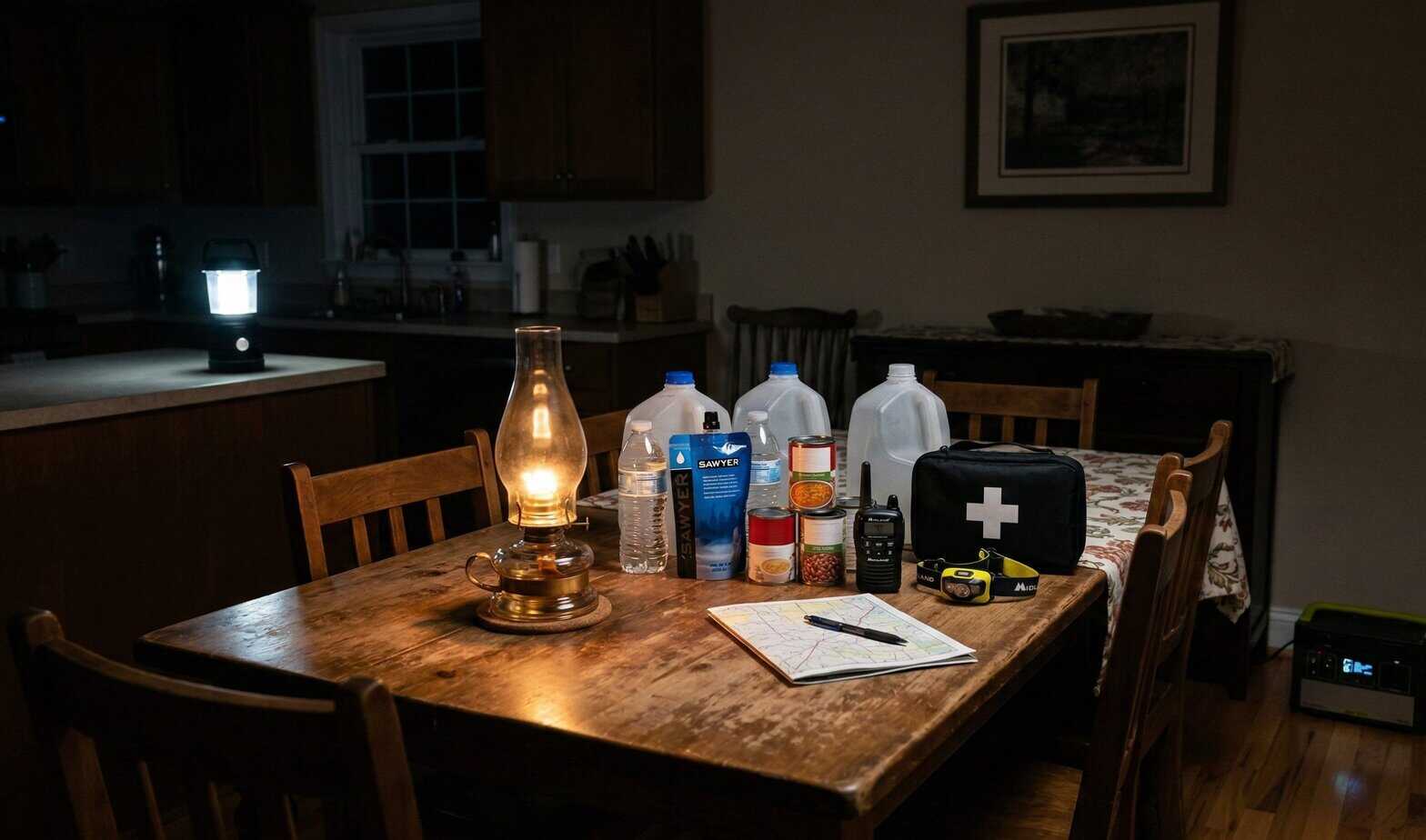
Most people think they have a solid emergency plan because they’ve stocked a few cases of water, stacked canned food in the pantry, and parked a generator in the garage. On the surface, that feels responsible and it looks like preparedness. But the first time something critical fails, whether it’s a dead battery, a blocked evacuation route, or a supply chain disruption that lasts longer than expected, that confidence starts to crack. What seemed like a plan turns out to be a collection of supplies tied together by hope.
Real resilience is built on survival plan redundancy, not optimism. Redundancy means every critical system in your life has layers: a primary option, a secondary fallback, and a third line of defense if the first two collapse. Water, food, power, communications, transportation, medical supplies, and even finances all need depth. When one layer fails, another carries the load. When conditions shift, your plan adapts instead of collapsing.
In this guide, we’re going to rebuild your preparedness strategy from the ground up using layered thinking. Whether you live in a downtown apartment or on rural acreage, whether you’re just starting out or tightening an already solid setup, the principle stays the same.
Hazards vary across the United States, but failure points are universal. If something can break, it eventually will. The difference between panic and control is whether you planned for that reality in advance.
Water Redundancy: If It Fails, Everything Fails
When you are building a survival plan, water is the system you cannot afford to leave to chance. Clean water is something everyone takes for granted in normal life, but in a disaster it becomes the first thing that can fail. Municipal systems can become contaminated, wells can go dry, and pumps can stop working.
Without clean water your body can only go a few days before dehydration sets in and everything else in your plan starts to unravel. That is why survival plan redundancy absolutely must include multiple layers of water access and purification.
Official emergency management guidance emphasizes the importance of having enough water stored for at least several days per person and knowing how to treat water safely if your stored supply runs out. This means you need more than one way to get safe water. Your first layer might be stored potable water in the house. Your second layer needs to be methods to purify raw water from other sources if needed. Your third layer should be mobile, reliable systems you can take with you if you have to evacuate.
A good example of a practical tool for this second or third layer is a quality portable water filter. One system that many preppers choose is LifeStraw Personal Water Filter. This simple, hand-operated device allows you to drink directly from streams, ponds, rain barrels, or other available sources and removes bacteria and protozoa so the water is safer to drink. Including a product like this in your gear means you do not have to rely solely on stored containers or chemical treatments.
Beyond having just one purification tool, you should think about redundancy within that layer too. For instance, keep a set of purification tablets in both your home and your bug out bag, and have at least one mechanical filter in each location as well. Then test your methods so you know how they work under stress.
A survival plan that counts on only one water strategy is fragile and will likely fail when you need it most. Building redundancy into your water systems ensures that if one approach fails, another will keep you alive long enough to solve the next problem.
Food Systems: Calories in Layers, Not Buckets
Most people feel secure once they stack a few buckets of rice, beans, and freeze-dried meals in the basement. It looks impressive and it photographs well, but food redundancy is not about how tall your stack is. It is about how many independent ways you can continue feeding yourself when one method breaks down.
Start with your primary layer. For most American households, that is the grocery supply chain plus whatever sits in the pantry. When that system slows or collapses during a hurricane, blizzard, or civil disruption, your secondary layer must already be in place. This includes a rotating pantry with shelf stable goods, bulk staples sealed for long storage, and freezer reserves. But here is where many plans quietly fail. Freezers depend on electricity and electricity depends on infrastructure. If your freezer is your only deep food reserve and the grid goes down for weeks, you are suddenly racing the clock.
That is where long term, non-electric food storage becomes critical. Freeze dried meals, properly stored grains, canned proteins, and dehydrated foods form a more stable second line. A popular option many preppers use for calorie density and shelf life is a long-term emergency kit such as the ReadyWise Emergency Food Supply Bucket. Products like this are not meant to replace a full pantry, but they add a reliable layer that does not depend on refrigeration or daily store access.
The third layer is skill based. Hunting, fishing, gardening, small livestock, food preservation, and even basic foraging knowledge extend your resilience beyond stored calories. Urban preppers may rely more on container gardening, community gardens, and barter networks. Rural preppers might lean into larger gardens, livestock, and wild game. Both environments require realistic planning. Gardening takes time and hunting requires season, tools, and success. None of it works if you start learning after the shelves are empty.
True survival plan redundancy in food means you can lose the store, lose the freezer, and still feed your family. It means you have calories that require no power, food that requires minimal cooking fuel, and at least one path to replenishment. Buckets alone are not a plan, but layers are.
Power and Lighting: Survival Plan Redundancy in a Grid-Down America
Power is the quiet backbone of modern life. When it disappears, most Americans realize within hours how dependent they really are. Refrigerators stop humming, the water pumps stop pushing and phones begin their slow countdown toward useless black screens. In a prolonged outage, the issue is not comfort, it is function. That is why survival plan redundancy must include layered power solutions that do not rely on a single fuel source or a single machine.
FEMA’s emergency guidance consistently stresses that extended outages can last days or longer after major disasters, and that households should prepare for the possibility of prolonged grid disruption. The key word there is prolonged. A small generator and a couple of gas cans might get you through a weekend. It will not carry you through weeks if fuel deliveries are disrupted or rationed.
Your first layer is grid power, and you should assume it can fail without warning. The second layer for many households is a fuel powered generator. That works well in the short term, especially for rural properties that need to run well pumps or chest freezers. A reliable inverter generator such as the Westinghouse iGen2200 Portable Inverter Generator provides quiet, fuel efficient backup for critical appliances and electronics. But that system still depends on gasoline, which may become scarce quickly.
The third layer should be fuel independent or fuel flexible. Solar generators with portable panels, battery banks, rechargeable lanterns, and even manual lighting options like oil lamps or crank flashlights reduce your dependence on stored fuel. Urban preppers in apartments may lean more heavily on battery stations and compact solar panels. Rural preppers may invest in larger solar arrays or hybrid systems that combine generator and battery storage.
Lighting is often overlooked until the sun goes down and the house turns into a maze. Every room should have a dedicated light source that does not depend on the main system. Headlamps, rechargeable lanterns, and battery powered area lights should exist in multiples, not singles.
If your entire power plan depends on one generator, you do not have redundancy. You have a mechanical gamble. Build layers that do not share the same weakness, and test them before you need them. That is how you stay operational when everyone else is scrambling in the dark.

Communications: When the Phones Go Silent
Communication failures create panic faster than almost anything else. When people cannot reach family members, confirm information, or understand what is happening, fear fills the gap. Most Americans assume their cell phone is a permanent lifeline. It is not. Cell towers rely on power, network routing, and physical infrastructure that can fail during hurricanes, wildfires, civil unrest, or cyber incidents. Even when towers stay online, networks clog quickly under heavy traffic.
Your first layer is standard cellular communication. Keep backup battery packs for your phone and maintain vehicle chargers so you are not caught with a dead device. But that is only the starting point. Text messaging often works when voice calls fail because it uses less bandwidth, so your family plan should include switching to text during emergencies.
The second layer should involve short range radio communication. Handheld two-way radios allow family members to communicate locally without relying on cellular networks. A widely used and affordable option is the Midland GXT3000 GMRS Two Way Radio. Radios like this provide several miles of range under good conditions and can be invaluable for neighborhood coordination or maintaining contact during evacuation.
The third layer moves beyond convenience and into resilience. HAM radio opens access to regional and even national communication networks that function independently of cell towers. It requires licensing and practice, which is exactly why most people avoid it. That hesitation becomes a liability when infrastructure collapses. Even if you do not become an advanced operator, having basic equipment and knowledge adds depth to your plan.
Redundancy in communication also means pre planning. Establish meeting points if communication fails and agree on check in times. Print important phone numbers instead of storing everything digitally. Urban preppers may need tighter coordination due to density and traffic. Rural preppers may face isolation and distance. In both cases, silence is dangerous.
If your entire communication plan fits in your pocket and depends on one device, you are exposed. Build layers that operate on different systems so that when one goes down, your connection to the outside world does not disappear with it.
Medical and Personal Security: Survival Plan Redundancy Under Stress
Injuries do not pause during disasters. In fact, they increase. Power tools get used in the dark. People clear debris without proper protection. Stress clouds judgment. If emergency services are delayed or overwhelmed, you become the first responder for your household. That reality alone should force you to think about survival plan redundancy in medical terms, not just food and water.
The Centers for Disease Control and Prevention emphasize that households should maintain emergency medical supplies and be prepared to manage injuries when professional help is delayed. That is the baseline, but a single first aid kit tossed under the bathroom sink is not redundancy. It is wishful thinking.
Your first layer should be basic first aid kits placed in multiple locations. One in the home, one in each vehicle, and one in your bug out bag. A well stocked kit such as the SurviveX 240 Pieces Survival First Aid Kit provides bandages, pressure dressings, tourniquets, and trauma supplies that go far beyond a handful of adhesive strips. But equipment alone does not create resilience. You need to know how to use it. Training in CPR, bleeding control, and basic wound care turns gear into capability.
Your second layer should include trauma specific supplies. Severe bleeding can become fatal within minutes. Tourniquets, hemostatic gauze, and compression bandages should exist in more than one location. If one kit is inaccessible, another must be within reach.
The third layer involves prescriptions and chronic care. Many Americans rely on daily medications. If supply chains are interrupted, even briefly, that becomes a serious vulnerability. Work with your physician to maintain extra refills when possible and store them properly. Keep printed copies of prescriptions in case digital systems fail.
Security overlaps with medical planning. Injuries are more likely when tensions rise and law enforcement response times stretch thin. Layered home security, exterior lighting, reinforced doors, and defensive planning reduce the chances you will need those trauma supplies in the first place.
Redundancy in this category is not dramatic. It is practical and sometimes uncomfortable to think about, but in a real emergency, the ability to control bleeding, manage infection, and protect your household is what keeps a bad situation from turning fatal. If your only medical plan is dialing 911, you do not have a backup. You have a dependency.
Mobility and Evacuation: One Route Is a Trap
Evacuation plans tend to look clean on paper. You mark a route on a map, load the vehicle, and assume you will leave ahead of the crowd. Reality is rarely that polite. Highways clog, fuel stations run dry, law enforcement closes roads, wildfires shift direction and floodwaters erase bridges. If your mobility plan depends on a single road and a single vehicle, it can collapse in minutes.
The U.S. Department of Transportation has repeatedly documented how quickly evacuation traffic can overwhelm major routes during hurricanes and other large scale emergencies. That is not a fringe scenario, it is predictable human behavior. People wait, then everyone leaves at once.
Your first layer is your primary vehicle with a maintained fuel tank and a realistic load plan. That vehicle should never sit below half a tank if severe weather or civil unrest is building. Fuel redundancy matters just as much as route redundancy. Store stabilized gasoline safely if you live in a rural area, and rotate it. Urban preppers may not have space for fuel storage, which makes early evacuation decisions even more critical.
A reliable jump starter adds a small but powerful layer of redundancy. A dead battery during an evacuation is not just inconvenient. It can strand you in traffic with no quick solution. Compact jump packs eliminate dependence on another vehicle being available.
Your second layer should include alternate routes that avoid major highways. Study back roads and drive them during normal times. Know which bridges flood and which intersections choke up. If you live in a city, identify pedestrian routes that allow you to move on foot if vehicles become unusable.
The third layer involves mobility without fuel. Bicycles, sturdy footwear, and manageable loadouts give you options if fuel distribution collapses. Rural preppers may rely on ATVs or secondary vehicles. Urban preppers may need compact, highly mobile gear setups.
Evacuation redundancy also means knowing when not to evacuate. Sometimes sheltering in place is safer. That decision requires awareness, not panic. If you only have one exit strategy, you do not have a strategy. You have a hope that conditions will cooperate. Build alternatives before you ever need them.
Financial and Documentation Redundancy: When Systems Freeze
Most preppers focus on physical supplies, but financial systems are just as vulnerable as power grids and supply chains. Debit cards rely on network connectivity. Banks rely on digital records. ATMs rely on power and armored truck deliveries. When those systems stall, access to your own money can disappear overnight. Survival plan redundancy has to include financial depth, not just canned goods.
The Federal Reserve has acknowledged that electronic payment systems can be disrupted during major emergencies, and it encourages households to maintain some level of emergency cash for short term needs. That guidance is often ignored because digital payments feel permanent, but in reality, they are not.
Your first layer is your regular bank account and digital payment access. That is the modern default. The second layer should be physical cash stored securely at home. Not a symbolic amount, but enough to cover fuel, food, temporary lodging, or urgent repairs for at least several days. In rural areas, cash may be the only accepted form of payment if connectivity drops. In urban areas, small denominations are essential because businesses may not have change.
The third layer involves diversification and documentation. Important documents such as birth certificates, property deeds, insurance policies, medical records, and identification should exist in both physical and digital form. Store paper copies in a fire resistant safe. Keep encrypted digital backups on secure drives stored separately.
Redundancy also applies to access. If your wallet is lost or stolen during an evacuation, can you still prove your identity? Do you have backup debit or credit cards stored separately? Have you written down account numbers and emergency contact information for financial institutions?
Economic disruption does not need to reach collapse levels to create chaos. A regional banking outage or cyber incident can freeze transactions long enough to cause real stress. If every dollar you control exists only as a number on a screen, you are depending entirely on infrastructure you do not control. Layer your finances the same way you layer water and power. Independence is not just about survival gear. It is about access, flexibility, and proof of ownership when systems fail.
Testing Your Plan: Redundancy That Looks Good on Paper Can Still Fail
A layered plan that has never been tested is just theory. On paper, everything works. The generator starts, the radios connect, the evacuation route stays clear and the water filter performs perfectly. But reality introduces friction, batteries die, connectors are missing, roads close and people panic. Survival plan redundancy only becomes real when you stress it.
The U.S. Department of Homeland Security has long encouraged households to run drills and exercises to evaluate emergency readiness, not just create written plans. Planning without testing leaves hidden weak points that only show up under pressure. That is not when you want surprises.
Start with a controlled grid down weekend. Turn off the main breaker. Run your household on backup systems only. Cook with your alternate method. Use stored water or filter collected water. Rely on flashlights instead of overhead lighting. You will quickly discover what you forgot. Maybe your extension cords are too short. Maybe your fuel storage is smaller than you thought. Maybe your family does not know where anything is stored.
Communications should also be tested intentionally. Switch to radio for a day and confirm that everyone knows the channels and basic operation. If you own equipment like the BaoFeng UV-5R Dual Band Radio (which I realized a while ago that are the #1 choice for most preppes), practice with it regularly. Radios that sit unused for years become dead weight because no one remembers how to program them.
Test evacuation plans by driving alternate routes during normal conditions. Identify construction zones, choke points, and seasonal hazards. Rural preppers should test secondary access roads in bad weather. Urban preppers should evaluate how quickly traffic builds during peak hours.
Medical redundancy should be reviewed as well. Open your kits and check expiration dates, but also replace degraded supplies. Practice applying a tourniquet properly. Confidence comes from repetition, not assumption.
Testing also reveals emotional stress points. How does your household react without internet access for two days? Does tension rise? Does communication break down? These small exercises strengthen your weakest layer, which is often human behavior.
Redundancy that exists only in storage bins can create a false sense of security. Redundancy that has been exercised, adjusted, and improved becomes resilience. The difference is experience.
Building Survival Plan Redundancy Without Going Broke
One of the biggest excuses people make is cost. They assume redundancy means buying two of everything, installing a full solar array, stockpiling years of food, and turning their home into a bunker. That mindset stops a lot of otherwise practical people from starting. Survival plan redundancy is not about duplication for the sake of duplication. It is about eliminating single points of failure in the most critical systems first.
Start with risk, not gear. A family in Florida should think differently about redundancy than someone in rural Montana. Wildfires, hurricanes, blizzards, earthquakes, and civil unrest all stress systems in different ways. Focus your money where your risk is highest.
Prioritize life sustaining systems. Water comes first, then food ,then medical, then power and communications. You do not need a warehouse of supplies. You need at least two independent ways to meet each essential need. For example, you might store potable water and also keep purification tablets and a gravity filter. You might keep a pantry and also add a modest long term food kit such. That adds depth without forcing you into extreme expense.
Look for redundancy across categories. A portable solar generator can power lights, charge radios, and maintain small medical devices. A quality multi fuel camp stove can cook food when electricity fails and also serve as backup during outdoor activities. Smart purchases serve more than one purpose.
Another way to control costs is phased implementation. Do not attempt to build every layer in a single month. Strengthen one system at a time. Replace weak components gradually and rotate supplies so nothing expires unused. Knowledge and training are often cheaper than hardware and sometimes more valuable.
Urban preppers may need to invest more in compact, efficient systems due to space limitations. Rural preppers may face higher upfront costs for larger scale power or water solutions. In both cases, careful prioritization prevents waste.
Redundancy built slowly and intentionally is stronger than panic buying after a headline scare. If you focus on removing single points of failure step by step, your plan will become deeper every year without destroying your budget. Preparedness is not about spending the most. It is about thinking clearly and building layers that actually matter.

The Mindset Layer: Adaptability Is the Final Backup
After you build layered water systems, diversified food storage, backup power, redundant communications, medical depth, mobility plans, and financial buffers, there is still one layer left. It is the one that determines whether all the others work under pressure. That layer is mindset.
Every official preparedness framework in the United States stresses personal responsibility and adaptability as core elements of resilience. Equipment matters, but the ability to stay calm, assess changing conditions, and adjust plans in real time matters more. Survival plan redundancy is not just mechanical. It is mental.
When conditions shift, rigid plans break, but flexible plans bend. If your evacuation route is blocked, can you reroute without freezing? If your generator fails, do you calmly transition to solar and ration power? If a family member panics, can you steady the situation instead of escalating it? Those responses are not purchased. They are practiced.
Part of mental redundancy comes from skills. Learn basic first aid beyond the contents of your kit. Practice land navigation without relying solely on GPS. Cook meals using your backup stove before you are forced to. Familiarity reduces stress. The unknown is what creates panic.
Another part comes from relationships. Know your neighbors and build quiet alliances. In both urban and rural settings, community adds depth to your plan. A neighbor with mechanical skills, medical training, or extra equipment becomes another layer of redundancy. Isolation increases fragility.
Finally, accept that no plan is perfect. Something unexpected will happen. Equipment will break, weather will shift or information will be incomplete. The goal of survival plan redundancy is not to create an invincible system. It is to ensure that when one layer fails, you still have options and the clarity to use them.
Preparedness is not paranoia, it is controlled realism. If it can fail, assume it eventually will. Then build another layer beneath it. Do that consistently across every critical system in your life, and you move from hoping things hold together to knowing you can handle disruption when it arrives.
 About the Author
David Andrew Brown is a former law enforcement agent with over 30 years of experience in criminal investigations, personal defense, and tactical response. A certified firearm instructor and home protection counselor, he now shares his expertise to help others stay alert, capable, and confident under pressure. “Preparedness isn’t paranoia,” David says. “It’s respect for reality.”
Suggested resources for preppers:
Why Mapping Bug Out Routes Is Vital
The #1 food of Americans during the Great Depression