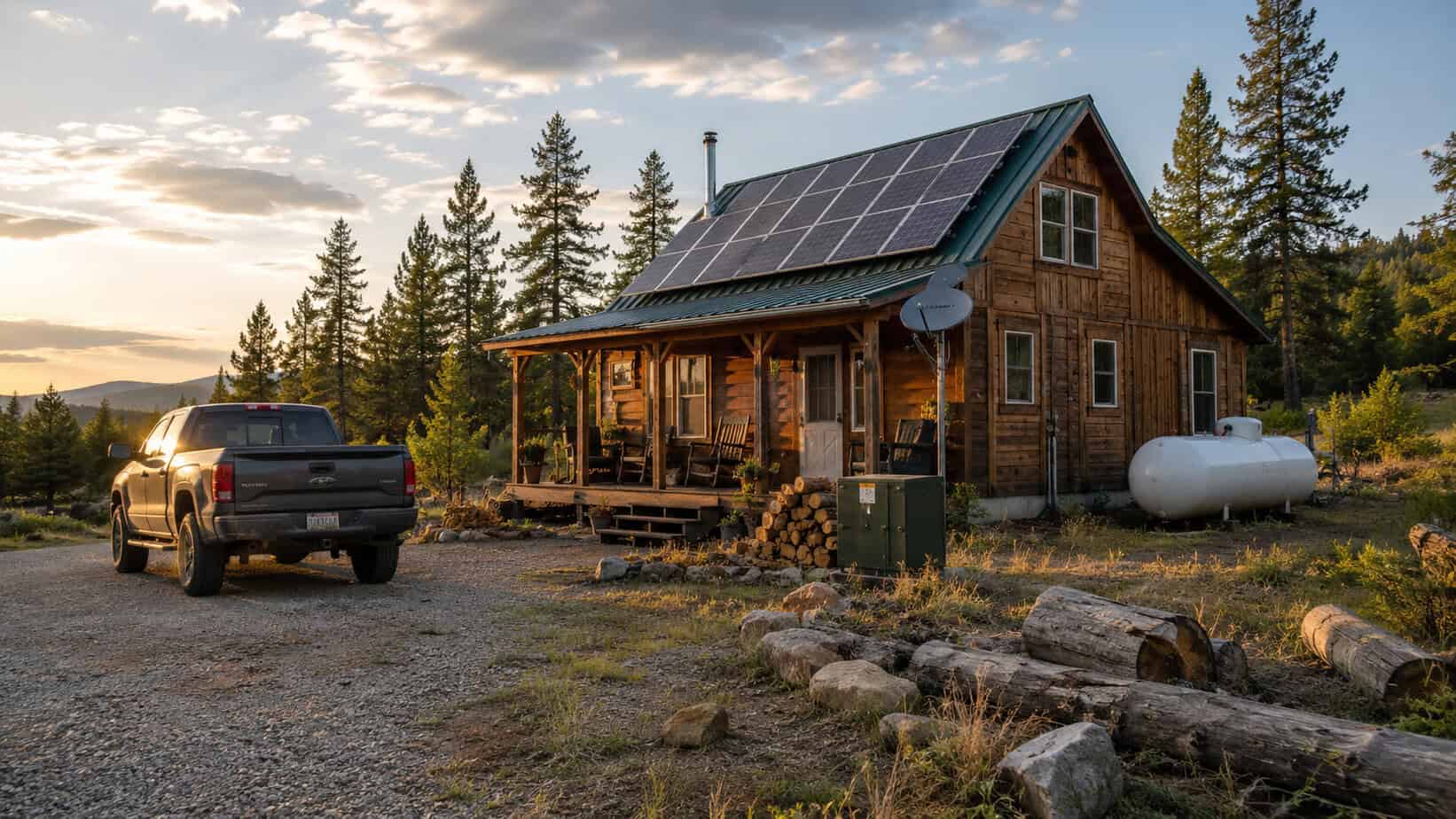
There is a particular kind of photo that shows up whenever someone talks about leaving the city for good. A cabin tucked against a tree line, a woman hauling water from a hand pump, solar panels glinting on a tin roof, and a caption that promises freedom from the system.
The story underneath that photo is almost always the same one: a family got tired of bills, traffic, and noise, so they built a homestead where nothing from the outside world could touch them again. It is a compelling image, and it sells books, YouTube channels, and entire identities built around the idea of escape.
The trouble is that the picture leaves out almost everything that actually makes the lifestyle work day to day. The off grid self-sufficiency myth persists because it photographs well, not because it holds up under scrutiny once someone looks at the supply lists, the delivery schedules, and the bank statements behind the scenes.
Behind nearly every “fully independent” homestead sits a propane delivery contract, a truck that needs parts from a dealership two counties away, a satellite internet dish that bills monthly, and a family member who still drives into town for a paycheck or a prescription.
None of this makes the lifestyle fraudulent or the people living it dishonest. It simply means that the language of total independence does not match the logistics of actually pulling it off, season after season, year after year.
This article is an honest audit of what off-grid living typically still leans on, why those dependencies exist for understandable and often unavoidable reasons, and what a more accurate, more useful version of resilience would actually require if someone genuinely wanted to get closer to the real thing rather than the marketing version of it.
The Off Grid Self Sufficiency Myth Starts With Energy, Not Just Electricity
When people imagine cutting ties with the grid, they usually picture solar panels and battery banks replacing a power line running in from the road. That part of the picture is genuine enough, since solar technology really has improved to the point where many households can cover daytime electrical needs without a utility hookup.
What gets left out of the daydream is heat, hot water, cooking fuel, and backup generation, all of which solar rarely covers on its own in a way that holds up through a real winter. According to the U.S. Energy Information Administration, propane remains an important fuel for residential consumers and farmers, with distinct seasonal demand patterns tied to space heating, and residential propane consumption is highest in winter and generally occurs in non-urban areas where other heating fuels are limited or expensive.
That detail matters because it shows propane is not a quirky workaround that some eccentric homesteaders happen to use out of nostalgia. It is a structural piece of how off-grid heating and cooking actually function for a huge share of rural households, including many that consider themselves fully independent.
A 500- or 1000-gallon tank buried in the yard creates the appearance of independence, since nobody sees a wire running to the house and no monthly utility statement arrives with a logo on it. But that tank still needs a delivery truck on a schedule, a driver employed by a fuel company, and a supply chain running back through refineries and distribution terminals that have nothing to do with the homestead itself.
The off-grid self-sufficiency myth tends to treat the buried tank as the final proof of independence, when really it represents a more patient form of dependency, measured in months between refills rather than minutes between bill payments. The dependency has not disappeared. It has simply been stretched out and made less visible.
A propane tank gauge that reports levels to a phone app, such as the Mopeka PRO+ wireless propane tank monitor, is a useful tool precisely because it acknowledges this reality instead of hiding from it. People who actually manage these systems day to day know they are managing a supply chain, not escaping one, and the smart ones plan refill timing around weather and road conditions the same way a city dweller plans around a billing cycle.
Medical Access Is the Dependency Nobody Wants to Talk About
Energy independence gets nearly all the attention in off-grid content because it photographs nicely and because it is genuinely achievable with enough investment. Healthcare gets almost no attention in the same conversations, even though it is arguably the dependency most likely to determine whether a remote lifestyle is sustainable for an entire family over decades rather than just a few adventurous years.
The data on this is blunt and the National Rural Health Association notes that ease of access to a physician is greater in urban areas, with the patient-to-primary-care-physician ratio in rural areas sitting well below urban levels, and that rural residents have greater transportation difficulties reaching health care providers, often traveling great distances to reach a doctor or hospital.
That distance is not a minor inconvenience that solar panels or a good well can solve. It is a structural fact tied to choosing land far from population centers, and it has been getting worse rather than better as hospitals in thin-margin rural areas continue to close their doors.
The U.S. Government Accountability Office has documented this trend closely, reporting that more than one hundred rural hospitals closed between 2013 and 2020, and that as a result, residents had to travel about twenty miles farther for common services like inpatient care, and forty miles farther for less common services such as alcohol or drug misuse treatment.
Anyone choosing to live off the grid with children, aging parents, or a chronic condition in the family is leaning on a healthcare infrastructure they did not build and cannot maintain themselves, regardless of how many practical skills they have learned.
A well-stocked trauma kit, like the Surviveware Comprehensive Premium Survival First Aid Kit, buys precious time in an emergency and can make the difference between a manageable injury and a tragedy. It does not, however, replace a surgeon, an ambulance crew, or a maternity ward. The most resilient homesteaders plan around this honestly, treating distance from a hospital as a serious risk to mitigate rather than a romantic feature to celebrate.

Vehicles and the Parts Economy Quietly Keep the Lifestyle Running
A truck on a homestead is not a luxury item parked for the occasional grocery run. It functions closer to a piece of load-bearing infrastructure that the rest of the operation depends on. It hauls hay, pulls a trailer to the feed store, carries someone to a job in town, and in plenty of cases doubles as the only realistic way to reach medical care quickly when something goes wrong.
None of that changes the fact that a truck is a complicated machine built from parts sourced through a global supply chain, serviced by mechanics trained somewhere far from the homestead, and kept legal and insured through paperwork tied directly to the same government and corporate systems that off-grid living is supposed to sidestep in spirit.
When a starter fails or a battery dies in the middle of nowhere, no homestead skill substitutes for the part itself. A jump starter can get a dead battery running long enough to drive into town, but it does not manufacture the alternator, belt, or filter that will eventually need replacing regardless of preparation.
Even families who are scrupulous about stockpiling spares still need to drive somewhere to buy more once the stock runs low, and the parts themselves were made in factories thousands of miles away, shipped through ports and distribution centers, and sold by suppliers who depend on the same logistics network as everyone else. Tires wear out on gravel roads faster than on pavement, brake pads do not last forever, and gasoline has to be purchased from someone else regardless of how far the nearest pump sits.
This is one of the clearest places where the off-grid self-sufficiency myth runs directly into the physical world. A vehicle that depends on parts, fuel, and registration from outside systems is, by definition, a connection to those systems, however far the truck has to drive to reach them.
Where the Off Grid Self Sufficiency Myth Meets the Internet Bill
Plenty of off-grid families fund their entire lifestyle through work that requires a reliable internet connection, and this is one of the more interesting contradictions hiding inside the whole movement.
They sell goods online, run YouTube channels documenting the homestead in loving detail, consult remotely for clients who never visit, or simply hold ordinary remote jobs that happen to pay well enough to cover land payments and equipment.
The income that pays for the cabin, the solar array, and the propane tank often depends entirely on broadband that has to be purchased from a satellite or cellular provider every single month, with no real alternative if the connection fails.
Pew Research Center’s data on this is sobering for anyone who imagines rural broadband as a solved problem in the modern era. While most adults living in rural areas subscribe to high-speed internet at home, they are less likely to do so than their peers living in suburban areas, and they are also less likely than urban or suburban adults to say they are online almost constantly, a pattern that suggests the connection itself, where it exists at all, is often less robust or more expensive relative to income than what city dwellers take for granted.
Many homesteaders solve this gap with satellite internet, which is itself an enormous infrastructure project involving rockets, ground stations, and a corporation billing a card every month without fail. There is nothing wrong with using that service, and for many remote households it is genuinely the best option available. It simply illustrates how far the dependency chain stretches behind even a single livestream filmed from a cabin deep in the woods.
A reliable connection is not a small detail for households earning income this way. It functions as the entire business model, and losing it for even a week can mean lost income at a scale that dwarfs the inconvenience of a missed firewood delivery.
Income Sources Rarely Come From the Land Itself
There is a romantic idea, repeated often enough that it starts to sound like fact, that a truly self-sufficient household earns its living entirely from what it grows, raises, or builds by hand on its own property. Reality, even among full-time commercial farmers with decades of experience, looks quite different.
The USDA’s Economic Research Service tracks this closely every year, and the pattern is consistent across decades of data: most farm households operate residence farms and depend on off-farm income to cover at least some portion of their living expenses, with the majority of that off-farm income coming from wages and salaries earned by household members working jobs unrelated to the farm itself.
These are people who actually farm for a living, with land, livestock, equipment, and generations of agricultural skill, and the data still shows them leaning heavily on jobs and paychecks earned outside the farm gate to make ends meet.
If working farmers with serious commercial operations depend this much on off-farm income, it stands to reason that hobbyist homesteaders, who typically have far less acreage and far less commercial agricultural output, depend on outside income even more heavily, even if that dependency rarely gets mentioned in the glossy version of the story. This does not diminish what people genuinely accomplish growing their own vegetables, raising chickens, or preserving a harvest for winter. It does mean the romantic framing of total food and income independence rarely survives contact with an actual bank statement.
Property taxes, vehicle insurance, school costs, and healthcare premiums all require cash that, for most families, comes from outside the homestead boundary no matter how productive the garden turns out to be. The off grid self-sufficiency myth tends to skip this part of the ledger entirely, focusing instead on the satisfying image of a full pantry rather than the spreadsheet that quietly paid for the canning jars, the land, and the truck that hauled the harvest in from the field.
Backup Power Reveals How Conditional Energy Independence Really Is
Solar arrays paired with lithium battery banks have become dramatically better over the past decade, and that progress is real and worth celebrating. What this progress has not eliminated is the need for backup generation during long stretches of cloud cover, deep winter darkness, or simple equipment failure that can strike any system no matter how well it was designed.
A portable power station such as the Jackery Explorer 1000 v2 can keep essential devices running through a short outage, but anyone who has lived through a week of overcast weather in November understands that battery storage has physical limits that no amount of optimism can fully overcome.
This is exactly why so many off-grid setups quietly include a fuel-powered generator as backup, frequently running on the same propane that heats the home and cooks the food. A dual fuel unit exists specifically because pure solar independence is, for most climates outside the desert Southwest, an aspiration rather than a daily reality that can be relied on every month of the year.
None of this should be read as a criticism of solar technology, which has genuinely transformed what is possible for remote properties. It is simply an honest acknowledgment that energy independence on a homestead is conditional, weather-dependent, and ultimately backed up by fuel that still has to come from somewhere else entirely.
Calling a setup like this “off the grid” obscures the fact that it is really running on three or four overlapping grids at once, just smaller and more personally managed than the original utility hookup ever was.
Self-Sufficiency and the Honest Question of Skills
One argument in favor of the lifestyle holds that even if homesteaders rely on outside systems today, they are steadily building the skills needed to require those systems less over time, inching closer to genuine self sufficiency.
There is real truth buried in this argument. People who spend years learning to weld, can vegetables, repair small engines, and manage livestock genuinely become more capable and less fragile than they were before, and that growth in competence is one of the most underrated parts of the entire movement.
The honest complication is that skill and infrastructure are simply not the same thing, no matter how much confidence a person builds over the years. Knowing how to repair a water pump does not manufacture the replacement seal kit sitting inside it. Knowing how to suture a wound in an emergency does not replace antibiotics, anesthesia, or a hospital lab capable of running bloodwork. Skills reduce how often someone needs outside help and how dependent they are on any single point of failure, which is genuinely valuable.
They do not, however, eliminate the underlying need for materials, parts, and specialized care that come from outside the property line. A homesteader with decades of mechanical experience is far less vulnerable than a beginner attempting the same lifestyle, but even the most experienced among them are still ordering parts from a supplier somewhere, just less often and with far more confidence about exactly what they need.
What Real Resilience Looks Like Instead of the Myth
If total independence is largely unattainable for ordinary families, regardless of how hard they work or how many skills they accumulate, what is actually worth building toward instead?
The answer that tends to hold up under real stress is redundancy rather than purity. A household that has propane heat, a wood stove, and a solar-plus-battery system layered together is far more resilient than one relying on any single source exclusively, even if none of those three sources is technically “off-grid” in the strict sense.
The same logic applies to income: a family earning money from several smaller, less correlated sources, rather than betting everything on one fragile remote job, is more resilient than a family chasing a single tidy narrative of total self-sufficiency.
Real resilience also means budgeting honestly for the dependencies that will not go away no matter how the marketing language is framed. That means setting aside real money for vehicle maintenance rather than assuming a truck will run forever on good intentions, keeping a genuinely useful medical kit and a realistic plan for emergencies given the actual distance to care, and treating internet and propane bills as core monthly expenses rather than reminders that the system has not been fully escaped.
Tools like a wireless propane tank monitor, a dependable jump starter, and a properly stocked first aid kit are not contradictions of off-grid values or signs of failure. They are the practical infrastructure that lets a remote lifestyle survive sustained contact with reality, rather than just looking good for a season before something breaks.
How a Realistic Resilience Plan Actually Comes Together
Building toward genuine resilience, as opposed to the polished version sold in glossy homesteading content, usually starts with an honest inventory rather than an aspirational one. That means listing every recurring dependency a household actually has, from propane deliveries and vehicle insurance to internet bills and the distance to the nearest emergency room, and then asking which dependencies have a backup plan and which do not. Families who go through this exercise honestly are often surprised by how many gaps show up once the romantic framing is set aside.
From there, the work becomes practical. A second, smaller fuel source for heat reduces the risk tied to a propane delivery being delayed by weather. A maintained emergency fund earmarked for vehicle repairs reduces the risk tied to a sudden mechanical failure forty miles from the nearest mechanic.
A diversified set of income streams reduces the risk tied to one client, one platform, or one algorithm change wiping out a household’s cash flow overnight. None of these steps require giving up on the off-grid lifestyle. They simply require treating the dependencies as permanent fixtures to be managed well rather than embarrassing exceptions to be hidden from view.

Why the Off Grid Self Sufficiency Myth Persists Despite the Evidence
It is worth pausing to ask why this myth keeps circulating so widely even though the data, and the lived experience of homesteaders themselves, consistently contradicts it.
Part of the answer is simply aesthetic. A photo of a hand-dug well is far more compelling than a photo of a propane delivery invoice, even though both are equally part of the same household’s actual self sufficiency strategy.
Part of the answer is financial as well, since content built around the promise of total independence reliably draws more attention and more subscribers than content that honestly discusses logistics and monthly bills.
There is also a deeper psychological draw worth naming. The idea of escaping every system feels like reclaiming control in a world that often feels chaotic and out of any one family’s hands. Admitting that a homestead still depends on hospitals, internet providers, fuel companies, and parts suppliers can feel uncomfortably close to admitting defeat, even though it is simply an accurate description of how modern life works for nearly everyone.
The families who do this lifestyle well over the long run tend to be the ones who let go of the purity narrative early and instead focus on building genuine redundancy, a real financial cushion, and realistic plans for the dependencies they cannot eliminate, only manage with skill and patience.
My Two Cents
Living off the grid is a worthwhile pursuit for plenty of families, and nothing in this piece is meant to talk anyone out of it. What deserves more honesty is the marketing language built up around the idea, because pretending total independence is achievable sets people up for disappointment or, in worse cases, dangerous decisions made under a false sense of confidence.
A family that budgets for propane, medical emergencies, vehicle repairs, and internet bills while still building real skills and real redundancy is in a far stronger position than one chasing an idealized version of self-sufficiency that does not exist anywhere in actual practice.
The goal should not be cutting every cord just to prove a point. The goal should be understanding exactly which cords remain, why each one matters, and making sure none of them can snap without a backup ready to catch the fall before real damage is done. That is a less romantic story than the cabin photo everyone shares online, but it is the one that actually keeps families warm, fed, and safe through a hard winter.
Independence, in the end, has less to do with isolation and more to do with knowing precisely what you still need and making sure you can always get it.
Author Bio
Bob Rodgers is a lifelong outdoorsman, herbalist, and seasoned prepper with over 20 years of real-world survival experience. As the founder of PreppersWill.com, he shares practical advice on self-reliance, off-grid living, and disaster preparedness, no hype, just hard-earned lessons from decades of hands-on prepping.
Suggested resources for preppers:
What you should know about survival foods with decades of shelf life
The Foods that helped the pioneers survive crop failures and hard times
Survival Foods of the Native Americans
If you plan to build a storage room and equip it with everything needed > Start Here!
