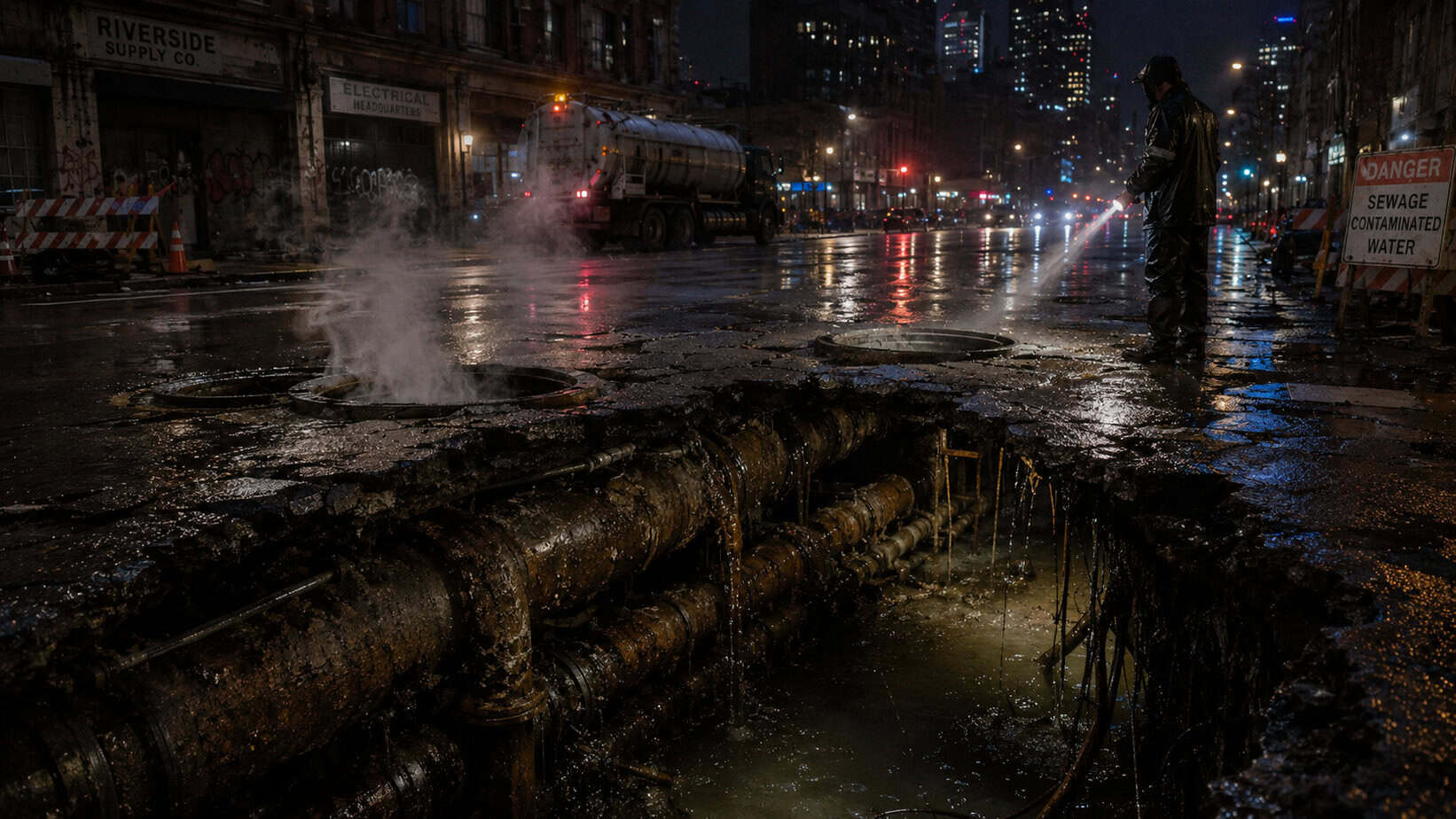
Most people in developed cities have never had to think twice about flushing a toilet. You push the handle, the waste disappears, and that is the end of it. But experienced urban preppers know that this comfortable routine is backed by a surprisingly fragile network of aging pipes, overwhelmed treatment plants, and infrastructure that was often built decades before the current population existed.
Sewage system failure in cities is not a fringe worst-case scenario reserved for disaster movies. It is a documented, recurring problem that has already affected real neighborhoods, real families, and real public health systems across the United States and around the world.
The 2025 ASCE Infrastructure Report Card gave U.S. wastewater systems a grade of D+, a score unchanged from the previous report four years earlier. That stagnant grade reflects more than 800,000 miles of sewer pipes, many of which are reaching or have already exceeded their designed service life.
Sixteen percent of the nation’s wastewater treatment facilities are operating at or beyond capacity. These are not abstract statistics. They are the conditions that, under the right stress, turn a slow-draining sink into a neighborhood-wide sanitation crisis.
This article is for the urban prepper who wants to understand the mechanics of how urban sanitation collapses, recognize the early warning signs before things get bad, and build a practical response plan grounded in the reality of city living.
Whether you are dealing with a natural disaster, infrastructure neglect, or a cascading grid failure, the knowledge of how sewage systems actually work and fail could be one of the most valuable things you carry into an emergency.
How Sewage System Failure in Cities Actually Happens
Understanding the failure mechanism is the first step to preparing for it. Most urban sewers are gravity-fed systems, meaning waste flows downhill through a network of pipes toward collection points and eventually to treatment plants. The system relies on consistent pipe integrity, functioning lift stations where gravity alone is insufficient, and treatment facilities that can handle the volume coming their way. Any one of those elements failing creates a cascade.
Pipe deterioration is the most common culprit. Concrete, clay, and even modern PVC piping all degrade over time. Roots from street trees infiltrate joints and cracks. Ground shifting from traffic, construction, or seismic activity causes misalignment or collapse. Grease buildup from restaurants and households narrows the effective diameter of pipes until blockages become inevitable. These are not spectacular failures. They accumulate quietly, below street level, until they cannot be ignored.
Lift stations are another critical weak point. These pumping stations keep sewage moving through low-lying sections of a city where gravity cannot do the job. They require continuous power to operate. During extended power outages, lift stations fail, and when they fail, the backed-up sewage has nowhere to go except backward, into streets, basements, and unfortunately, drinking water systems. The EPA has documented that sanitary sewer overflows (SSOs) release untreated waste containing bacteria, viruses, protozoa, helminths, and fungal spores, all of which can cause illnesses ranging from gastroenteritis to cholera and infectious hepatitis.
The Infrastructure Crisis Behind Urban Sanitation Collapse
The condition of America’s underground infrastructure is genuinely alarming when you look at the numbers with clear eyes. According to the American Society of Civil Engineers, the U.S. has more than 800,000 miles of public sewers and another 500,000 miles of private lateral lines. A significant portion of this network was installed in the mid-twentieth century, meaning it has been in the ground for 60 to 80 years, in some urban centers even longer. Most municipal pipe systems were engineered for a 50-year lifespan.
The financial picture makes things worse. In 2024, the wastewater and stormwater sectors had combined annual capital needs of approximately 99 billion dollars, but the actual funding gap was 69 billion dollars, meaning only around 30 percent of necessary investment was being made. At that pace, the gap is projected to grow to more than 690 billion dollars by 2044. This is not a funding problem that can be quietly managed. It is a slow-motion structural failure unfolding beneath every major American city.
Climate change adds pressure that older systems were never designed to handle. Extreme rainfall events overwhelm combined sewer systems, flooding streets with a mixture of stormwater and untreated sewage. Drought conditions cause ground shrinkage that displaces pipes. Coastal cities face saltwater intrusion into aging concrete infrastructure.
What the ASCE grades cannot fully convey is how vulnerable these systems become when multiple stressors converge at once, which is precisely the kind of scenario a serious prepper must think through.
Sewage System Failure in Cities: Warning Signs You Should Never Ignore
Urban preppers who pay attention to their environment have a real advantage. Sewage system failures rarely arrive without warning. The system communicates its distress through a language that most city residents have been conditioned to overlook or dismiss as a minor inconvenience.
Slow drains throughout an entire building or multiple units in the same block are one of the clearest early signals. A single slow drain usually points to a localized clog. But when multiple fixtures on different floors or in different apartments begin draining sluggishly at the same time, the problem is almost certainly in the main line. Gurgling sounds coming from toilets and floor drains, particularly when other water is being used elsewhere in the building, indicate air displacement from a pressurized or partially blocked main sewer. These sounds are the system telling you that the flow is compromised.
Sewage odors in basements, crawl spaces, or near street-level drains signal that gases from the sewer are escaping through cracks or compromised trap seals. In a healthy system, sewer gases move in a single direction toward the treatment plant. When they reverse course, something structurally significant has changed. Wet spots or unusually lush vegetation in patches of yard or parkway grass can indicate a broken sewer lateral leaking into the soil.
These are not cosmetic issues. They are indicators that the system is compromised and that sewage system failure in cities, when it eventually does arrive, will find the infrastructure already weakened.

Public Health Consequences: What Sewage Collapse Actually Does to a City
The romanticized version of a survival scenario often focuses on food and water. But historical evidence makes clear that sanitation failure is one of the fastest triggers of mass illness in dense urban environments. When sewage systems collapse or overflow, the pathogens they contain do not stay in place. They migrate into groundwater, contaminate surface water used for cooking and drinking, and coat surfaces in areas where people walk, work, and gather.
The World Health Organization links poor sanitation directly to the transmission of cholera, typhoid, dysentery, hepatitis A, intestinal worm infections, and polio. According to WHO data, inadequate sanitation contributes to approximately 564,000 deaths globally each year, the vast majority from diarrheal disease.
While American cities operate with far more robust baseline infrastructure than low-income nations, the pattern of disease that emerges during sewage system failure follows the same biological logic regardless of geography. When raw sewage reaches drinking water supplies, the waterborne pathogen risk becomes acute within days, not weeks.
Historical examples underscore the point. In 2017, the sewerage system in Sana’a, Yemen, stopped functioning, and within ten days a catastrophic cholera outbreak erupted. Over 200,000 cases were documented. Although the political and economic context there was extreme, the underlying biological mechanism of what happened when sewage collapsed is exactly the same mechanism that would play out in any dense urban area without functioning sanitation. The difference is speed of response, not whether disease would emerge.
Urban vs. Rural: Why City Preppers Face Unique Sanitation Challenges
Rural preppers often have more flexibility when it comes to sanitation alternatives. Land is available to dig a proper pit latrine or install a composting toilet system with adequate soil absorption. Neighbors are farther away, which reduces the density of contagion if waste management practices are imperfect. Rural residents often have a well with pressure that is independent from municipal infrastructure, keeping drinking water viable even when public services fail.
Urban preppers have none of those advantages. Apartment dwellers cannot dig anything. City ordinances prohibit outdoor waste disposal in virtually all circumstances. Neighboring units, floors, and buildings mean that a sanitation failure in one location spreads its contamination footprint rapidly through close quarters. The very density that makes cities economically vibrant during normal times becomes a catastrophic liability during sewage system failure in cities, because the volume of waste generated per acre is orders of magnitude greater than in a rural setting.
Additionally, urban preppers must contend with the fact that municipal systems, when they begin to fail, often do so unevenly. One neighborhood’s system may back up while an adjacent one remains functional. This creates zones of contamination adjacent to zones of apparent normalcy, which leads to a false sense of security in populations just outside the affected area. Understanding the sewer district boundaries in your neighborhood and knowing which direction water flows through your local system can give you a meaningful head start in assessing your personal risk.
Short-Term Sanitation Solutions for Apartment and Urban Dwellers
When municipal sewage fails, the most immediate need is waste management. For urban preppers in apartments and dense housing, that means having alternative systems ready before they are needed. The good news is that effective short-term solutions are affordable, compact, and require minimal storage space.
A portable toilet system built around a five-gallon bucket and a snap-on toilet seat with heavy-duty waste bags is the urban prepper’s most practical first line of defense. These setups are lightweight, easy to store under a sink or in a closet, and can be put into service within minutes. The Emergency Zone Honey Bucket Style Toilet Complete Set is a well-regarded option that includes a bucket toilet seat, liner bags, and waste gelling chemicals for hygienic disposal.
Waste gelling agents and chemical treatments serve a critical role in these systems. They neutralize odor, solidify liquid waste for safer handling, and reduce pathogen exposure during bag disposal. Without them, even a properly lined bucket becomes a biohazard management problem in an enclosed living space. Waste bags should be double-bagged before disposal and stored away from food preparation areas until municipal collection or waste disposal becomes possible.
If your budget allows and your space permits, a self-contained portable toilet with a flushing mechanism and a sealed waste tank offers a more comfortable and sanitary experience for extended outages. Products like the Dometic 970 Series or Camco portable toilets are designed for extended use and include sealed holding tanks that prevent odor escape and liquid spillage. For multi-day or multi-week scenarios, having a proper unit rather than a bucket will significantly improve the health and morale of everyone in the household.
Water Safety During Sewage System Failure in Cities
One of the least discussed but most dangerous aspects of urban sewage collapse is what it does to the water supply. In cities with combined sewer systems, where stormwater and sewage travel through the same pipes, an overflow event can push raw waste into drainage channels that ultimately connect to surface water sources. Even in systems designed to keep sewage and stormwater separate, pipe failures and pressure reversals can contaminate water mains through compromised joints or cross-connections.
The assumption that tap water remains safe during a sewage system failure is a dangerous one. Boil water advisories, when they are issued, typically lag behind the actual contamination event by 24 to 72 hours because it takes time for testing to confirm pathogen presence. Preppers who wait for official advisories before treating their water are already behind the curve.
Having a reliable water purification system that can handle biological contamination is non-negotiable for serious urban preppers. Water purification tablets are compact, inexpensive, and extremely effective when used correctly. Potable Aqua Water Purification Tablets are a longstanding, military-tested option that neutralizes bacteria and protozoa including Giardia lamblia and are small enough to store in a kitchen drawer or go-bag.
For households with more storage capacity, a gravity-fed water filter capable of removing bacteria, viruses, and protozoa provides a longer-term solution that does not require fuel or electricity. These filters can process river water, rainwater, or any other available source into water that is safe enough to drink and cook with. Pairing a gravity filter with water purification tablets gives you a redundant system that can handle both particulate contamination and biological threats simultaneously.
Additionally, storing a minimum of one gallon of water per person per day for at least 14 days is the kind of baseline preparation that makes the difference between a manageable crisis and a desperate one. Commercial water storage containers rated for long-term use are significantly better than repurposed juice jugs or non-food-grade containers, which can leach chemicals or harbor microbial growth over time.
Personal Hygiene and Sanitation Protocols When the System Goes Down
Beyond waste disposal and water purification, maintaining basic hygiene during a sewage system failure is what actually prevents disease from spreading through a household or building. The breakdown in sanitation infrastructure removes the safety net that modern plumbing provides, meaning that habits most people take for granted, like handwashing after using the toilet, suddenly require intentional management of water resources.
Waterless hand sanitizer with at least 60 percent alcohol content should be treated as a primary hygiene tool rather than a supplement. It requires no water and kills the broad spectrum of pathogens most likely to be present during a sewage failure event. Keeping multiple bottles staged at bathroom locations, food preparation areas, and entry points keeps cross-contamination from becoming a persistent household risk.
Biodegradable wet wipes provide a reasonable substitute for washing when running water is unavailable or being conserved. They should be stored in quantity alongside your emergency sanitation supplies. For families with infants or elderly members, having an ample supply is not a luxury but a health necessity. Disposable gloves, worn during any waste handling activity, are another low-cost, high-value item that belongs in every urban prepper’s kit.
Surface disinfection matters more than most people realize during extended sanitation failures. Doorknobs, faucet handles, countertops, and toilet surfaces should be wiped regularly with a diluted bleach solution or an EPA-registered disinfectant. The goal is to break the chain of fecal-oral transmission, which is the primary route through which waterborne and sewage-related illnesses spread from one person to another in a contained living space.
Building a Realistic Urban Prepper Sanitation Kit
There is a meaningful gap between reading about sanitation preparedness and actually having a functional system ready to deploy when the need arises. Building a practical sanitation kit for urban preppers does not require a large budget or a warehouse of supplies. It requires thoughtful selection of the right tools in sufficient quantities, stored in accessible locations.
The core of an urban sanitation kit should include a portable toilet system, a two to four week supply of heavy-duty waste bags that are compatible with your chosen toilet setup, a sufficient quantity of waste gelling and deodorizing chemicals, at minimum two weeks of water purification tablets, and a supply of nitrile gloves for waste handling. These items form the functional backbone of a system that can manage the biological realities of a sewage failure without requiring any special skills or space.
Surface disinfection supplies, including concentrated bleach and empty spray bottles for dilution, waterless hand sanitizer, and biodegradable wet wipes, round out the hygiene side of the kit. These are consumables, so rotate them into regular household use and replace them before they expire.
For apartment dwellers without outdoor space, waste storage during an extended outage requires thought. Sealed waste bags placed inside a lidded trash bin, stored in a bathroom or balcony space away from living areas, is the most practical interim solution before municipal collection resumes. Having a bag of cat litter or commercial odor absorber nearby can significantly reduce smell in enclosed spaces. Aquatabs water purification tablets are worth stocking alongside your food and water supplies, as their small footprint makes them easy to cache in multiple locations without taking up meaningful shelf space.
Long-Term Considerations: Community Response to Sewage System Failure in Cities
Individual preparedness goes a long way, but urban sewage system failure in cities at scale is ultimately a community-level crisis. The decisions made collectively in the first 48 to 72 hours following a major sanitation breakdown will determine whether a neighborhood manages the situation with relative order or descends into the kind of public health emergency that strains hospitals and social systems.
Knowing your neighbors and having basic communication channels established before a crisis hits is something the prepper community sometimes underemphasizes. During a sewage failure event, information about which block’s system is backed up, which building’s water is still clean, and where municipal services are setting up temporary sanitation stations travels person to person faster than it travels through official channels.
Building-level coordination, such as establishing a common protocol for waste disposal in a multi-unit building, can prevent the situation in any one apartment from contaminating shared infrastructure for everyone else.
Community coordination also means knowing the contact information for your local utility’s emergency line, your city’s department of public works, and your area’s emergency management office. During a widespread sewage system failure, these agencies establish mobile sanitation units, temporary water distribution points, and bypass pumping operations.
Getting your household connected to those resources early, rather than waiting to see if they come to you, is the difference between weathering the crisis and being overwhelmed by it.
Finally, the longer-term advocacy perspective matters for preppers who think beyond the next emergency. The deteriorating state of urban sewer infrastructure is a policy problem with a policy solution.
Organizations like the Water Environment Federation and the American Society of Civil Engineers publish regular reports that citizen advocates can use to push local representatives toward meaningful infrastructure investment. Reducing the probability of sewage system failure in cities over the next decade is, ultimately, a civic project as much as a personal one.
Concluding
Look, I have spent a lot of time thinking about grid-down scenarios, food storage, and security. But if I am being straight with you, sanitation is the one prep category that most urban preppers genuinely underestimate until they start digging into the actual history of infrastructure failures and disease outbreaks. When a city loses its sewage system, things get serious fast, and the people who are scrambling to improvise waste disposal in the middle of a crisis are going to be the same people too distracted by basic hygiene management to handle anything else.
The good news is that this is one of the most affordable areas of preparedness you can address. A five-gallon bucket with a toilet seat, a box of waste bags, some gelling packets, a bottle of Potable Aqua tablets, and a gravity filter will not break the bank. Together they represent a genuinely capable sanitation and water safety system for the kind of extended urban outage that is far more likely than most people want to acknowledge.
The ASCE is not being dramatic when it gives wastewater infrastructure a D+. That grade is backed by engineering inspections, failure rate data, and capacity assessments of real systems serving real cities right now. Sewage system failure in cities is not a hypothetical threat to prepare for someday. For a growing number of American neighborhoods, it is an ongoing and worsening reality.
Get your sanitation kit sorted before the day comes when you actually need it. Your health and the health of everyone in your household may depend on that call you made today.
Author Bio
Bob Rodgers is a lifelong outdoorsman, herbalist, and seasoned prepper with over 20 years of real-world survival experience. As the founder of PreppersWill.com, he shares practical advice on self-reliance, off-grid living, and disaster preparedness, no hype, just hard-earned lessons from decades of hands-on prepping.
Suggested resources for preppers:
Food preps when you lack money
The #1 food of Americans during the Great Depression
Survival Foods of the Native Americans
If you see this plant when foraging, don’t touch it!

I have a standing sewage treatment system that puts out portable water. So far I only use it for plants. My dogs think it’s okay to drink it when it exists the container. They’re still healthy, but I would boil it if I had to drink it myself.