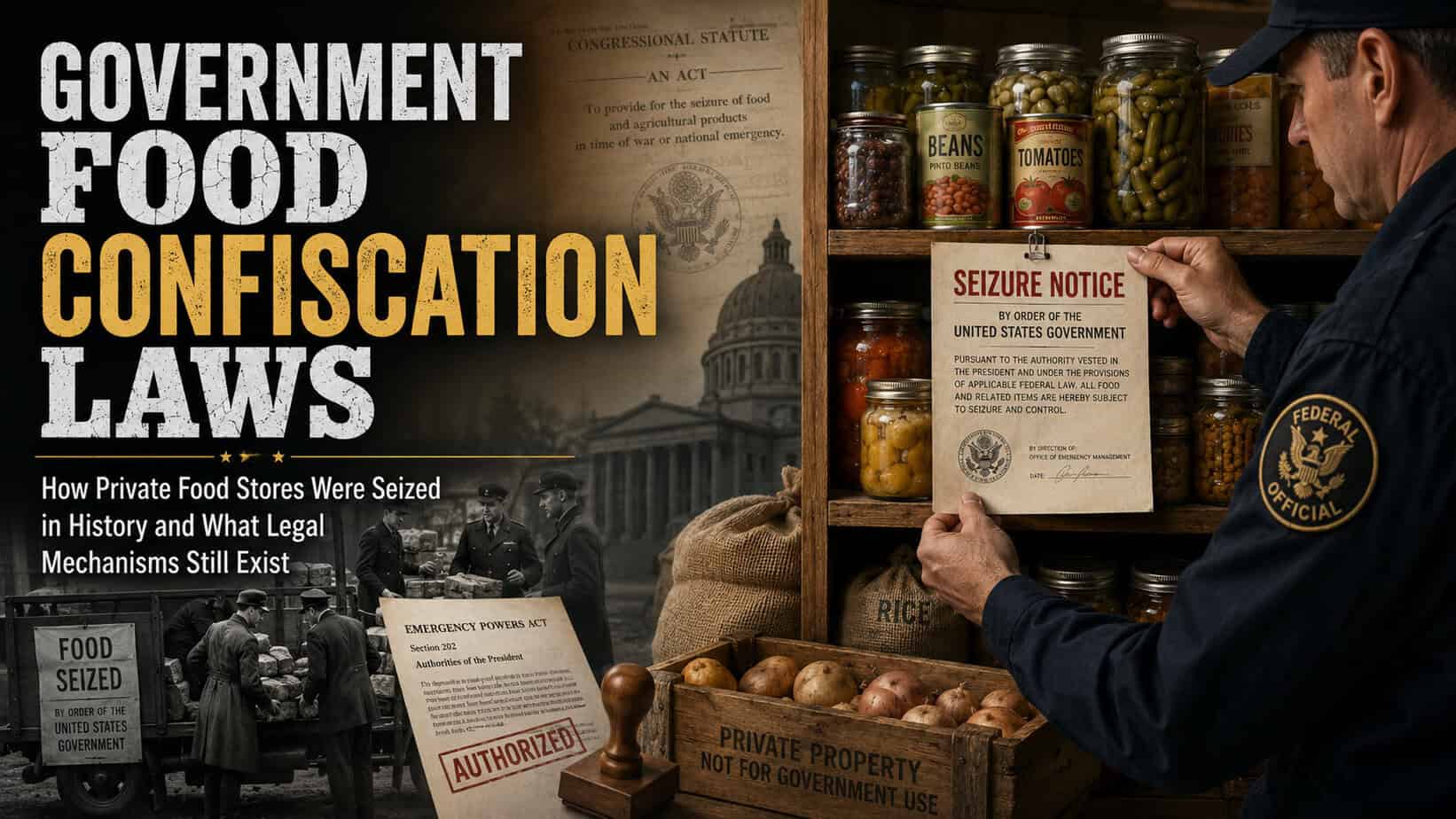
Most people assume that the food stockpiled in their pantry, freezer, or basement belongs to them unconditionally. Under normal circumstances, they are absolutely right. But history tells a far more complicated story, and the legal frameworks governing food supply, distribution, and access during emergencies reveal a side of government power that most people rarely think about until a crisis forces them to.
Government food confiscation laws, whether formally codified or embedded within broader emergency statutes, have existed in various forms across nearly every major civilization. And in the modern United States, the legal infrastructure for federally directed food resource management remains very much intact, even if rarely invoked.
Understanding the history of how governments have seized, rationed, and redistributed private food stores is not just an academic exercise. Whether you are a prepper planning for long-term food independence, a policy researcher, or simply a curious citizen, knowing how these laws work and where they come from gives you a clearer picture of the relationship between individual property rights and state power during crisis scenarios.
From Stalin’s grain brigades to the U.S. Office of Price Administration during World War II, and from the Defense Production Act of 1950 to the FDA’s modern mandatory recall authority, the legal machinery behind food control has always been more extensive than most people realize.
The Historical Roots of Government Food Confiscation Laws
Long before modern democracies drafted formal emergency statutes, governments were seizing food from private citizens as a matter of survival and political control. In ancient Rome, imperial authorities regularly requisitioned grain stores from provinces, funneling supplies toward military campaigns and urban populations in times of scarcity.
The practice, known as annona militaris, was essentially a formalized system of food extraction that left farming communities with whatever the state deemed sufficient for subsistence. Medieval European feudal systems operated under similar principles, with lords claiming a percentage of harvests as taxation, a custom that often-left peasants dangerously close to famine when harvests were poor.
These early precedents established a foundational assumption that would persist through centuries of governance: during crises, the state’s need for food resources takes precedence over individual ownership. This assumption became codified, refined, and in some cases weaponized as governments grew more centralized and bureaucratically capable of enforcement.
The concept of government food confiscation laws as we understand them today grew out of these early precedents, evolving through war economies, revolutionary political systems, and modern emergency management frameworks.
The Soviet Union’s Forced Grain Collectivization and the Holodomor
Perhaps the most devastating example of state-directed food confiscation in the twentieth century occurred in Soviet Ukraine between 1932 and 1933. Under Joseph Stalin’s forced collectivization program, the Soviet government systematically dismantled private farming operations and compelled peasants onto state-controlled collective farms. Independent farmers who resisted were branded as kulaks, declared enemies of the state, and subjected to arrest, deportation to labor camps, or execution.
What followed was a campaign of food extraction so extreme that it produced a deliberately engineered famine. Brigades of Communist Party activists, secret police, and armed soldiers were dispatched to Ukrainian villages with orders to seize every last scrap of grain, regardless of whether anything remained for the families who had grown it.
A 1932 decree known colloquially as the “Law on Five Ears of Grain” made it a capital crime for a starving farmer to pick up fallen grain from a collective field. The state punished this act of desperation with ten years in a labor camp or execution, and confiscation of all personal property.
Historians at the National Museum of the Holodomor-Genocide have documented that the Soviet regime maintained unrealistically high grain quotas despite full knowledge of the resulting starvation, and that approximately four million Ukrainians died from the engineered famine.
The Holodomor remains one of the starkest illustrations of how government food confiscation laws, when stripped of any humanitarian constraint, become instruments of genocide. More information is available at.
World War II Rationing and the U.S. Office of Price Administration
Not all historical examples of government food control are so catastrophic. During World War II, the United States implemented one of the most expansive civilian rationing programs in its history, an effort that was largely accepted as a patriotic duty by most Americans even if it significantly curtailed individual freedom of consumption.
The legal basis for this program rested on the Priorities and Allocation Act of 1940, which Congress expanded significantly through the Second War Powers Act of 1942, granting the President broad authority to allocate scarce commodities.
President Roosevelt used Executive Order 8875 to establish the Office of Price Administration (OPA), which became the primary federal body responsible for controlling the distribution of rationed goods. Sugar rationing began in May 1942, followed by coffee, meat, butter, and dozens of other food products.
Americans received ration books with coupons, and purchasing beyond one’s allotment was not merely frowned upon but illegal. Hoarding was treated as a serious offense, and enforcement teams could and did seize stockpiled goods from civilians found to be in violation of OPA rules.
The National WWII Museum notes that rationing placed a heavy burden on civilian supplies and required extraordinary coordination between federal agencies, local rationing boards, and the public. The program demonstrated that democratic governments could implement sweeping food control measures with public cooperation, provided the justification was perceived as legitimate and the burden was shared broadly. More details on this period can be found at.
Government Food Confiscation Laws and the Defense Production Act of 1950
In the postwar years, the United States government did not simply abandon its wartime food control apparatus. Instead, it institutionalized the legal framework for resource management through the Defense Production Act of 1950, a statute that remains in force today and forms the legal backbone for federal authority over food resources during national emergencies. The DPA granted the President far-reaching powers to prioritize and allocate materials, including food resources, to support national defense.
Executive Order 13603, signed by President Obama in 2012, updated the DPA’s delegation framework and specifically assigned the Secretary of Agriculture authority over food resources, food resource facilities, livestock, and the domestic distribution of farm equipment during national emergencies.
This was not a new or radical expansion of government power, as the order itself was essentially an update of similar directives going back to the Truman administration. Each successive president has maintained and refined this framework, recognizing that the ability to direct food resources is a fundamental component of national security planning.
The Congressional Research Service has thoroughly documented the DPA’s history and its modern applications, noting that the six federal agencies to which priorities and allocations authority has been delegated are required to establish procedures for exercising these powers under both emergency and non-emergency conditions.
Chinese Great Leap Forward: Food Seizure as Policy Catastrophe
The Soviet Union was not the only Communist government to engineer famine through forced food extraction. Between 1959 and 1961, China’s Great Leap Forward under Mao Zedong produced what historians now recognize as the deadliest famine in human history, with estimates of between 15 and 55 million deaths. Rural communes were required to meet grain quotas set by the state, and local officials frequently reported inflated production figures to avoid punishment. The result was that the central government continued extracting grain from regions already experiencing severe food shortages, because the official numbers suggested there was plenty to spare.
Teams of cadres were sent into villages to search homes for hidden food supplies, confiscating anything above what the state deemed necessary for bare survival. Families that had managed to conceal small amounts of grain or vegetables faced punishment, public humiliation, and in many cases violent retribution.
The combination of unrealistic quotas, dishonest reporting, political terror, and systematic food confiscation created a catastrophic feedback loop that government food confiscation laws in democratic societies are specifically designed to prevent through oversight, due process, and institutional accountability.

FDA Mandatory Recall Authority: Modern Government Food Seizure Tools
In contemporary democratic systems, government food confiscation laws manifest in a very different form than in totalitarian regimes. The U.S. Food and Drug Administration gained mandatory food recall authority through Section 206 of the FDA Food Safety Modernization Act of 2011, which added Section 423 to the Federal Food, Drug, and Cosmetic Act.
Under this provision, the FDA Commissioner has the authority to order a mandatory recall of any food product when there is a reasonable probability that the product is adulterated or misbranded and that consuming it could cause serious harm or death.
Before FSMA, the FDA had to rely on voluntary recalls by manufacturers or seek court orders to remove contaminated food from the market. The new authority significantly streamlined the government’s ability to act quickly in food safety emergencies. The FDA’s guidance on mandatory recalls explains that responsible parties are given the opportunity to voluntarily comply before a mandatory order is issued, preserving a degree of procedural due process even in urgent situations.
This form of food seizure authority is fundamentally different from what the Soviets or Maoist China exercised. The FDA’s power operates within a framework of legal safeguards, transparency, and a genuine public health rationale. Manufacturers can contest orders, courts can review decisions, and the press can scrutinize every action the agency takes. These institutional constraints are precisely what separates legitimate modern regulatory authority from the coercive food extraction of authoritarian regimes.
Government Food Confiscation Laws During Natural Disasters and Martial Law
Perhaps the most concerning aspect of government food control authority for preppers and food sovereignty advocates involves what happens when normal constitutional protections are suspended under martial law or a declared national emergency.
The Defense Production Act and related executive orders delegate to the Secretary of Agriculture and, in certain circumstances, to the Department of Homeland Security the authority to prioritize and allocate food resources, effectively overriding normal market distribution in favor of government-directed supply chains.
What this means practically is that during a severe enough national emergency, the federal government has the legal framework in place to direct where food supplies go and, by extension, to restrict private citizens from accumulating or retaining stocks beyond what authorities deem appropriate.
Section 2072 of the DPA gives the President authority to define legal limits on hoarding of scarce materials in emergency conditions. Once such limits are defined, anyone exceeding them would be subject to enforcement action, including confiscation of excess supplies.
After Hurricane Katrina, the chaos surrounding food and supply distribution raised serious questions about government emergency management capabilities and the line between legitimate resource reallocation and arbitrary seizure. Local authorities in several affected areas did confiscate firearms and supplies from private citizens in circumstances that were later challenged in court.
The episode served as a reminder that even in a modern democracy, crisis conditions create pressure on government agencies to act in ways that can infringe on property rights, and that legal remedies are often slow to arrive for those most directly affected.
Historical Food Requisitioning During World War I: Early Precedents in the United States
The Food Administration established by President Woodrow Wilson during World War I through the Lever Food and Fuel Control Act of 1917 represented the first major federal intervention into food supply management in American history.
Herbert Hoover, who headed the Food Administration, led a campaign that mixed voluntary conservation appeals with regulatory authority over the production, distribution, and export of food commodities. Hoover had the power to license food dealers and could revoke licenses from those found to be hoarding or price-gouging, effectively putting them out of business.
While the World War I approach was considerably less coercive than the outright confiscation programs seen in wartime Europe, it nonetheless established the precedent that the federal government could and would regulate private food commerce during national security emergencies.
The Lever Act authorized the President to purchase, store, and sell food commodities and to regulate the practices of food producers and distributors. Violations could result in fines, imprisonment, and loss of business licenses, creating real enforcement teeth behind what was publicly promoted as a voluntary “meatless Monday” patriotic program.
What Preppers and Private Citizens Should Know About Government Food Confiscation Laws
For individuals who invest in building substantial long-term food supplies, understanding government food confiscation laws is not a matter of paranoia but of practical legal literacy. The existing legal framework in the United States does not make private food storage illegal under normal conditions, and there is no current law prohibiting individuals from maintaining a large food stockpile on their own property.
However, the legal picture changes significantly during declared national emergencies, under martial law, or if authorities determine that hoarding is contributing to a public health or supply crisis.
The DPA and related executive orders create a framework under which the government can, in extreme circumstances, direct the reallocation of food resources, including those held by private citizens. This is not a theoretical concern without historical basis.
During World War II, civilian food hoarding was actively prosecuted. In several states, individual state laws on emergency resource management go further than federal minimums, giving state governors significant authority to commandeer private property, including food stocks, during declared emergencies.
Government Food Confiscation Laws in Contemporary Global Context
The United States is hardly alone in maintaining legal frameworks that allow for government food resource management during emergencies. Most modern nation-states have some version of emergency powers legislation that covers food and water supplies.
The United Kingdom’s Civil Contingencies Act of 2004 grants ministers sweeping powers to requisition property, including food, during emergencies. France maintains detailed plans for food supply continuity under its Defense Code. Australia’s biosecurity and emergency management legislation similarly allows for the commandeering of food supplies during declared crises.
What varies significantly between democratic and authoritarian systems is the degree of institutional oversight, judicial review, and transparency surrounding the exercise of these powers. In democratic societies, government food confiscation laws operate within a web of constitutional rights, administrative procedures, and political accountability that limits their application and creates pathways for legal challenge. In authoritarian contexts, these same powers have historically been exercised without constraint, producing some of the worst humanitarian catastrophes of the modern era.
The NCBI’s review of U.S. food safety legislation notes that the FDA’s authority under the Federal Food, Drug, and Cosmetic Act has been progressively strengthened over the decades, with each major food safety crisis prompting legislative expansion of government oversight powers.
Global food supply chain vulnerabilities exposed by the COVID-19 pandemic, the Russian invasion of Ukraine (which involved the documented theft of Ukrainian grain), and recurring climate-related crop failures have prompted many governments to revisit and strengthen their emergency food management legal frameworks.
This means that the legal architecture around government food confiscation laws is likely to expand in scope and specificity in the coming decades, making civic awareness of these laws more important than ever.
My Two Cents
Having spent considerable time researching how governments have used and abused food control authority across history, my honest takeaway is this: the legal mechanisms for government food confiscation are real, they are still on the books in the United States, and they are not something any serious person should dismiss as fringe paranoia.
The same country that interned Japanese Americans and requisitioned civilian property during World War II has a detailed, updated executive order framework for directing food resource allocation during national emergencies. These powers exist for legitimate reasons, but they are not without risk of overreach.
That does not mean you should be afraid. Knowledge is protective and understanding that government food confiscation laws exist, knowing the historical contexts in which they have been invoked, and recognizing the legal distinctions between legitimate regulatory authority and coercive seizure gives you a much better foundation for both preparedness and civic engagement.
Build your food stores thoughtfully, understand the laws in your state regarding emergency resource commandeering, and stay informed about changes to federal emergency management authority.
History rewards the prepared and punishes the complacent, and the line between a functioning supply chain and a desperate scramble for resources can be shorter than most people want to believe.
Other resources:
What you should know about survival foods with decades of shelf life
The Foods that helped the pioneers survive crop failures and hard times
Survival Foods of the Native Americans
If you plan to build a storage room and equip it with everything needed > Start Here!
