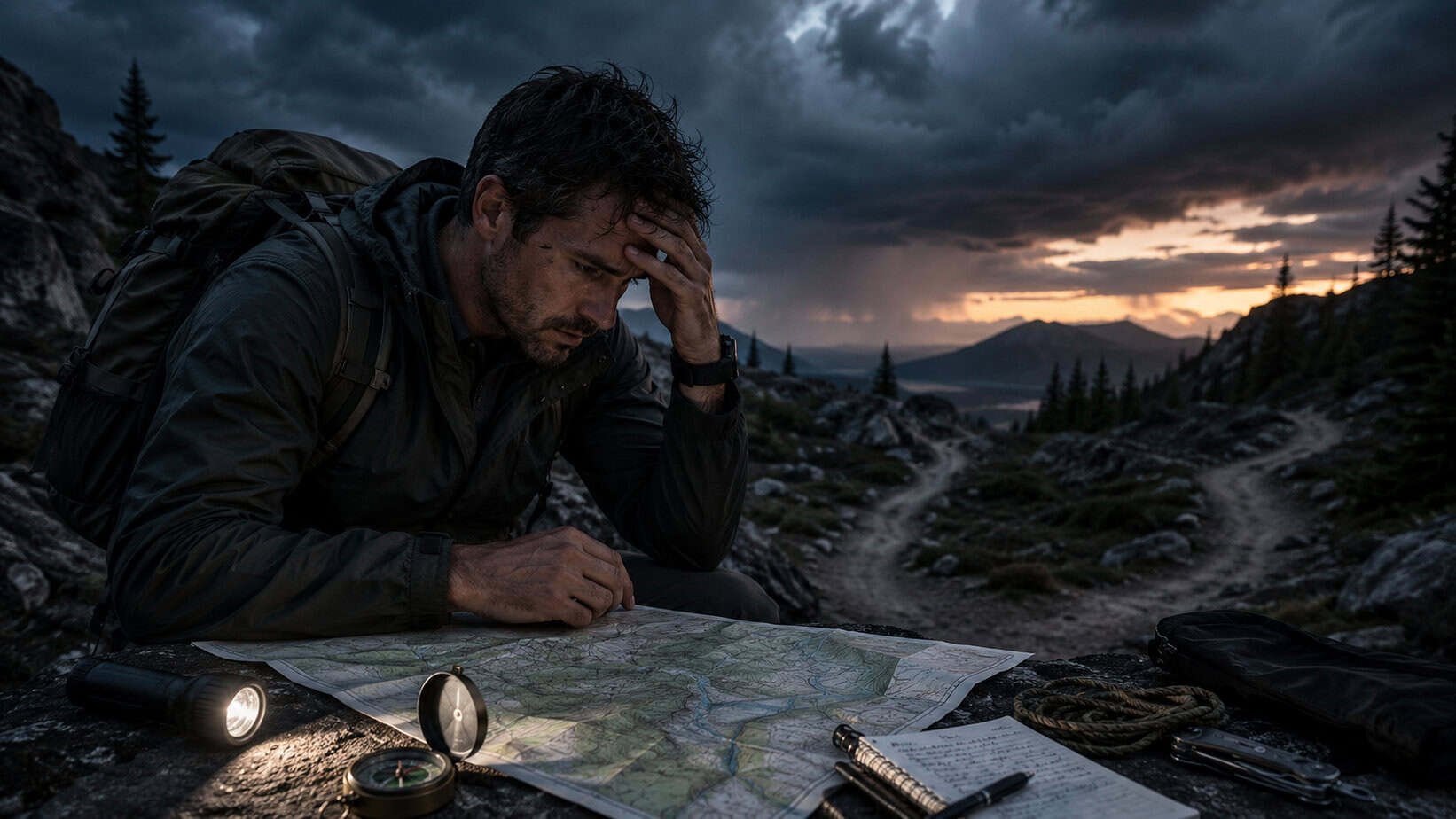
There is a dangerous myth in the preparedness world that intelligence automatically turns into good action when life gets ugly. It sounds comforting because most serious preppers read, plan, compare gear, study maps, and think through scenarios long before trouble arrives.
The problem is that a crisis does not test your intelligence in a clean classroom setting. It tests your ability to use a tired, frightened, overloaded brain while the environment is loud, uncertain, painful, dark, wet, or moving faster than your plan.
That is where survival decision making under stress becomes the difference between useful preparation and expensive theater. The smartest person in the room can freeze at a locked door, ignore obvious danger, follow a bad plan because he already committed to it, or waste precious minutes trying to gather perfect information. High IQ can help with learning, pattern recognition, and planning, but it does not cancel adrenaline, fear, sleep loss, tunnel vision, ego, or the body’s hardwired threat response.
Special Forces training, emergency management research, aviation safety, firefighting, and wilderness survival all point toward the same brutal truth. People do not rise to the level of their smartest theory. They usually fall back on habits, rehearsed procedures, and simple decision rules that still work when the brain is overloaded. The goal is not to become fearless. The goal is to build a mind that can act inside fear without needing perfect calm first.
Survival Decision Making Under Stress Starts Before the Crisis
Good decision-making in survival situations begins long before the sirens, the smoke, the broken-down vehicle, or the first hard choice. The brain performs best when it has seen a problem before, even in rough practice.
That is why military units rehearse actions on contact, why pilots run emergency checklists, and why firefighters drill the same procedures until they can perform them under heat, darkness, and bad radio traffic. Survival decision making under stress is rarely built by reading one more gear review. It is built by making the first few choices automatic enough that panic does not get a vote.
The human brain has limited working memory. Under calm conditions, you can compare options, remember details, weigh tradeoffs, and imagine second-order consequences. Under acute stress, that same mental workspace shrinks. Attention narrows toward the most threatening or emotionally loud stimulus. You may stare at the fire and forget the exit, focus on a bleeding hand and ignore incoming traffic, or argue with a family member while the weather window closes.
NIOSH research on judgment and decision-making under stress notes that emergency decision makers must contend with stress in life-or-death situations and that prior training is closely tied to performance under stressful conditions.
The practical takeaway is simple but uncomfortable. Your survival plan has to reduce thinking at the point of impact. You still need judgment, but your judgment should operate from a prepared menu, not a blank page. Decide now what triggers evacuation, what triggers sheltering in place, who grabs which bag, where the family meets, who handles pets, where the shutoff tools are, and what conditions make a route unacceptable. Written triggers matter because stressed people are very good at negotiating with themselves. A vague plan invites debate when time is already bleeding away.
Why High-IQ People Freeze, Rationalize, and Delay
High intelligence can become a liability when a crisis rewards action more than analysis. Smart people often have large mental models, deep curiosity, and a strong desire to understand the full situation before acting. In ordinary life, those traits are valuable. In a survival setting, they can create analysis paralysis. The person keeps gathering data, challenging assumptions, and waiting for confirmation while the window for a safe move gets smaller.
This is one of the ugliest parts of survival decision making under stress. A highly analytical mind can rationalize danger with impressive language. The floodwater is probably not rising that fast. The smell of smoke may be from another neighborhood. The person pounding on the door might only need help. The map says the road should be open. The news would have warned us if it were truly serious. Each statement may sound reasonable by itself, but the combined effect is delay. Survival failures often come from a chain of defensible little choices that add up to a catastrophic one.
Stress also changes what the brain values. Research on stress and decision-making has found that stress can influence valuation, learning, and risk-taking, often pushing people toward habit, biased reward processing, or poorly calibrated risk judgments. That matters because intelligent people are not immune to bias. In fact, they may defend a bad decision more skillfully because they can generate better arguments for staying the course.
A good prepper has to train against that tendency. The cure is not dumbing yourself down. The cure is setting simple action thresholds ahead of time and respecting them when your mind starts bargaining.
Cognitive Load Turns Small Problems Into Cascading Failures
Cognitive load is the amount of mental effort your brain is carrying at one time. In daily life, you can usually hide a heavy load. You check your phone, answer questions, make coffee, track appointments, and still function. In survival conditions, that load rises sharply. You may be cold, hungry, dehydrated, sleep-deprived, responsible for family members, watching a threat, trying to navigate, and making decisions with incomplete information. Even a minor task, like tying a knot or reading a map, can suddenly feel complicated.
Survival decision making under stress collapses when too many open loops compete for attention. A person trying to purify water, calm a child, listen to emergency radio, patch a wound, find spare batteries, and decide whether to leave is not making one decision. He is making a dozen decisions while his nervous system is screaming for speed. That is where mistakes appear. People forget basic steps, double-dose supplies, misread labels, leave gear behind, lose track of time, or keep repeating a task that is no longer useful.
At home, you can reduce cognitive load with checklists, staging, labels, and physical organization. A go bag buried under camping gear is not prepared. A trauma kit without clear layout becomes a rummage bag. A power outage plan that requires searching three drawers for batteries is a plan designed for calm days. Use big labels. Use clear containers. Put items in the order you would use them. Keep critical gear boringly predictable.
The Body Hijacks the Boardroom
A crisis does not ask your brain for permission before it changes your body. Heart rate rises, breathing becomes shallow, hands shake, digestion slows, hearing may narrow, and time perception can distort. These reactions are not character flaws. They are part of a survival system designed to keep you alive during immediate danger. The trouble is that modern emergencies often require fine judgment, communication, navigation, medical care, and restraint. Those tasks compete with a body that wants to run, fight, or lock up.
Survival decision making under stress gets worse when people misread these body signals. A racing heart may be interpreted as proof that the situation is hopeless. Shaking hands may be mistaken for cowardice. A blank mind may be treated as personal failure. Once shame enters the picture, the person can spiral further. He starts thinking about how he appears instead of what must happen next.
The American Psychological Association has reported that stress can push people toward postponing decisions, sticking with the status quo, and planning less effectively. For survival purposes, that means your body may nudge you toward doing nothing while your environment demands movement. The prepper answer is to pair body control with action cues. Breathe, name the problem, choose the next task, move.
Survival Decision Making Under Stress Requires Simple Rules
Complicated plans often look impressive on paper and fail in dirty conditions. A good survival rule is short enough to remember, clear enough to apply, and strict enough to stop debate. Special operations personnel use far more advanced planning than the average household, but the field lesson for civilians is very simple. Under cognitive overload, simple rules beat clever improvisation most of the time.
Survival decision making under stress improves when you have prebuilt rules for common threats. For example, “do not drive through moving water” is better than estimating depth under rain, darkness, and social pressure. “If smoke is visible inside the house, everyone exits before anyone investigates” is better than assigning a family member to check the attic during panic. “No one separates without a time and rally point” is better than trusting phones that may be dead, jammed, wet, or out of service.
This is where many high-IQ people struggle. They dislike hard rules because hard rules feel crude. They can imagine exceptions, and because they can imagine exceptions, they start treating every situation as special. Survival is full of special cases, but the first job is to avoid the obvious killers. You can refine later if you are alive.
One useful method is the “if this, then that” format. If the power fails for four hours, fill every safe container with water. If the first route is blocked, use the alternate route without discussion. If anyone is missing for ten minutes during a bug-out, everyone returns to the last rally point. These rules create forward motion when the brain wants to stall.
What Special Forces Training Actually Teaches
Most people misunderstand elite military training because they focus on toughness and ignore decision architecture. Yes, Special Forces candidates and operators endure cold, hunger, fatigue, pressure, physical punishment, and uncertainty. Those hardships matter, but the deeper lesson is that performance under stress depends on disciplined basics, team roles, rehearsed procedures, communication, and the ability to keep acting with partial information.
Survival decision making under stress is trained through exposure, repetition, and feedback. A person learns what stress feels like, makes decisions while uncomfortable, receives correction, and repeats the process until basic functioning survives the pressure. The U.S. Special Operations Command has placed formal emphasis on brain health and cognitive performance, describing the need to align medical and operational resources to support superior cognitive performance and brain health in SOF. That should tell civilian preppers something important. Even elite units do not treat the brain as a magical organ that can simply be commanded to perform.
Special Forces style decision-making also teaches humility. Operators are trained to use checklists, briefs, back briefs, contingency plans, and after-action reviews because memory and confidence are not enough. They rehearse what can go wrong before it goes wrong. They assign responsibilities before confusion starts. They simplify communication because long speeches collapse when radios are broken and people are moving.
For the home prepper, the lesson is not to play soldier. The lesson is to build a civilian version of stress-tested routines. Practice loading the vehicle in the dark. Time how long it takes to shut off water and power. Walk your evacuation route instead of only studying it online. Run a no-notice drill where phones are treated as unavailable. Cook a meal without grid power after a long day, not on a relaxed Saturday morning when everyone is in a good mood.

Situational Awareness Is a Skill, Not a Vibe
Situational awareness has become one of those phrases that gets thrown around until it loses meaning. It does not mean walking around paranoid, staring at everyone, or pretending you are in a movie. It means observing relevant cues, understanding what they may mean, and projecting what could happen next. In a survival event, awareness has to be specific enough to guide action.
Survival decision making under stress depends on noticing the right things early. The crowd is changing direction. The wind is pushing smoke toward your neighborhood. The creek is rising faster than expected. The gas station line is becoming hostile. The child is getting quiet from cold rather than calming down. The person at the door is watching your hands instead of explaining his problem. Small cues matter because they give you time. Time is the cheapest survival resource until you waste it.
Army University Press, discussing nontechnical skills, describes decision-making as a process involving situational awareness, problem definition, evaluation of response options, selection and implementation, and analysis of results. That sequence is useful for civilians because it reminds us that awareness alone is not enough. You observe, interpret, decide, act, and reassess.
Train the Pause Without Training Hesitation
There is a fine line between a useful pause and dangerous hesitation. A useful pause is brief, intentional, and tied to action. Hesitation is open-ended. It waits for fear to leave, for perfect data to arrive, or for someone else to take responsibility. In survival conditions, the goal is not to eliminate the pause. The goal is to make the pause short enough to prevent panic decisions without becoming a hiding place.
Survival decision making under stress benefits from a simple mental sequence: stop, breathe, identify the main threat, choose the next action, communicate it, move. This sequence can happen in seconds. It is not a board meeting. It is a way to prevent the brain from grabbing the first emotional impulse and calling it a plan.
Practice this under mild stress first. Set a timer for five minutes, turn off the lights, and find your headlamp, water shutoff tool, and first aid kit. Afterward, write down what slowed you down. Another day, put on gloves and open your medical kit with your non-dominant hand. Try reading a map after doing burpees or walking fast uphill. Cook with stored food while the kids are making noise. None of this perfectly recreates a disaster, but it teaches the brain that discomfort and useful action can exist at the same time.
Survival Decision Making Under Stress Is a Family System
Many survival plans quietly assume one competent adult will make every serious decision. That may work on paper, but it creates a dangerous bottleneck. If that adult is injured, absent, asleep, overwhelmed, or emotionally compromised, the whole plan can collapse. Survival decision making under stress has to be distributed across the household in a way that fits age, ability, and trust.
Children can learn simple actions without being terrified. They can learn rally points, emergency contacts, how to stay put when separated, how to blow a whistle, how to identify safe adults, and how to follow a one-page family plan. Older children can learn basic radio use, water collection, pet handling, and flashlight discipline. Adults should know each other’s roles and should be able to swap roles when necessary. A plan that only one person understands is not a family plan.
A strong family system uses short commands, shared vocabulary, and visible checklists. “Load phase one” should mean something specific. “Rally point two” should not require explanation. “Medical first” should tell everyone what priority comes before packing more gear. When the language is clear, the group spends less energy interpreting each other.
This is also why gear should be staged by role. The person handling pets should know where leashes, crates, food, medication, and water bowls are. The person handling documents should not be digging through camping gear. The person handling security should not also be responsible for finding the toddler’s shoes. Spread the load before the crisis, because stress will not distribute it fairly for you.
Build a Home Training Plan That Makes Bad Choices Harder
Training at home does not need to become theatrical. You do not need smoke bombs, screaming, or fake commando nonsense. You need repeatable drills that expose weak assumptions and make good choices easier than bad ones. The best plan is simple enough to actually do and uncomfortable enough to reveal friction.
Survival decision making under stress can be trained with a weekly fifteen-minute drill. Week one, run a power outage drill and time how long it takes to get light, water, radio, and cooking options staged. Week two, practice a five-minute evacuation loadout. Week three, run a medical access drill with gloves and low light. Week four, walk through your home at night and identify hazards, exits, fire extinguishers, and alternate escape points. Repeat the cycle and improve one thing each time.
You can also use small constraints to simulate cognitive overload. Limit speech to short commands. Use only headlamps. Remove one piece of expected gear and see whether the system adapts. Start the drill when people are tired, because real trouble rarely waits for your best mood. Do not overdo it. Training that creates resentment will not last.
For useful home drills, pair decision practice with physical tools: a printed checklist, a kitchen timer, a simple radio, a flashlight, a whistle, and a compact medical kit. The goal is not perfection. The goal is to make catastrophic stupidity less available when fear, fatigue, noise, and uncertainty start pressing on the brain.
Conclusion: My Two Cents
My two cents is that most people are preparing for the wrong version of themselves. They imagine the calm, rested, informed version sitting at a desk with a full battery, good lighting, and time to think. The version that shows up during a real emergency may be hungry, angry, scared, embarrassed, cold, rushed, and responsible for people who are also scared. That person needs fewer theories and more rails to run on.
The real value of preparedness is not owning gear. Gear matters, but gear without practiced decisions can become clutter with a price tag. A smart prepper builds systems that protect him from his own overloaded brain. He writes triggers before pride gets involved. He practices basics when conditions are mildly uncomfortable. He gives family members clear roles. He keeps checklists where hands can find them. He reviews mistakes without ego.
Survival decision making under stress is trainable, but it is not trained by confidence alone. You train it by rehearsing the ugly minutes before they arrive. When things go sideways, intelligence still matters, but practiced simplicity matters more. The hard truth is that you will never think perfectly in a crisis, so you should prepare to think simply, move deliberately, and let your systems carry part of the load.
Author Bio
Bob Rodgers is a lifelong outdoorsman, herbalist, and seasoned prepper with over 20 years of real-world survival experience. As the founder of PreppersWill.com, he shares practical advice on self-reliance, off-grid living, and disaster preparedness, no hype, just hard-earned lessons from decades of hands-on prepping.
Suggested resources for preppers:
What you should know about survival foods with decades of shelf life
The Foods that helped the pioneers survive crop failures and hard times
Survival Foods of the Native Americans
If you plan to build a storage room and equip it with everything needed > Start Here!

You seem to have left out the TRUE first responder in critical life/death situations that people call first. Police. I worked in some of the most dangerous places in America – Miami 70-80-90s. The critical thinking, situational awareness, and other skills were necessary all shift, every shift. Many of us have been shot at or been around gunfire at a far higher % of military personnel. Yes, fire fighters have dangerous jobs, but they are REactive all the time. Police must be PROactive. Big difference. I was police. My other half was fire. We are completely different creatures. I’M the one you want in a shtf situation that requires quick thinking and pro-active action. And, I’m the female. I’M the warrior.