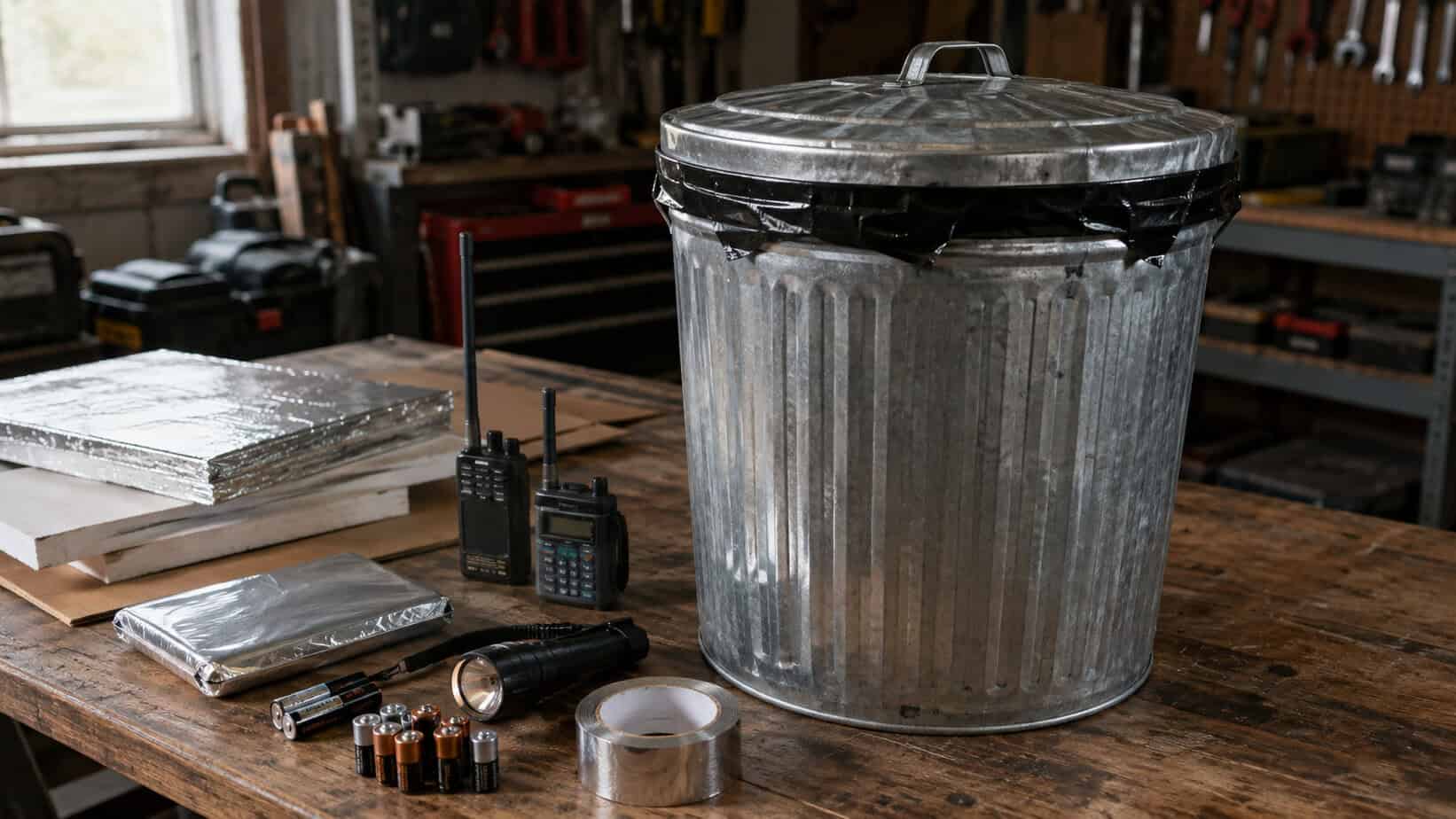
Spend an evening reading survival blogs and you will come away convinced that a galvanized trash can, a roll of aluminum tape, and a sheet of cardboard are all that stand between your radio collection and the end of the world.
The advice gets repeated so often that it has hardened into folklore. Line the can, tape the lid, keep the gear off the metal, and your electronics will supposedly ride out a high-altitude nuclear detonation without a scratch.
Actual shielding engineering is a good deal messier than that, and once you spend time with the measurement standards that professionals use, you start to understand why faraday cages don’t work the way most prepper articles claim. The underlying concept is sound and has been sound since Michael Faraday built his famous ice pail experiment in 1843. The trouble lives in the gap between the physics and the way that physics gets translated into weekend project instructions written by people who have never once put a probe inside their own enclosure to see what leaked in.
Shielding behaves like a spectrum rather than a switch. An enclosure attenuates incoming energy by a certain number of decibels at a certain frequency, and that number shifts depending on how the box is built, how tightly it closes, what passes through its walls, and which wavelength happens to be hitting it. A container can kill a cell signal beautifully and still pass along the fast rising transient that would fry a microcontroller. Recognizing that difference separates a preparation that performs from one that simply looks reassuring on a shelf.
What follows is an honest walk through the parts that most articles skip, along with the practical adjustments that genuinely improve your odds.
What a Faraday Cage Actually Does Before Anyone Adds Duct Tape
A conductive enclosure works because free electrons in the metal rearrange themselves in response to an external electric field. Those redistributed charges create an opposing field inside the shell, and the two roughly cancel. For a perfect conductor of infinite thickness with no openings, the interior field drops to zero and stays there. That is the textbook version, and it is the version that gets quoted in every article about protecting gear from an electromagnetic pulse.
Reality introduces three complications right away. Real metals have finite conductivity, real enclosures have finite thickness, and real boxes have lids, seams, handles, and hinges. Each of those departures from the ideal case reduces performance by a measurable amount. Engineers describe that performance as shielding effectiveness, expressed in decibels, and they measure it at specific frequencies because the answer changes across the spectrum.
There is also a distinction between static fields and time varying fields that most popular write ups blur together. A grounded metal shell handles a static electric field almost perfectly. A nanosecond scale pulse containing energy from the low kilohertz range up past a gigahertz is a completely different engineering problem, and the same enclosure can score wildly different numbers against each one.
This is the foundation for the claim that faraday cages don’t work as advertised in the prepper space. The devices themselves work exactly as physics says they should. The gap appears because hobby builds are rarely evaluated against the frequency content of the threat they supposedly defeat, so the builder never learns whether the box delivers 15 decibels of attenuation or 80. Those two outcomes lead to very different mornings after.
Faraday Cages Don’t Work as Sealed Magic Boxes, and the Math Explains Why
Shielding effectiveness follows a logarithmic scale, which trips up a lot of people. Twenty decibels means the field strength inside is one tenth of what it was outside. Forty decibels gets you to one hundredth. Military hardening specifications for critical command and communications facilities generally call for something in the range of 80 decibels across a broad frequency band, which corresponds to a ten thousandfold reduction in field strength.
Hobby enclosures rarely come close. A taped metal can might land somewhere between 20 and 50 decibels depending on frequency and on how carefully the lid mates with the body. Whether that is adequate depends entirely on the incident field strength and on the survival threshold of the electronics inside, and almost nobody doing a backyard build has any idea what either of those numbers is for their situation.
The formal method for measuring an enclosure lives in IEEE Standard 299, which lays out uniform procedures for testing shielded enclosures from 9 kHz to 18 GHz using specific antenna types across low frequency, resonance, and plane wave regions. Reading through the procedure is sobering, because it makes obvious how much instrumentation is required to produce a number you can trust.
Here is where the claim that faraday cages don’t work becomes precise rather than dramatic. The enclosures attenuate. They simply attenuate by an unknown and usually unimpressive amount, and unknown attenuation is not the same thing as protection. An article that tells you to tape a lid and walk away has quietly skipped the entire verification step that gives the number meaning.
The Microwave Oven Myth That Should Have Died a Decade Ago
Somewhere along the line, someone noticed that a microwave oven contains radio frequency energy and concluded that an unplugged oven makes a ready built shielded container. The idea spread because it sounds clever and costs nothing. Unfortunately, the design goals of a microwave door have almost nothing in common with the design goals of a hardened enclosure.
A domestic oven operates at a single frequency near 2.45 GHz. The perforated screen in the door has hole spacing chosen specifically to block that wavelength, and the door frame uses a quarter wave choke rather than a continuous conductive gasket. Regulatory limits permit a certain amount of measured leakage at that frequency, so the oven is not designed to reach zero even at the one frequency it cares about. Take that same door down to 100 MHz or up to 5 GHz and the performance falls apart in ways the manufacturer never had reason to address.
You can test this yourself in about thirty seconds. Put a phone inside, close the door, and call it. In a large number of ovens the phone rings, because cellular bands sit well away from the frequency the door was engineered to contain. That single experiment demonstrates the broader lesson that faraday cages don’t work when the enclosure was optimized for a different frequency than the one you care about.
If you want a container with published attenuation figures rather than folklore, purpose built shielded pouches tested against known standards are a far more sensible starting point.

Seams, Lids, and Gaskets: Where Your Trash Can Quietly Leaks
Aperture behavior is the single most misunderstood aspect of amateur shielding. Leakage through an opening, scales with the longest linear dimension of that opening relative to wavelength, not with its area. A gap that measures one millimeter tall and forty centimeters long behaves like a forty-centimeter slot antenna, and it will happily couple energy into your enclosure even though the total open area looks trivial.
That is exactly the geometry you get where a galvanized lid rests on a galvanized can. The two surfaces touch in a handful of spots and hover a fraction of a millimeter apart everywhere else. Zinc coating oxidizes, paint interferes with contact, and the ordinary aluminum tape sold in hardware stores uses a non-conductive acrylic adhesive that insulates the very joint you were trying to bridge. Federal guidance on shielding mitigation stresses continuous electromagnetic barriers and treated penetrations precisely because joints are where real installations fail.
Anyone who has watched a professional shielded room get commissioned understands the obsession with contact pressure. Those rooms use beryllium copper finger stock, conductive gaskets, and dozens of clamping points, and technicians still find leaks during acceptance testing.
The practical upshot for a home build is that faraday cages don’t work unless the closure is treated as the primary engineering challenge rather than an afterthought. A heavy gauge galvanized can with a tight rolled rim gives you a decent starting shell, and copper foil tape with genuinely conductive adhesive lets you bond the seam instead of merely covering it.
Faraday Cages Don’t Work Better Because You Grounded Them
Few pieces of advice get repeated with more confidence and less justification than the instruction to drive a ground rod and bond your container to it. The reasoning usually offered is that the pulse energy needs somewhere to go, which sounds intuitive and misrepresents what is happening.
A closed conductive shell excludes external fields through charge redistribution within the shell itself. The interior does not care about the potential of that shell relative to the earth. A sealed metal box sitting on a wooden shelf provides the same interior field cancellation as an identical box wired to a ground rod, because the physics depends on the continuity of the conductor rather than its reference potential.
Grounding matters enormously in two other contexts. Large shielded facilities need bonding for personnel safety and for lightning protection, and any enclosure with cables passing through its wall needs a properly bonded entry panel so that filters and surge devices have a reference. Neither of those situations describes a sealed can of spare radios sitting in a closet.
There is a genuine downside worth naming. A long ground wire attached to a small enclosure becomes an antenna in its own right, capable of picking up induced current and delivering it directly to the shell, and if that wire passes through the wall rather than bonding to the outside surface you have created a coupling path straight into the protected volume. So, the observation that faraday cages don’t work as commonly described applies here in a slightly different form, since the recommended improvement frequently degrades the very performance it was supposed to enhance.
Mesh Size, Skin Depth, and the Frequencies Nobody Tests For
Two material properties determine how much energy makes it through a solid wall. Skin depth describes how far an alternating field penetrates a conductor before dropping to roughly 37 percent of its surface value, and it shrinks as frequency rises. At 1 MHz the skin depth in copper sits around 66 microns, and at 100 MHz it drops to a few microns. Household aluminum foil measures about 16 microns, which means a single layer performs poorly at low frequencies and much better in the high megahertz range.
Mesh introduces the aperture problem again. A screen behaves like a solid sheet only while the openings stay small compared with the wavelength, and a common working rule keeps the largest opening below one twentieth of the shortest wavelength you intend to block. Quarter inch hardware cloth stops being useful somewhere in the low gigahertz region, which is unfortunate given how much energy the early time component of a high-altitude pulse carries at those frequencies.
Laboratory work on this subject is more nuanced than any blog summary. Researchers at Oak Ridge National Laboratory and Lawrence Livermore National Laboratory measured how high-altitude pulse signals actually leak into power generation facilities and modeled attenuation as a function of frequency, building construction, and angle of incidence. The finding that matters for a home builder is that shielding effectiveness varies enormously across the band and cannot be summarized with a single reassuring number.
Once you internalize that variability, the statement that faraday cages don’t work stops sounding like contrarian noise and starts sounding like a straightforward description of measurement results.
Faraday Cages Don’t Work at All If Wires Run Through the Wall
Radiated coupling gets all the attention, yet conducted coupling causes the majority of damage in documented incidents. Long conductors act as collectors. A power line, an antenna feed, a solar array cable, an Ethernet run, or even a lengthy USB cable will gather induced current from a passing transient and carry it straight into whatever it is attached to.
This is why the phrase faraday cages don’t work applies with full force to any enclosure that has something plugged into it. Punching a hole in a shielded box for a charging cable converts an enclosure into a decorative metal container with a convenient antenna feeding its interior. The shield stops being a shield the moment an unfiltered conductor crosses the boundary.
Professional installations handle this with an entry panel where every conductor passes through a bonded feedthrough filter or a fiber optic isolator, and where the filter housing makes continuous contact with the shield wall. That approach is expensive, and it is expensive for a reason.
For a household preparation the sane answer is separation rather than filtration. Keep a set of spare electronics genuinely offline, fully disconnected, batteries removed where practical, and stored inside a sealed enclosure that has no penetrations whatsoever. Your working gear stays in use and accepts the risk. Your reserve gear stays dark. Anyone who tells you that you can keep a solar generator connected inside a trash can and still call it protected is describing something that does not exist.
Testing Your Build Without Fooling Yourself With a Cell Phone
The standard verification ritual involves sealing a phone inside and dialing it. Passing that test feels satisfying and proves very little. Cellular networks operate over narrow bands, base stations transmit with substantial power, and modern handsets tolerate weak signals remarkably well, so a phone that fails to ring might be sitting behind 30 decibels of attenuation or 70.
A slightly better home method uses a portable AM and FM receiver, because sweeping across the dial exercises a wider frequency range and lets you listen for partial attenuation rather than a simple pass or fail. Broadcast stations vary in strength, so use a strong local station and note whether it fades or disappears entirely.
Serious verification requires a signal source, a receiver, and the ability to record levels in decibels with the enclosure open and then closed. An inexpensive RF signal strength meter or a software defined radio dongle paired with a small noise source gives you something approaching a real measurement for a modest outlay. Sweep the band, log the difference, and repeat after every odification to the lid or seam.
Testing changes your relationship with the whole project. Builders who measure their enclosures usually discover that faraday cages don’t work nearly as well as expected on the first attempt, and they end up rebuilding the closure two or three times before the numbers stop embarrassing them. That iterative process is the entire point, and skipping it leaves you with an untested assumption dressed up as a preparation.
What You Are Actually Protecting Against: E1, E3, and Solar Weather
A high-altitude nuclear detonation produces three distinct components. The E1 component rises in a few nanoseconds, reaches field strengths measured in tens of kilovolts per meter, and carries frequency content spanning several decades of the spectrum. That is the component that threatens integrated circuits directly through short conductor coupling, and it is the one an enclosure is meant to address.
The E3 component behaves entirely differently. It is a slow magnetohydrodynamic disturbance lasting tens to hundreds of seconds, and it induces quasi direct current in very long conductors such as transmission lines and pipelines. No practical enclosure blocks it, and no enclosure needs to, because a handheld radio has no conductor long enough to develop dangerous current.
Severe geomagnetic storms produce effects closely related to E3, and the space weather record shows the same pattern of damage concentrated in grid scale infrastructure rather than in consumer devices. Federal coordination work on both electromagnetic pulse and geomagnetic disturbance risk focuses overwhelmingly on grid components, control systems, and communications infrastructure for exactly this reason.
Understanding which threat you are addressing reframes the whole conversation. A large share of the internet claims that faraday cages don’t work against solar storms, which is technically true and largely irrelevant, since the storm was never going to reach through your walls and kill a flashlight. The realistic worry after a severe space weather event is a grid that stays down for months, and that calls for a different category of preparation entirely.
Building Something That Genuinely Works Instead of Something That Feels Good
Start by deciding what actually belongs inside. A short list of genuinely irreplaceable items beats a large collection of duplicates. Two handheld radios, a receiver capable of shortwave, a small solar charger, a spare inverter control board, a laptop or tablet holding your reference library, and a set of batteries stored separately covers most realistic needs.
Use nested layers. An inner wrap of heavy foil or conductive fabric, an insulating layer of cardboard or foam so nothing touches metal, then a sealed outer shell, gives you multiplicative attenuation rather than a single point of failure. Surplus ammunition cans with intact rubber gaskets make surprisingly good inner containers once the gasket channel is bridged with conductive tape, since the rubber alone insulates the joint rather than sealing it electrically.
Bond every seam with conductive adhesive tape, overlap generously, and burnish the tape down so the adhesive makes real contact. Then measure the result, write the number on a label, and store the label with the container so future you knows what was verified rather than assumed.
Finally, build redundancy that does not depend on electronics at all. Printed maps, paper manuals, a mechanical watch, and a hand crank or battery powered emergency receiver keep working regardless of what happened to your enclosure. Accepting that faraday cages don’t work perfectly pushes you toward exactly this kind of layered planning, which is a far stronger position than betting everything on one taped can in the garage.
My Two Cents
After years of watching this topic circulate, my honest read is that the shielding conversation has become a proxy for feeling prepared rather than an engineering exercise. Building a container is satisfying. Measuring it is tedious. Guess which step gets left out of the article with the nice photos.
I still think a well-built enclosure is worth the weekend. Metal is cheap, conductive tape is cheap, and a properly bonded can holding two radios and a spare charge controller costs less than a decent pair of boots. What I would push back on is the confidence. Anyone telling you that a taped trash can guarantees survival of your electronics against a high-altitude pulse is selling certainty that the measurement data does not support, and the honest version of the advice is that faraday cages don’t work as absolute barriers so much as useful risk reduction with a number attached.
Build the box. Bond the seam properly. Test it with something better than a phone call, then test it again after you improve the lid. Keep your reserve gear disconnected and boring. Spend the rest of your energy on water, food, heat, and the low technology backups that keep functioning no matter what the spectrum does. That combination has served people far better than any single clever container ever has.
Stephen Harris has written this article for Prepper’s Will.
Suggested resources for preppers and off-gridders:
The latest innovation in solar pannels – 3D technology
Solar Power Requirements For An Off-Grid Home
Find Out What’s the Closest Nuclear Bunker to Your Home
How To Prepare Your Off-grid Home To Survive A Wildfire
