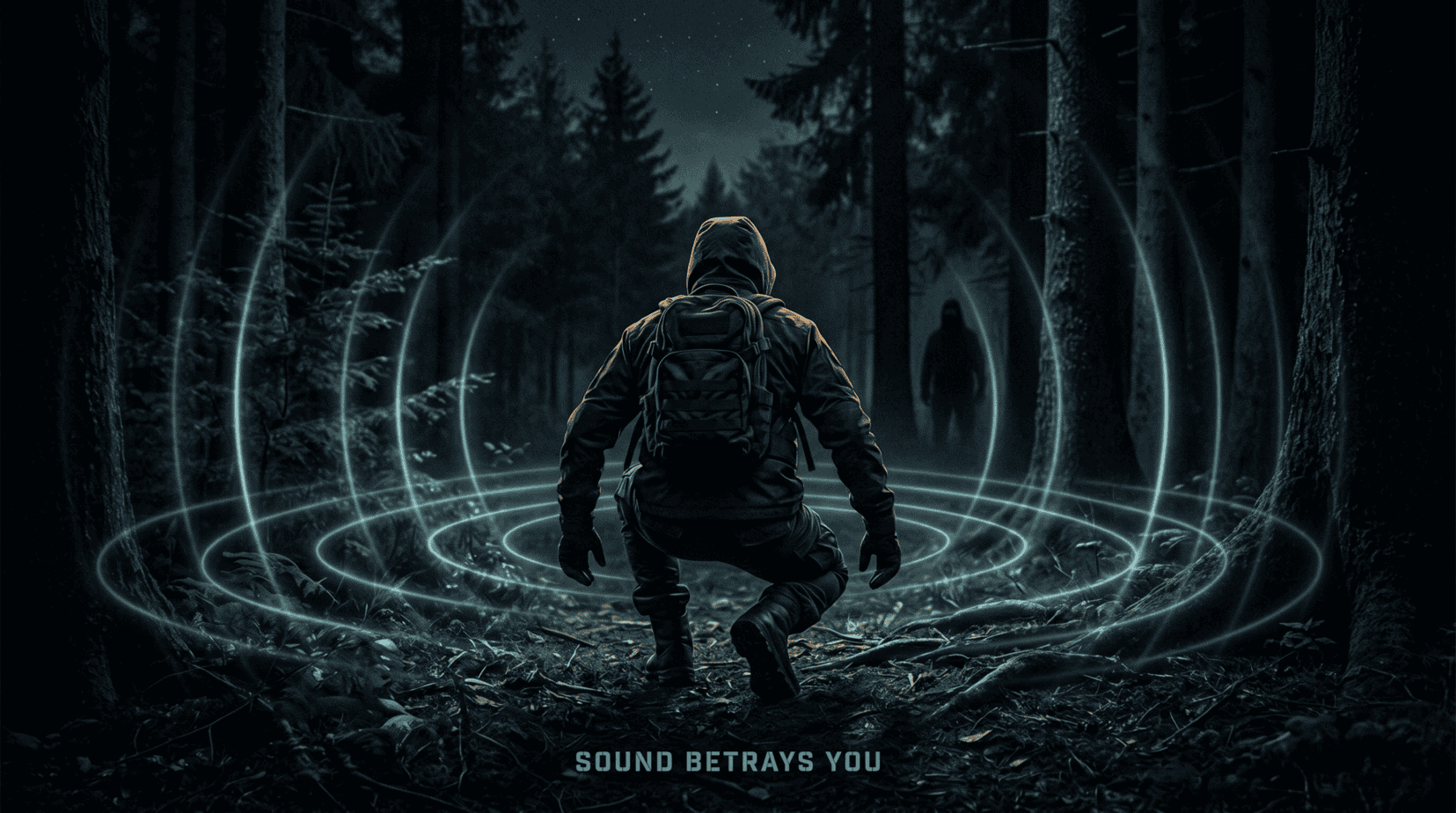
Most people go through their entire lives generating noise without a second thought. Your keys jangle against your hip, your jacket swishes with every step, your phone buzzes on a hard surface, and somewhere down the hall, your generator hums loud enough to wake the neighbors.
In ordinary life, none of that matters much,but the moment you find yourself in a situation where staying undetected becomes a priority, whether that is moving through backcountry wilderness, maintaining operational security in a rural retreat setting, or simply wanting to understand how sound betrays position, all of that casual noise takes on a very different meaning.
Understanding the sounds that give away your location is not just a tactical skill reserved for soldiers and hunters. It is a foundational piece of situational awareness that applies to preppers, hikers, hunters, wildlife photographers, security professionals, and anyone who has thought seriously about what happens when things go sideways.
Sound travels in ways most people dramatically underestimate, carrying information about your presence, your direction of movement, and even your activity, sometimes across distances that would surprise you. The physics behind it are straightforward, but the practical implications require deliberate attention and, frankly, a change in habits.
This guide breaks down the specific sounds that compromise your position, explains why they carry so much farther than you expect, and walks through practical, gear-supported solutions for controlling your noise signature when it genuinely counts.
Why Sounds That Give Away Your Location Travel Farther Than You Think
Before getting into specific noise categories, it helps to understand something about how sound actually works at a physics level. Sound propagates as pressure waves through a medium, in most cases air, and the energy behind those waves diminishes as it spreads outward in all directions. In theory, sound should fade rapidly with distance. In practice, environmental conditions frequently conspire to carry noise much farther than that simple model would suggest.
Temperature plays a significant role. On a cold, still night, sound carries with remarkable clarity because the air is denser and more uniform, reducing the scattering effect that warmer, more turbulent air produces.
Wind direction matters enormously too and if the wind is blowing from your position toward a potential observer, your noise signature travels with it and can stay coherent at distances that would otherwise be well beyond audible range. Humidity, barometric pressure, and the presence of natural acoustic reflectors like valleys, cliff faces, and still bodies of water all shape how sounds that give away your location actually reach other ears.
The U.S. Army has studied this extensively in the context of training ranges and community noise impacts, noting that wind and temperature gradients can bend and focus sound waves toward some areas while dispersing them from others. That same physics applies to your campfire, your generator, your footsteps, and every other noise you produce in the field. Knowing that cold, calm conditions are the worst possible scenario for noise discipline should inform the timing and planning of any activity you need to keep quiet.
The Specific Sounds That Give Away Your Location in Any Environment
Let us get into the meat of it. There is a fairly predictable list of noises that consistently betray position across both natural and urban environments, and most of them are surprisingly controllable once you know what to listen for.
Metallic contact and rattling. This is the single most common noise problem for anyone carrying gear. Loose carabiners, buckles striking each other, keys on a ring, loose ammunition, battery packs sliding around inside a pouch, or a water bottle cap not fully tightened, all of these create irregular, high-frequency sounds that carry well and that the human ear is particularly good at distinguishing from natural background noise.
The sound is distinctly artificial, which makes it especially alarming to anyone who is listening. Military personnel have long addressed this by wrapping metal hardware in paracord, ACE bandage material, or tape, and by packing pouches tightly enough that nothing can move. Civilian gear often lacks this discipline entirely.
Fabric swishing. Synthetic outerwear, particularly older nylon shells and some polyester fleeces, generates a consistent swishing sound with every arm swing and leg movement. It is less sharp than metal contact but equally rhythmic and equally distinctive. In a natural environment where the dominant sounds are wind, water, and wildlife, a regular swishing cadence reads immediately as human movement. Softshell fabrics and wool blends are dramatically quieter, and choosing clothing for stealth is something hunters have understood for generations.
Footfalls and stride pattern. The sound of footsteps on dry leaves, gravel, or hard ground is one of the most universally recognizable sounds that give away your location. Beyond the raw volume of the impact, your gait creates a rhythm, and rhythm is something human auditory processing is wired to detect as significant. Walking more slowly, placing the ball of the foot down first rather than the heel, and choosing paths that avoid crunchy or rocky substrates all reduce your footfall signature substantially.
Voice and coughing. Even conversational tones carry impressive distances in quiet outdoor environments. A normal speaking voice on a calm night can be intelligible at fifty meters and audible at well over one hundred. Coughs and sneezes are harder to suppress but not impossible to muffle with a sleeve or a piece of soft fabric pressed against the face.
Equipment operation sounds. Generator start-up, the clatter of cooking gear, the snap of a tent pole during setup, water sloshing in a half-empty bottle, the mechanical click of a firearm action, the beep of a digital device, the vibration of a phone alert: all of these are sounds that give away your location in ways that can pinpoint not just your general direction but often your specific activity. Filling water containers completely to eliminate sloshing, setting devices to silent mode, and batching noisy activities into single windows rather than scattering them across hours are all habits worth building.

How Clothing Choices Affect Your Acoustic Signature
The gear you wear contributes enormously to your overall noise footprint, and this is an area where most people have significant room for improvement without spending a lot of money.
The primary offenders are stiff, synthetic materials, particularly older-generation rain jackets and tactical shells. These fabrics are designed for durability and water resistance, not acoustic stealth, and they pay for those properties with noise.
Wool is the classic alternative, and it remains relevant for good reason: it is naturally quiet, temperature-regulating, and odor-resistant.
Softshell fabrics represent a good middle ground between weather protection and noise reduction, offering reasonable wind resistance without the crinkle and swish of a hard shell.
Footwear matters almost as much as what you wear on your upper body. Moccasin-style soles and soft rubber soles transmit much less impact noise than hard plastic or rigid boot soles. The thickness and softness of the sole determines how much of your step’s energy gets absorbed versus transmitted as sound through the ground.
For those who need to carry gear, the discipline of packing matters as much as the gear itself. Loose items inside a pack create noise with every movement.
Compartmentalizing your gear, padding metal objects with soft material, and filling void space with soft goods like clothing or sleeping gear all contribute to a quieter setup. A well-organized pack loaded intelligently produces a fraction of the noise of a carelessly loaded one.
Controlling Generator and Mechanical Noise
One of the most common ways people compromise their position in a field or retreat setting is through the operation of generators and other mechanical equipment. The hum of a generator is one of the loudest and farthest-reaching sounds in a quiet rural environment, and it conveys a great deal of information: someone is present, they have electrical power needs, and they have the equipment to meet those needs.
On a calm night, the distinctive engine note of a standard portable generator can be heard from a substantial distance across open ground, and even farther in valleys or other acoustic trapping terrain. This is not a minor consideration for anyone who takes operational security seriously.
There are several mitigation strategies worth knowing. Burying a generator in a trench with adequate air circulation for cooling is a technique used by military units operating concealed command posts, as discussed in training resources on noise discipline. The trench absorbs and deflects sound, dramatically reducing the noise signature at distance without affecting the generator’s performance.
Commercially, the most practical option for most people is a purpose-built inverter generator rather than a conventional open-frame generator. Inverter generators are fundamentally quieter at the engineering level, running at variable speed rather than constant full speed, and encased in acoustic housing.
A Honda EU2200i, for example, operates at around 48 to 57 decibels depending on load, which is comparable to a normal conversation. Compare that to a conventional open-frame generator running at 65 to 75 decibels or more, and the difference in detectability is significant. If generator silence is a priority, the Honda EU2200i is worth every dollar.
Batching your generator use to specific windows, running it during times of day when ambient noise is naturally higher, and using acoustic enclosures or generator tents are additional layers of mitigation that compound each other’s effectiveness.
A generator tent or acoustic baffle box, essentially a vented enclosure lined with sound-absorbing material, can reduce the perceived noise level of even a moderately loud generator by several decibels at distance.
Combining that with thoughtful placement behind a natural berm or a dense stand of vegetation adds another layer on top. No single fix eliminates the problem, but stacking several mitigation strategies together produces results that genuinely change your acoustic footprint at range.
Water: The Sound Source Most People Ignore
Water creates some of the most overlooked sounds that give away your location, and this applies in more ways than most people consider.
The most obvious is a half-filled water container. Whether it is a bottle, a bladder, a canteen, or a metal pot, water sloshing as you move creates a rhythmic, distinctive sound that carries farther than you might expect. The fix is simple: either fill containers completely, leaving no air space for the water to move against, or empty them fully. Anything in between is an acoustic liability.
Beyond containers, the sound of water being used, pouring, filtering, splashing during crossing, cooking with a boiling pot, can all announce your activities to anyone within earshot. Water purification systems that operate silently, like gravity filters or chemical treatment, are meaningfully quieter than anything involving boiling or pump noise. If you must boil water, doing so inside a shelter with some acoustic buffering helps considerably.
Stream crossings deserve special mention. Moving water naturally masks some ambient sound, which is a double-edged situation. On one hand, you can move more noisily in the vicinity of a running stream without the sound carrying far. On the other hand, the noise of crossing, especially splashing and the sound of soaked gear, can project above the baseline stream noise if you are not deliberate about how you approach and execute the crossing.
A quality gravity water filter like the Sawyer Squeeze system lets you filter water in complete silence with no moving parts, no pump noise, and no boiling required, making it one of the most acoustically responsible pieces of gear available for backcountry use.
Communication: The Sounds That Give Away Your Location Most Precisely
Of all the sounds that give away your location, communications rank among the most dangerous from a detection standpoint, for a straightforward reason: they are directional, they are often sustained, and they carry highly specific information.
A conversation, even conducted at low volume, carries not just the fact of your presence but often details about your plans, your numbers, your resources, and your intentions. This was understood in military contexts long before the development of modern surveillance technology, and it remains true in any scenario where maintaining a low profile matters. Military doctrine on noise discipline is explicit: talk only when necessary, use the lowest effective volume, and avoid vocalizing anything that would be damaging if overheard.
The directional nature of voice communication is worth dwelling on. Unlike omnidirectional noises such as a generator hum or a rattling pack, a voice conversation is often audible primarily in the direction it is facing, which can make it easier for a trained listener to triangulate your position with surprising accuracy. Leaning into terrain features, conducting conversations inside enclosed spaces, and using hand signals or pre-agreed visual codes for common exchanges all reduce your voice signature considerably.
Radio communication introduces its own acoustic layer. The squelch break and the burst of transmitted audio from a radio are sharp, distinctive sounds that stand out in natural environments. Using earpieces and keeping transmissions brief and to the point are standard practices for anyone operating with noise discipline in mind. If you are working with a group in a field setting, a good set of two-way radios with earpiece capability keeps communication tight and quiet. The Baofeng UV-5R with a compatible earpiece is a practical and affordable option for coordinated small-group communication without generating a lot of ambient noise from speaker output.
Environmental Factors That Amplify or Suppress Sounds
Controlling your noise output is only half of the equation. Understanding the environmental conditions that affect sound propagation helps you make smarter decisions about when to conduct noisy activities and when to stay quiet.
The relationship between temperature, wind, and sound propagation is well understood in acoustics. As Britannica explains in its coverage of sound physics, low frequency sounds have longer wavelengths and can travel much farther than high-frequency ones, which is why the low rumble of heavy equipment carries across distances that seem improbable. This is directly relevant to choosing when to run engines, when to move heavy gear, and when to conduct activities that generate sustained low-frequency noise.
Terrain shapes the acoustic landscape in powerful ways. A valley acts as a natural amplifier, collecting and focusing sound that would otherwise disperse. A ridgeline can create an acoustic shadow on the downwind side, offering meaningful noise concealment for activities conducted just below it. Water, as discussed, produces masking noise that can cover your activities at short range but does not scale infinitely with distance.
Time of day is one of the most practically useful environmental variables. Background noise levels drop dramatically at night, particularly in rural environments. Activities that are acoustically inconspicuous during the day can be starkly obvious after sunset.
Conversely, dawn and dusk periods often feature wind and bird activity that mask moderate noise levels reasonably well. Planning your noisy activities to coincide with naturally higher ambient noise windows is a simple and effective form of acoustic discipline.
Precipitation is a reliable masking layer for moderate noise. Rain produces broadband noise that covers a wide frequency range, offering meaningful cover for movement and activity. However, the acoustic conditions that follow rain, particularly a calm, cold night after a storm front passes, can be among the worst for noise discipline, with exceptional clarity of sound propagation.
Footwear and Movement Techniques for Acoustic Stealth
Moving quietly is a learnable skill, and the fundamentals have been understood by hunters, trackers, and military scouts for as long as people have needed to move undetected.
The heel-to-toe gait that most people use in daily life is acoustically terrible for quiet movement. It concentrates the impact of each step into the heel strike, transmitting force through hard ground and producing a clear, rhythmic sound. The alternative is placing the ball of the foot down first, feeling the terrain for unstable or noisy material like dry leaves or gravel before committing weight, then rolling the foot back to the heel. This technique takes deliberate practice but reduces footfall noise substantially.
Speed is inversely related to acoustic stealth in most terrain. Faster movement over natural surfaces produces more noise, both through increased impact force and through the inability to test each step before committing. Slow, deliberate movement is almost always quieter, and patience is the central virtue of acoustic discipline.
Vegetation contact creates noise that is easy to overlook. Brushing past branches and stems, stepping through long grass, and pushing through dense undergrowth all produce sounds that are audible at surprising distances in quiet conditions. Moving around obstacle vegetation rather than through it is slower but dramatically quieter.
For footwear, a pair of trail runners or moccasin-style boots with soft rubber soles outperforms hard-soled tactical boots in most quiet-movement scenarios. Some dedicated trackers and woodsmen go even further, carrying a pair of wool socks to pull over their footwear for the quietest possible contact with natural surfaces. Wool against the ground absorbs both sound and vibration in a way that rubber soles cannot fully replicate, particularly on hard packed earth or concrete surfaces.
For those seeking a balance of performance and acoustic discipline, lightweight trail footwear with a flexible sole is generally the right choice. The Merrell Men’s Moab 3 Mid offers a soft rubber outsole that absorbs impact noise considerably better than most hard-shell tactical boots, while still providing meaningful ankle support for uneven terrain.
Building a Personal Noise Audit for Your Gear and Habits
One of the most practical things you can do is conduct a deliberate noise audit of your own kit and behavior, a systematic check that identifies every source of sound you generate and addresses it before you are in a situation where it matters.
The process is simple. Put on everything you would normally carry and wear in a field setting, then move around in a quiet environment, your backyard at night works well, paying attention to every sound you generate. Shake your pack, walk at different speeds and make normal movements like reaching for gear, turning your head, adjusting your clothing. Crouch, stand, roll to one side. You will almost certainly discover sounds that give away your location in ways you had not been aware of before conducting the test.
Common findings from this kind of audit include loose metal buckles that can be taped or replaced with polymer alternatives, pockets containing loose items that can be reorganized or padded, zippers that should be fully closed rather than partially open, and water containers that should be filled completely. The audit also reveals habitual noise, the unconscious clearing of the throat, the tendency to drop gear rather than place it, the habit of talking through problems rather than thinking through them silently.
Beyond gear, the audit extends to behavioral habits. Do you slam your vehicle door when you arrive at a trailhead? Do you talk at normal conversational volume without checking who might be within earshot? Do you operate generators or other mechanical equipment without thinking about the timing? These habits are addressable once you have identified them.
The Psychological Side of Staying Quiet
There is a dimension to noise discipline that goes beyond gear and technique, and it has to do with the mental habits of awareness and impulse control.
Most noise is generated unconsciously. People cough when they feel the urge without thinking about whether to suppress or muffle it. They drop items when they are tired because putting them down quietly requires deliberate effort. They talk when they are anxious because silence feels uncomfortable. They check their phones out of habit and let the notification sounds play because that is what they always do. Breaking these patterns requires sustained attention, and sustained attention is exhausting in a way that most people underestimate.
Military training addresses this through repetition until the quiet behaviors become the default. For civilians, building noise discipline means starting with deliberate practice in low-stakes situations and building the habits before they are needed in high-stakes ones. Walking quietly in your home, deliberately silencing your gear before trips, and making a habit of checking ambient sound levels before making noise are all small practices that compound over time.
Research into how military personnel have historically used sound to locate adversaries, including the development of specialized acoustic listening devices in World War I documented by the MIT Press, shows just how sensitive trained listeners can be to directional sound signatures. The takeaway for anyone trying to control their sound footprint is that you should assume a capable listener, not an inattentive one.
The psychological discomfort of sustained silence is real and should be trained for directly. Practicing extended periods of noise discipline during camping trips or training exercises builds the mental tolerance and the reflexive habits that make quiet movement and operation feel natural rather than effortful. Most people find that after a few dedicated practice sessions, a significant portion of the discipline becomes automatic, reducing the cognitive load of staying quiet during moments when that cognitive load needs to go toward other things entirely.
It also helps to develop a habit of auditory awareness, not just of the sounds you make but of the sounds around you. Understanding the ambient baseline of an environment, what it sounds like when nothing unusual is happening, makes departures from that baseline immediately detectable. This kind of heightened listening is a skill that strengthens with practice, and it serves double duty: it helps you control your own noise, and it helps you detect the noise of others.
My Two Cents
 Here is the honest take after years of thinking about this topic: most people vastly underestimate how much noise they make and how far that noise travels. They plan their operational security around visual concealment and completely forget that their generator, their rattling pack, and their normal conversational voice are broadcasting their position with perfect clarity to anyone who is paying attention.
The good news is that noise discipline is almost entirely a habit problem, not a money problem. The most effective changes you can make cost nothing: filling your water containers fully, packing your gear tightly, choosing slower movement, batching your noisy activities into high-ambient-noise windows, and simply talking less. These adjustments compound quickly into a meaningfully quieter profile.
Where gear does help, it tends to help a lot. Quiet fabrics, properly organized pouches, inverter generators, silent water filters, and earpiece-equipped radios all address specific noise sources with real effectiveness. But gear without disciplined habits is just expensive noise-making equipment. Start with the habits, then layer in the tools.
Whether you are a hunter, a prepper, a backcountry traveler, or someone who simply values being thoughtful about what you broadcast to the world around you, controlling the sounds that give away your location is one of the highest-leverage skills you can develop. It costs mostly attention and practice, and it pays back in ways that are hard to measure until the moment when it genuinely matters.
If there is one thing I would ask you to take away from all of this, it is the value of the noise audit. Go outside tonight with your full kit, move around in the dark for a few minutes, and just listen to yourself. You will hear things you have never noticed before. That awareness alone is worth more than any piece of gear you have at home.
Author Bio
Bob Rodgers is a lifelong outdoorsman, herbalist, and seasoned prepper with over 20 years of real-world survival experience. As the founder of PreppersWill.com, he shares practical advice on self-reliance, off-grid living, and disaster preparedness, no hype, just hard-earned lessons from decades of hands-on prepping.
Other resources worth checking out:
Seven Key Elements Your Home Defense Plan Needs
How to stop bleeding in seconds and other first-aid techniques
