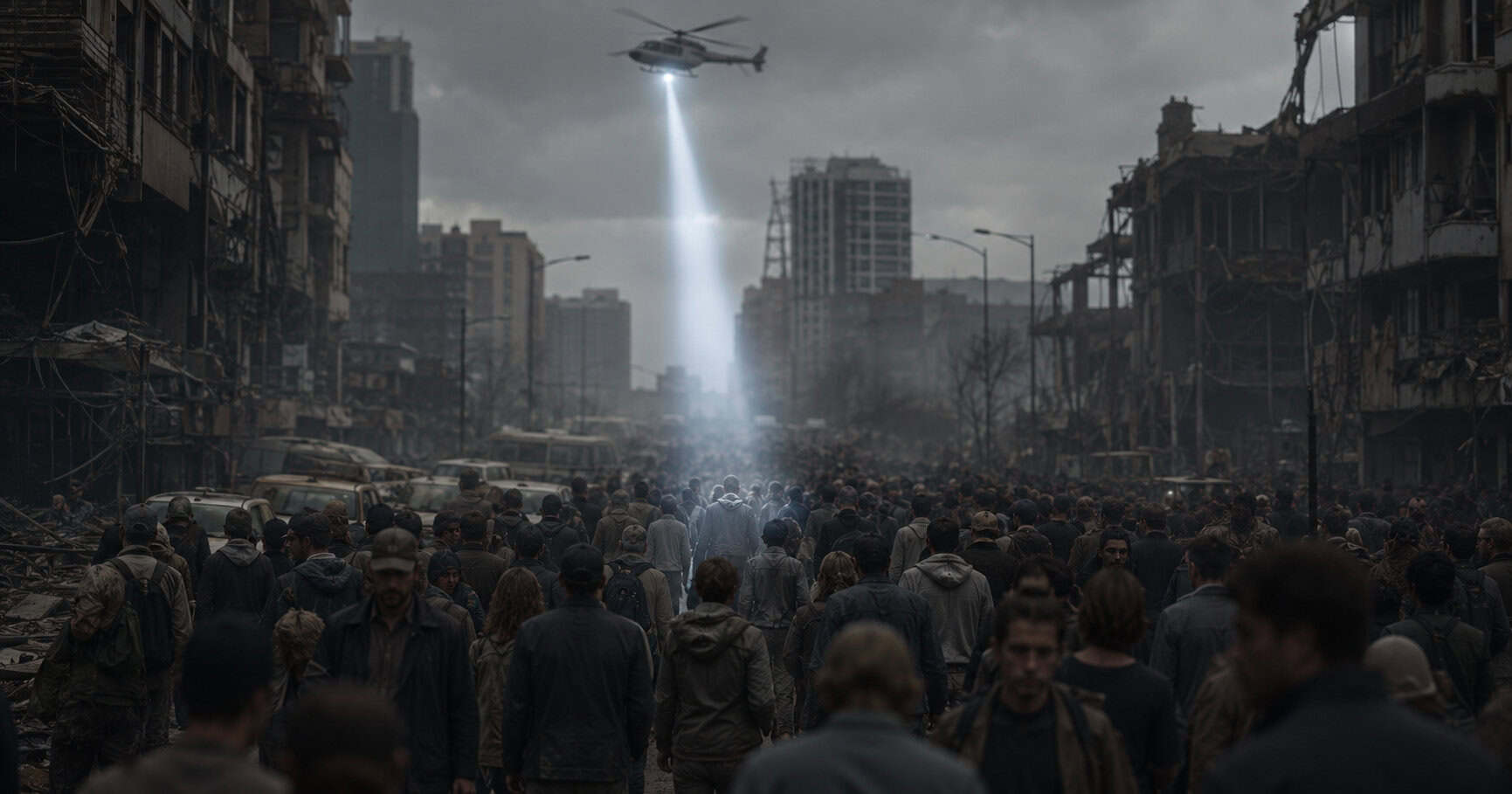
The grey man strategy has become one of the most widely repeated concepts in the prepping and survival community. The idea is elegant in its simplicity: during a crisis, you become invisible.
You wear nothing that signals preparedness, you carry nothing that draws envy, and you move through crowds without triggering a second glance. Proponents argue that in a world turned upside down, the person who looks like just another frightened civilian is far safer than the one who looks like they have something worth taking. And to a significant degree, they are right.
But here is what the grey man strategy evangelists rarely discuss: there are concrete, well-documented scenarios where invisibility stops being a survival asset and starts becoming a liability.
There are situations where being unnoticed means being passed over by the people who could actually keep you alive. There are moments in a crisis where the decision to remain unseen is, functionally, the decision to remain unhelped.
This article is not a takedown of the grey man concept because there is real value in understanding how to blend in, how to move without triggering threat responses in desperate people, and how to protect your resources by not advertising them. However, the grey man strategy, like any single-mode approach to survival, has failure points. Those failure points can be fatal, and almost nobody in the preparedness space talks about them honestly. That changes here.
What the Grey Man Strategy Actually Teaches
At its core, the grey man strategy is about deliberate anonymity. Practitioners learn to choose clothing that is neutral in color, unremarkable in brand, and free of anything military or tactical-looking. They pack gear into ordinary-looking bags rather than molle-laden rigs that scream “I have supplies.”
They study how to move through a crowd without the kind of alert, scanning body language that marks someone as trained or prepared. The goal is to be forgotten the moment you leave someone’s field of view.
This approach draws from real intelligence tradecraft, where operatives working in hostile environments are trained to avoid anything that makes them memorable. It also borrows from basic threat assessment: during a collapse scenario, desperate people gravitate toward those who look capable or well-resourced.
A man with a tactical backpack, a visible holster, and a confident stride in the middle of a disaster zone is advertising himself as either a target or a person others will desperately attempt to follow and negotiate with. Both outcomes complicate survival.
When Invisibility Becomes Danger: Checkpoint Scenarios
One of the most overlooked failure modes of the grey man approach surfaces at checkpoints. In the immediate aftermath of a major disaster or civil unrest event, both government and informal community checkpoints tend to emerge. National Guard units, local law enforcement, and sometimes armed community groups establish perimeter control, especially around resource distribution points, evacuation routes, and safe zones.
At these checkpoints, the grey man works beautifully right up until the moment it does not. The problem is that checkpoint operators are screening for threats, and people who look too carefully unremarkable can trigger suspicion just as easily as people who look obviously tactical. Someone who gives minimal information, avoids eye contact, and carries a bag packed in a way that conceals its contents may pass, or may get pulled aside for a more intensive search.
More critically, checkpoints operated by community organizations or volunteer groups often prioritize helping people who clearly identify their situation and their needs. A person who blends in too effectively may simply be waved through without accessing the water, medical supplies, or information that was available to those who presented themselves clearly. The grey man who gets through the checkpoint without accessing its resources has survived the interaction but missed the opportunity embedded in it.
FEMA’s own guidance on disaster survivor assistance emphasizes the importance of survivors actively presenting themselves to assistance teams, which directly conflicts with the instinct to stay invisible. Invisibility has a cost when resources are being actively distributed to those who can be seen.
Triage Situations and the Grey Man Strategy’s Blindspot
Medical triage in a mass casualty event is governed by protocols designed to identify and prioritize the most salvageable victims as quickly as possible. Systems like START (Simple Triage and Rapid Treatment) work by having responders move rapidly through a scene, assessing breathing, pulse, and mental status. The people who are most likely to receive early intervention are those who are visible, accessible, and communicating.
Research on mass casualty triage published in peer-reviewed emergency medicine literature makes clear that the triage process is extremely fast, resource-limited, and heavily dependent on responders being able to quickly identify who is in distress. A person who has trained themselves to suppress visible signs of distress, to maintain calm body language, and to avoid drawing attention may, in a genuine medical emergency, fail to receive the triage priority their actual condition warrants.
This is not a theoretical concern. The grey man practitioner has often spent considerable time training themselves not to look like they need help, not to appear weak or distressed, and not to be the kind of person who draws the attention of others. These are all excellent skills in a looting scenario. They are counterproductive skills in a mass casualty situation where being overlooked by a first responder could mean dying in a category that did not warrant immediate intervention.
If you or a member of your group is genuinely injured or ill during a crisis, the grey man default needs to be consciously overridden. You need to signal distress clearly and loudly, which runs completely counter to everything the grey man methodology trains you to do.
Community Formation: Why the Invisible Person Gets Left Out
Surviving a prolonged crisis is fundamentally a social exercise. History and disaster research are remarkably consistent on this point: individuals who remain isolated do not survive long-term disruptions as well as those embedded in functioning communities. This is not a soft argument about the importance of human connection. It is a hard, practical observation about how resources, information, security, and labor are distributed in crisis environments.
Communities form around identifiable people. When a neighborhood organizes after a disaster, the people who step forward, identify their skills, and make themselves known quickly become part of the inner circle that makes decisions about resource allocation, watch schedules, and who gets access to what. The grey man who has successfully remained invisible to this process may find themselves treated as an outsider, or worse, as a potential threat, precisely because nobody knows who they are.
Research from the National Institutes of Health on survivor personality factors and social support during emergencies supports the view that disaster survival is primarily a social phenomenon, not an individual one. People who cooperate, communicate, and make themselves known to their communities consistently show better outcomes than those who operate in isolation. The grey man strategy, taken to its logical extreme, produces exactly the kind of isolation that disaster research consistently identifies as a survival liability.
Ready.gov’s community preparedness resources hammer the same point from the government side: community engagement and mutual aid networks are consistently identified as foundational elements of disaster resilience. You cannot participate in a network that does not know you exist.

The Grey Man Strategy Fails When Authorities Are Looking to Help
One of the assumptions baked into the grey man philosophy is that authority figures in a crisis are threats to be avoided. In some scenarios, particularly in cases of civil unrest or authoritarian overreach, this assumption has merit. But in the far more common scenario of a natural disaster or infrastructure failure, government and humanitarian responders are actively trying to locate survivors and deliver assistance.
FEMA Urban Search and Rescue Task Forces, for example, deploy with the explicit mission of locating and extracting survivors from damaged structures and disaster zones. These teams conduct systematic searches, but their ability to find survivors depends enormously on those survivors making themselves visible and audible. The grey man instinct to stay quiet, stay hidden, and avoid drawing attention is directly opposed to the behaviors that improve your odds of being located by a legitimate rescue operation.
This is particularly relevant in scenarios involving structural collapse, flooding, or other situations where survivors may be in locations that are not immediately obvious to searchers. A person who has trained themselves to suppress noise and visibility may suppress exactly the signals that would lead a search team to them. Making yourself heard, marking your location, and in any way signaling your presence is the opposite of the grey man default, and it is also what saves lives in these scenarios.
The Grey Man Strategy and the Problem of Fixed Identity
There is a subtler issue that the grey man strategy tends to create over extended crisis periods, which is the problem of not having an established identity within your social environment when you suddenly need one. People who have cultivated relationships in their community, who are known by their neighbors, who have demonstrated skills or contributed to local networks before a crisis hits, carry enormous social capital into a disaster. That capital is essentially irreplaceable once the crisis begins.
The grey man practitioner who has deliberately kept a low profile, avoided community involvement, and maintained distance from neighbors in the interest of operational security may find that when they need to call in a favor, there are no favors to call in. When they need someone to watch their back during a supply run, there is nobody who trusts them enough to do it. When they need access to a community’s shared resources, they have no standing that would entitle them to ask.
Pre-crisis relationship building is the single most important preparedness investment that the grey man strategy tends to crowd out. You can maintain basic operational security and still be a known, trusted, contributing member of your local community. These things are not mutually exclusive, but the more dogmatic versions of grey man thinking treat community visibility as a pure liability rather than an asset with a complex cost-benefit structure.
Reading the Scenario: When to Disappear and When to Stand Out
The most sophisticated version of the grey man philosophy is not a permanent state but a contextual mode. Skilled practitioners shift between visibility profiles based on threat assessment, which requires genuine situational awareness and the mental flexibility to override trained defaults when the scenario demands it.
The core question in any crisis situation is who has power in this environment and what are they looking for. If the answer is desperate civilians who might recognize that you have food or water, then the grey man approach serves you well. If the answer is organized rescue personnel who are trying to identify and assist survivors, then visibility becomes your best tool. If the answer is a community that is organizing and making decisions about shared resources, then being a known and trusted individual is the asset that the grey man strategy tends to erode.
Building this kind of contextual switching into your preparedness framework requires deliberate practice. It means not just rehearsing how to look unremarkable but also rehearsing how to rapidly shift into high-visibility mode, how to present your identity and skills credibly under stress, and how to establish trust with strangers quickly when you need to. SWAT Magazine’s piece on grey man tactics touches on the idea that going grey is a skill set to be deployed rather than an identity to be adopted permanently.
The Grey Man Strategy in Civil Unrest vs. Natural Disaster: A Different Calculus
The grey man strategy was largely developed with civil unrest and social collapse scenarios in mind, and in those contexts, the calculus is different from a natural disaster. During a riot, political upheaval, or period of widespread violence, the case for invisibility is much stronger. Authority figures may themselves be threats. Community formation may be happening along lines that exclude outsiders violently. The cost of being identified as a outsider, as someone with resources, or as someone who represents a particular group can be extremely high.
Natural disasters and infrastructure failures operate under different social dynamics. Research on trust and social capital after disasters consistently shows that ingroup trust tends to increase after natural disasters, meaning that communities become more cooperative internally even as they may become more cautious about outsiders. If you can establish yourself as part of a community’s ingroup quickly, you benefit from dramatically increased cooperation and mutual aid. If you remain invisible, you may simply remain outside the ingroup boundary.
This distinction matters enormously for how you think about your preparedness approach. A scenario where civil authorities have lost legitimacy and violence is widespread calls for a very different posture than a scenario where a hurricane has damaged infrastructure and neighbors are pooling resources. The grey man practitioner who has one mode for all scenarios is not actually practicing adaptive survival, they are practicing a doctrine that happens to fit certain scenarios and fails in others.
Building a Smarter Framework Around the Grey Man Strategy
The grey man strategy is not wrong. It is incomplete. A genuinely robust preparedness framework incorporates its core insights about low-profile presentation and threat avoidance while building in the situational awareness to recognize when those defaults should be suspended and the skills to execute a different posture when needed.
This means developing what you might call a variable visibility approach. At its foundation is the grey man’s basic toolkit: neutral clothing, low-profile gear, calm body language, and the habit of not advertising your preparations. Layered on top of that is a set of deliberate practices for establishing community relationships before a crisis, signaling for help when rescue is the priority, presenting identity and skills credibly when joining a group mid-crisis, and communicating your situation clearly at checkpoints or to emergency personnel.
Gear selection should reflect this dual requirement. A discreet backpack that conceals its contents should also contain high-visibility signaling tools. A grey man wardrobe should include a compact bright layer that can be deployed when you need to be found. Your EDC should include identification and a brief skills resume that you can quickly present to a community organizing around you.
The grey man strategy at its best is a mode, not a lifestyle. Practitioners who understand this will survive scenarios that pure grey man adherents will struggle with, because they have maintained the flexibility that real crisis environments demand. No single posture survives contact with the full range of scenarios that a genuine long-term emergency will present.
Concluding
I have spent years reading and thinking about preparedness, and the grey man strategy remains one of the most seductive concepts in the space precisely because it feels so clean. Disappear, stay safe, protect your resources. The problem with clean concepts is that real disasters are messy, and they tend to expose the failure points of any single-mode approach.
My honest take is that the grey man philosophy is built on a threat model that overrepresents the danger of other civilians and underrepresents the value of community and rescue systems. Yes, desperate people can be dangerous. Yes, advertising your preparedness is a bad idea. But the version of a crisis where you survive alone, invisible, and self-sufficient, while theoretically satisfying, is not the version that most people will actually face. Most crises involve community responses, aid distribution, search and rescue operations, and the rapid formation of informal social structures that determine who gets what.
Get good at the grey man approach. Learn to move without drawing attention, choose gear that does not signal your preparations, and understand the threat dynamics of a crowd in crisis. Then build the community relationships, the visibility skills, and the contextual judgment that complete the picture. Survival is not a single skill. Treat it like one and the gaps will find you.
 About the Author
David Andrew Brown is a former law enforcement agent with over 30 years of experience in criminal investigations, personal defense, and tactical response. A certified firearm instructor and home protection counselor, he now shares his expertise to help others stay alert, capable, and confident under pressure. “Preparedness isn’t paranoia,” David says. “It’s respect for reality.”
Suggested resources for preppers:
Why Mapping Bug Out Routes Is Vital
The #1 food of Americans during the Great Depression
How To Defend A Bug Out Location
If you see this plant when bugging out, don’t touch it!
