Every prepper bookshelf seems to hold the same handful of foraging books, and most of them were written with a broad national audience in mind. That approach works fine for dandelions and cattails, which look about the same from Maine to Oregon.
It falls apart when the plant or mushroom you want has a poisonous lookalike that only shows up in certain states, certain elevations, or certain months. These regional toxic twins are the reason experienced foragers get nervous when someone tells them they learned everything from one popular guide printed on the other side of the continent.
If you homestead, live off grid, or keep a bug out plan that depends on wild food, the lookalikes growing within walking distance of your property matter far more than the ones pictured in a glossy chapter about common poisonous plants. A family in northern California and a family in West Virginia can both go looking for a white mushroom or a wild onion bulb and face completely different threats. The book in their hands may only warn them about one of those threats, or about a species that doesn’t even grow where they live.
This article walks through some of the most dangerous regional pairings in North America, explains why generic guides so often miss them, and shows you how to build a localized safety system of your own. None of it replaces hands-on training with a local expert, but it will help you ask sharper questions and spot the gaps in the references you already own.
Why Regional Toxic Twins Slip Past National Field Guides
Publishers face a practical problem when they write for a whole continent. A book that covers that much ground has to choose which lookalikes get space, and the natural choice is the species with the widest range or the most famous reputation. A toxic bulb confined to western sagebrush country, or a deadly mushroom that fruits mainly in coastal oak woodlands, might get a single sentence or nothing at all. That editorial math is exactly how regional toxic twins end up underrepresented in the books preppers rely on most.
Taxonomy adds a second layer of trouble. Many older guides lumped several species under one name, and later research split them apart by region. The eastern and western versions of a plant or mushroom can differ in color, habitat, and season, which means a photo taken in Pennsylvania may give an Oregon forager the wrong mental picture. When a guide was last revised decades ago, those splits never reach the reader.
Migration is the third factor, and it cuts both ways. People move across the country or arrive from overseas carrying identification habits that served them well at home. The National Capital Poison Center cautions that mushroom identification skills picked up in one part of the country, or in another country entirely, can’t be trusted in a new area. Plants and fungi move too, hitching rides in nursery soil and on imported trees, then establishing themselves in places where local foragers have no history of dealing with them.
For survival-minded readers, this creates a dangerous blind spot. You may have practiced identification for years and still be completely unprepared for the regional toxic twins growing on the land you just bought. Your general skills carry over, although the species-level knowledge usually has to be rebuilt from scratch. Treat any move, any new hunting lease, and any bug out location as a fresh region that needs its own study, even if the woods look familiar from the road.
Water Hemlock East and West: Two Species, One Deadly Root
Water hemlock has a well-earned reputation as one of the most toxic plants in North America, and it is a textbook example of how regional toxic twins hide inside a single common name. According to the USDA Forest Service, spotted water hemlock (Cicuta maculata) covers most of the continent, while western water hemlock (Cicuta douglasii) takes over in the northwestern United States and western Canada. The same page explains that its toxin, cicutoxin, can bring on convulsions, seizures, and vomiting within about an hour of eating it.
Both species favor wet ground, which is exactly where homesteaders look for water parsnip, angelica, and other members of the carrot family. The eastern plant often shows purple streaking or mottling on the stem, while many western plants look cleaner and greener, so a forager trained to look for spots may relax around a western plant that lacks them. In northern states and Canada, bulblet water hemlock (Cicuta bulbifera) adds yet another variation, with small bulblets tucked into the leaf axils and narrower leaflets than either of its cousins.
A few features hold fairly steady across the range. The leaflet veins tend to run toward the notches between teeth instead of ending at the tips, and the base of the stem, when split lengthwise, usually reveals hollow chambers separated by cross walls. Wild parsnip and water parsnip lack that chambered structure, although you should never rely on a single trait to clear any plant in the carrot family.
If you keep goats, sheep, or cattle, water hemlock is a pasture problem as much as a foraging problem. Walk ditches, pond margins, and spring seeps on your land during early summer when the plants flower, mark every stand you find, and learn whether your area leans toward the spotted, western, or bulblet form. Local knowledge of these regional toxic twins protects your animals and your dinner table at the same time.
Death Camas and the Wild Onion Trap in Western Meadows
Wild onions are one of the first plants many beginners feel confident gathering, and eastern guides often present them as nearly foolproof because the onion smell settles most questions. In the West, that same confidence can land you in an intensive care unit. Death camas, now placed mostly in the genus Toxicoscordion, grows in dry meadows, sagebrush slopes, and mountain grasslands, and its bulb looks remarkably like an onion once it comes out of the ground. It sits near the top of the list of regional toxic twins that eastern-written guides tend to shortchange.
A case report indexed by the National Library of Medicine described seven family members in northeastern Arizona who ate bulbs they believed were wild onion. Their symptoms began within 30 to 60 minutes, starting with nausea, vomiting, and abdominal pain before progressing to a dangerously slow heart rate and low blood pressure. All seven were admitted to intensive care, and two needed medication to hold their blood pressure up. Everyone recovered within a day, which is a far better outcome than many historical poisonings recorded among ranch families and livestock.
The picture gets more complicated in the Pacific Northwest, where death camas often shares wet meadows with edible blue camas (Camassia), a traditional food of many Indigenous nations. While both are flowering, the difference is easy to see, since blue camas carries showy blue to purple flowers and death camas produces clusters of small cream-colored blooms. Once the flowers fade, the leaves and bulbs look far too similar for casual harvesting.
The practical rule for western foragers is simple enough to memorize. Crush a leaf, and if you don’t smell onion or garlic, leave the plant where it grows. Your hands can carry onion scent from a previous plant, so smell each specimen separately and wipe your fingers between samples. Better still, flag camas and onion patches while they bloom and return to those exact spots later, a method that turns regional toxic twins into mapped, predictable hazards you can plan around.
Death Caps and Destroying Angels on the Pacific Coast
No group of regional toxic twins has killed more foragers than the amatoxin mushrooms, and the West Coast now carries a heavier load than much of the country. The death cap (Amanita phalloides) arrived from Europe and spread through California and parts of the Pacific Northwest, often around oaks and planted trees. California also has its own native killer, the western destroying angel (Amanita ocreata), which turns up in city parks and wild oak woodlands alike.
The numbers from California’s most recent season should get every prepper’s attention. A CDC report covering November 2025 through March 2026 counted 39 suspected amatoxin poisonings in northern California, including three liver transplants and four deaths. Investigators noted that many patients had previously foraged similar looking mushrooms in other countries, and the report identifies October through April as the combined peak season for the two species.
That detail captures the whole localization problem. Someone who gathered edible lookalikes for years in Mexico, Eastern Europe, or East Asia built reliable instincts in places where those particular killers didn’t share the same habitat. Carry those instincts into a Bay Area Park after a rainy November and they can turn deadly. Eastern foragers face their own version with the eastern destroying angel (Amanita bisporigera), a pure white summer and fall species that gets mistaken for button mushrooms and young puffballs.
Amatoxins survive cooking, drying, and freezing, and symptoms usually start six or more hours after the meal, sometimes followed by a period of apparent improvement while the liver continues to fail. For anyone planning to live off wild food during a long emergency, the only sensible policy is to exclude white spored, gilled mushrooms from your menu unless a local expert has trained you on the exact species in your county. Always dig up the entire base of any mushroom you collect, since the cup-like volva at the bottom is one of the clearest warning signs and often stays hidden in the soil.
Jack O’Lanterns Posing as Chanterelles Across the Country
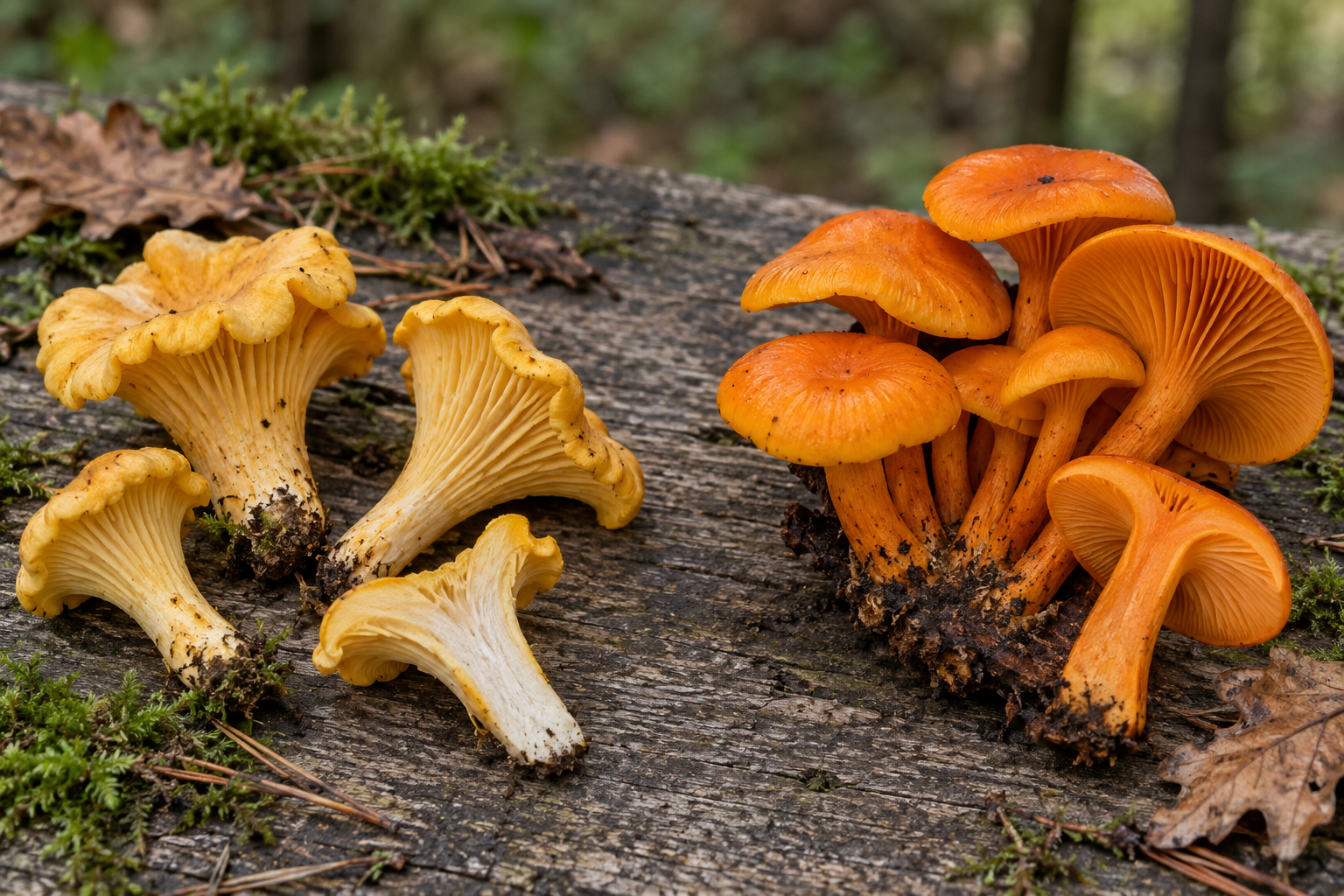
Chanterelles rank near the top of every forager’s wish list, and their most common lookalike shows how regional toxic twins can change appearance from coast to coast. The eastern jack o’lantern (Omphalotus illudens) is bright pumpkin orange and grows in dense clusters at the base of oaks, on stumps, or from buried roots. The western jack o’lantern (Omphalotus olivascens) mixes olive and brownish tones into its orange, which makes it look noticeably different from the eastern photos printed in many popular books.
North Carolina State Extension points out that many older field guides wrongly listed the North American species as Omphalotus olearius, a name that later studies showed belongs to a different mushroom. If your reference still uses that single European name, take it as a sign that its lookalike information may be out of date for your region. The Extension profile also describes gills running down the stalk and a white spore print, both of which make useful checks.
Chanterelles carry blunt, forked ridges that look more like wrinkles melted into the underside of the cap, and they generally grow singly or scattered from soil. Jack o’lanterns have sharp, blade-like gills that fork far less, and the flesh inside the stem usually stays orange all the way through, while a torn chanterelle tends to show paler flesh inside. Clustering on wood is a helpful clue, although buried roots can make a jack o’lantern cluster look like it rises straight from bare ground, so a shortcut based only on substrate can fail you.
Poisoning from jack o’lanterns rarely kills, yet the severe vomiting, cramping, and diarrhea can last many hours. In a grid down situation without easy access to IV fluids, that level of dehydration becomes a genuine survival threat, especially for children and older adults. Foragers in the Southeast should also know that several smaller orange chanterelle species there fruit during the same summer weeks as jack o’lanterns, which puts more pressure on quick decisions than in regions with a shorter, cooler season.
Moonseed, False Hellebore, and Eastern Woodland Deceivers
The East has its own regional toxic twins that western and European books rarely give much attention. Canada moonseed (Menispermum canadense) climbs through thickets and fence lines across much of eastern and central North America, and its dark blue-black fruit clusters look very much like wild grapes in late summer. Moonseed berries are poisonous and have caused serious illness when gathered by mistake, and the vines often tangle together with true grapes, so you can pull both from the same fence row.
Several checks separate the two. Wild grape vines climb with forked tendrils, while moonseed twines its whole stem around supports and has no tendrils at all. Moonseed leaves attach to the stalk slightly inside the leaf edge, and their shallow lobes have smooth margins instead of the toothed edges typical of grape leaves. The most reliable test sits inside the fruit, since a grape holds a few small pear-shaped seeds, while a moonseed berry holds a single flattened seed curved like a crescent moon.
In Appalachia and the Northeast, spring brings a different trap. Ramps are prized, heavily harvested, and increasingly sold at markets, and they emerge in rich, moist woods at the same time as false hellebore (Veratrum viride). False hellebore leaves are strongly pleated along parallel veins and wrap around a thick central stalk, and they carry no garlic smell. Escaped lily of the valley can also turn up near old homesteads, and its smooth leaves resemble ramps closely enough to fool someone who forages by sight alone. Both of these plants can cause dangerous effects on the heart.
Western mountain homesteaders deal with a close relative, California corn lily (Veratrum californicum), which forms large stands in high meadows and is well known for harming livestock. For eastern and western readers alike, the smell test used for wild onions applies equally to ramps, so tear a leaf, sniff it on its own, and reject anything that doesn’t smell unmistakably of garlic.
How Regional Toxic Twins Shift With Elevation, Soil, and Season
Geography is only the first filter you need to apply. Two properties in the same state can host very different regional toxic twins depending on elevation, soil type, rainfall, and how the land has been disturbed. A valley homestead with irrigated lawns and planted ornamental trees may grow mushrooms that never appear on the ridge a thousand feet above it, and a single wet autumn can bring out species that stay hidden through dry years.
Lawns and pastures make the point clearly. The false parasol, also called the green spored lepiota (Chlorophyllum molybdites), is often described as the most frequently eaten poisonous mushroom in North America. It thrives in grassy areas across the South, the Midwest, and warmer parts of the West, and it looks a great deal like edible parasols and shaggy parasols. A spore print usually settles the question, because the false parasol drops a greenish print while its edible relatives drop white. Mature caps show the green most clearly, so young buttons carry extra risk.
Nut trees offer another example. Chestnut plantings are coming back on many homesteads, and buckeyes and horse chestnuts produce shiny brown nuts that look similar once the husks fall away. Chestnuts grow inside a bur covered with dense, needle-sharp spines and usually have a pointed tip with a small tassel, while buckeyes and horse chestnuts form in leathery husks that are smooth or carry only scattered, stubby spines, and their nuts are rounder.
Timing deserves every bit as much attention as location. Western destroying angels can fruit in late winter and spring after many foragers have put their baskets away, and some bulbs can only be separated with confidence while in flower. Record the month and weather conditions each time you find a toxic twin on your property. Over a few years, that log becomes a calendar of risk far more accurate than any national guide, and it tells you which weeks demand extra caution when food stores run low.

Building Your Own Localized Lookalike Notebook
The most reliable foraging reference you will ever own is the one you build yourself for a specific piece of ground. Start with a guide written for your part of the continent instead of a one size fits all national book. Eastern and central readers can lean on the Peterson Field Guide to Edible Wild Plants and western readers will find strong state and regional titles as well. For fungi, pair a continental reference such as the National Audubon Society Field Guide to North American Mushrooms with checklists published by your state mycological society.
Next, call your county extension office and ask which poisonous plants cause the most livestock and human cases in your area. Extension agents and regional poison centers see these patterns every year, and most are happy to share what they know. Join a local mycological society or native plant society, attend their forays, and ask members which regional toxic twins worry them most.
Build the notebook itself around pairs. Give each edible its own page, then list every local lookalike beside it, with distinguishing features, habitat, fruiting months, and GPS coordinates for any stands on your land. Tape in photos of your actual specimens, including roots, stem bases, cross sections, and spore prints, because pictures taken in your own soil and light will match what you see far better than studio shots from another state.
Finally, set household rules and write them on the first page. Nobody eats a new species until two separate identification checks agree. Keep a raw sample of anything wild you cook in the refrigerator for at least a day, so a poison center or hospital has something to identify if someone gets sick. Post the Poison Help number (1-800-222-1222 in the United States) inside your pantry door and in your bug out bag. Those small habits turn scattered facts about regional toxic twins into a system your whole family can follow under stress.
Field Gear That Makes Regional Toxic Twins Easier to Catch
Gear can’t stand in for training, although the right tools make the fine details that separate regional toxic twins much easier to see in the field. A folding jeweler’s loupe with 20x or 30x magnification weighs almost nothing and lets you inspect gill edges, leaf hairs, vein patterns, and the tiny structures that set lookalikes apart.
A dedicated mushroom knife with a curved blade and a brush on the handle helps you dig out the entire base of each specimen instead of snapping it off at ground level, which matters enormously with amanitas. Carry a small trowel for bulbs as well, since telling death camas from wild onion depends on examining the bulb and smelling freshly exposed tissue.
Separate collection containers prevent the quiet disaster of cross contamination. Wax paper bags or small paper sacks let you keep every species apart, so a fragment of a destroying angel never ends up mixed into a basket of edibles. Label each bag on the spot with the location and your suspected identification, and pack a few sheets of black and white paper or a small pane of glass for spore prints back at camp or home.
Your hands need protection during this work as well. Wild parsnip and giant hogweed sap can cause painful burns when exposed skin meets sunlight, and handling unknown members of the carrot family bare-handed is a habit worth breaking early. Durable nitrile gloves pack flat and let you split stems and roots without direct contact. Round out the kit with a waterproof notebook and a phone or GPS unit for marking stands. A loupe, a good knife, clean separation, and careful records give you a repeatable process for checking regional toxic twins, and a repeatable process is exactly what a survival situation demands.
My Two Cents on Foraging Where You Actually Live
After years of walking woods and fields in more than one part of the country, I’ve come to believe that the most dangerous forager is the confident one who just moved. The skills feel portable, the woods look familiar, and the plants seem like old friends. Regional toxic twins don’t care how many seasons you spent hunting chanterelles somewhere else, and they rarely show up in the index of a book written for a different climate.
If you’re serious about wild food as part of your preparedness plan, spend your first full year on new land learning the poisons before you harvest a single edible. Walk the property every month, photograph everything, and let local experts correct you while mistakes are still cheap. Keep your notebook honest, including the times you guessed wrong.
I’d also urge you to treat wild mushrooms, especially white spored gilled species, as a privilege you earn slowly, one verified species at a time. Greens, berries, nuts, and roots you have verified on your own property will carry a family much further in hard times, with far less risk attached. Learn your ground, respect the local lookalikes, and that land will keep feeding you for a very long time.
Author Bio
Bob Rodgers is a lifelong outdoorsman, herbalist, and seasoned prepper with over 20 years of real-world survival experience. As the founder of PreppersWill.com, he shares practical advice on self-reliance, off-grid living, and disaster preparedness, no hype, just hard-earned lessons from decades of hands-on prepping.
Other Useful Resources:
Drinking Water Survival Myths You Should Know
How to obtain water from the air
The Impacts of Water Scarcity in Major Cities
Knowledge to survive any medical crisis situation during a major disaster
