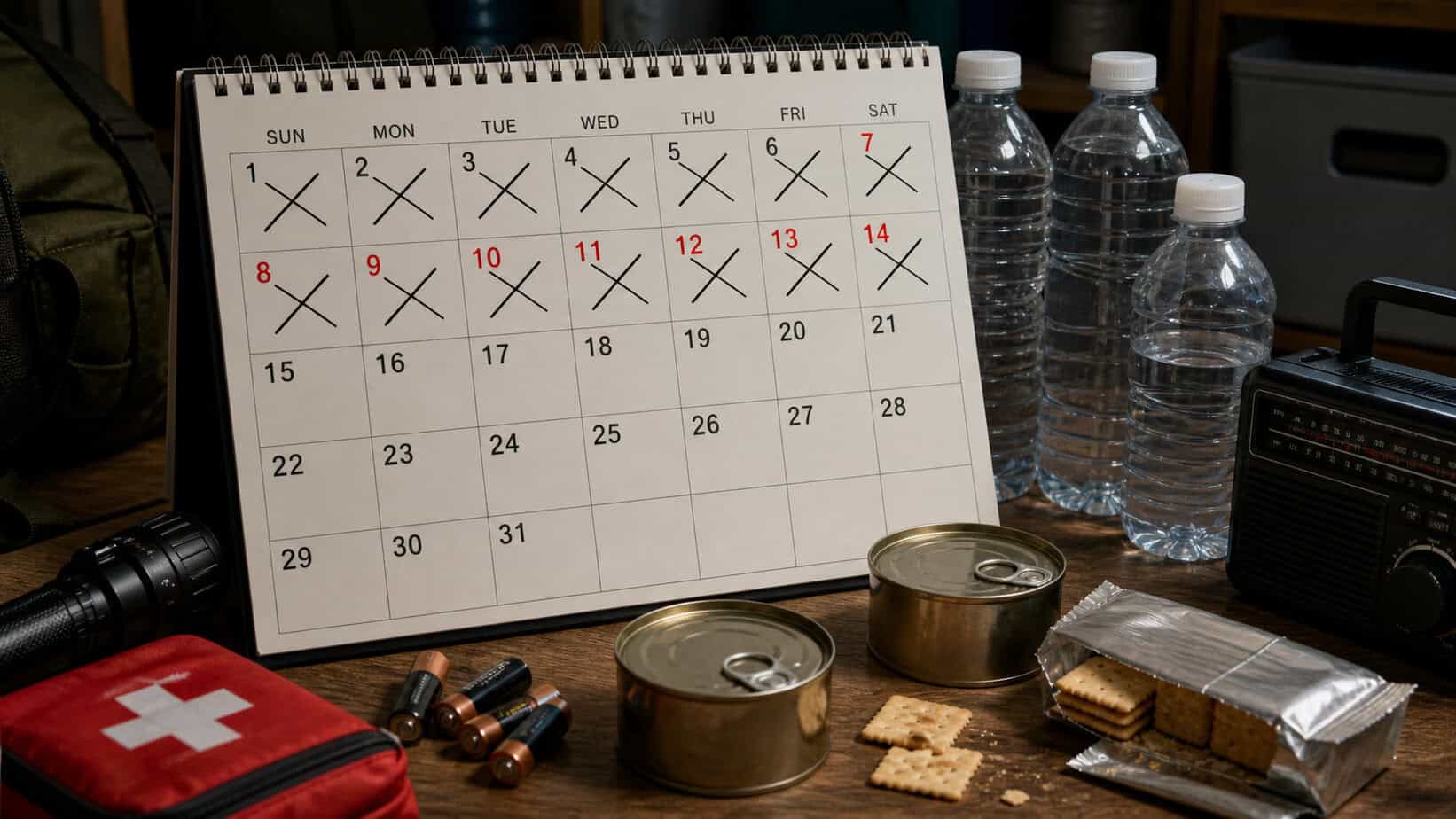
Most people who put together an emergency kit feel a quiet satisfaction afterward. They have their 72-hour bag, a few gallons of water, some canned goods, a flashlight with fresh batteries, and maybe a printed family plan tucked into a binder.
That sense of readiness feels solid, even responsible, but experienced survivalists, emergency managers, and disaster recovery specialists all point to the same blind spot that catches prepared households completely off guard: the second week survival problem.
When a crisis stretches beyond the first three to five days, nearly every standard preparedness plan begins to quietly unravel. Water runs lower than expected, the morale dips and sanitation become a real issue. Those medical needs that seemed manageable now turn urgent and the food supply, though technically sufficient in calories, starts generating conflicts over choice and variety.
The second week survival problem is not about some catastrophic oversight. It is about the gap between how long emergencies actually last and how far most plans are genuinely designed to go. Disasters like hurricanes, extended power grid failures, infrastructure collapses, and prolonged civil disruptions routinely push well beyond that initial three-day window. Understanding where plans break down and what to do about it before it happens is the difference between surviving and truly weathering what comes.
Why the 72-Hour Rule Was Never the Whole Story
The 72-hour preparedness standard has been the go-to benchmark for emergency agencies for decades. It grew out of reasonable assumptions about how quickly government and community resources could mobilize after a localized disaster. FEMA’s own guidance on building an emergency supply kit recommends stocking enough food and water for several days as a starting baseline. The problem is that this baseline was never intended to represent the ceiling of what you might need. It was always meant to be the floor.
Real-world disasters have a habit of not reading the script. Hurricane Katrina left parts of Louisiana and Mississippi without viable infrastructure for weeks, not days. The 2021 Texas winter storm knocked out power and water for millions of households for a period that stretched well past any 72-hour assumption.
Wildfires, flooding events, and ice storms have all demonstrated that the period during which you are truly on your own can extend in ways that feel almost surreal to people who thought they were prepared. Once you understand that three days of supplies is the starting point, not the end goal, the entire way you think about preparedness shifts.
Experts who study long-duration emergencies consistently note that the hardest transition is not from day one to day three. It is from day five to day seven, and then from day seven into the second week. Each stretch introduces new resource pressures, emotional fatigue, and logistical challenges that most standard plans simply do not address. Building a genuine two-week capability requires thinking through those later stages now, while you still have the time and resources to do so.
The Second Week Survival Problem Begins with Water
Water is where most emergency plans first crack under the pressure of a prolonged event. The math that works for 72 hours stops working by day eight or nine, especially in households with children, elderly family members, or anyone who is physically active during the crisis.
The CDC recommends storing at least one gallon of water per person per day for drinking and sanitation, and notes that this baseline can double under conditions of heat or physical exertion. For a family of four, that means a minimum of 28 gallons for a single week, not counting the inevitable extras used for basic hygiene, cooking, and cleaning.
Most households that have “enough water” for an emergency have somewhere between two and four gallons stored per person. That covers drinking for a couple of days, but it leaves almost nothing for wound cleaning, food preparation, or the basic dignity of washing your hands properly. During the second week survival problem, this shortage becomes acute. People start rationing water at levels that create secondary problems: dehydration-related fatigue, infections from improper hygiene, and contamination of food supplies.
The solution requires two parallel tracks. First, store more water than you think you will need, aiming for a two-week supply at a minimum. Second, invest in a quality water filtration and purification system that can process water from non-standard sources such as rain collection, nearby ponds, or municipal lines that may be running but unverified for safety.
Food Fatigue: The Hunger That Plans Do Not Anticipate
Calories are easy to count on paper but morale is harder. Emergency food planning almost universally focuses on meeting basic caloric needs while overlooking the psychological reality of eating the same limited options day after day. By the end of the first week, and certainly into the second, food fatigue sets in with a force that most people genuinely underestimate.
Children become resistant to eating. Adults start skipping meals rather than consuming foods they find unpalatable. Caloric intake drops not because the food is unavailable, but because the will to eat it has eroded.
The second week survival problem in food terms is a morale problem as much as it is a nutrition problem. Comfort, variety, and even small indulgences take on outsized importance when everything else in the environment feels unstable and stressful. This is why survival experts consistently recommend including high-morale foods alongside the staple calories.
Things like instant coffee, hot chocolate packets, hard candy, peanut butter in individual portions, and shelf-stable crackers may seem trivial in a planning spreadsheet, but they serve a genuine psychological function during prolonged stress.
From a practical standpoint, variety and rotation matter enormously. Build your two-week supply around a rotation of at least ten to fifteen different meal bases so that no single item appears more than twice in a week. Freeze-dried meal options like Mountain House meals offer a surprisingly broad range of flavor profiles and can be prepared with minimal water, which also helps address the water conservation challenge. Pair these with shelf-stable protein options and a diverse range of snacks, and the caloric math holds up without the psychological collapse.

Medical Needs Become Critical After Day Seven
Most standard first aid kits are designed for acute injuries: cuts, burns, sprains, and minor infections. They are not designed for the chronic medical management that becomes essential when an emergency stretches into its second week.
A person who takes daily medication for blood pressure, diabetes, thyroid conditions, or mental health management will face serious consequences if their supply runs out on day five of a fourteen-day event.
Someone with asthma may burn through their rescue inhaler well before conditions normalize. A diabetic dependent on refrigerated insulin faces an entirely different category of crisis when power stays out long enough.
The second week survival problem around medical needs often catches people off guard precisely because these are not dramatic medical emergencies. They begin quietly as missed doses and delayed treatments, then compound into genuine health crises over time. Preparing for this requires having direct conversations with your healthcare providers before an emergency happens. Ask specifically about emergency supplies, extended prescription refills, and guidance on medication management during a prolonged power outage.
Beyond prescription needs, general medical supplies run thin faster than most people realize. Bandages get used, antiseptic runs out, and over-the-counter medications that seemed like plenty on day one become scarce by day ten. A well-stocked trauma kit, such as the MyMedic MyFAK First Aid Kit, provides a much deeper supply base than the average drugstore first aid box. Pair it with a comprehensive manual on wilderness medicine or extended care, because when professional medical help is not accessible, knowledge becomes your most important tool.
Power Outage Planning That Accounts for Two Full Weeks
The American Red Cross recommends storing non-perishable food and water supplies for at least two weeks specifically because power outage events routinely last beyond the 72-hour window that most kits are designed around. An extended power outage cascades through every other preparedness category simultaneously. Food safety becomes an immediate concern the moment refrigeration stops. Heating and cooling systems fail. Medical devices stop functioning, communication becomes harder without charged devices and lighting disappears.
Managing a multi-week power outage requires addressing all of these categories in advance. For food, the priority is using perishables in the first 24 hours before they spoil, then transitioning to your shelf-stable supplies in a planned rotation.
A good cooler loaded with block ice can extend refrigerated food safety by several days, buying time for the transition. For heating in cold climates, safe indoor-rated propane heaters or wood stove systems become essential. For cooling in hot climates, wet towels, shade management, and cool water access become survival priorities that go well beyond comfort.
Power generation at the household level has become significantly more accessible in recent years. A solar generator like the Jackery Explorer 1000 can power small appliances, charge devices, run CPAP machines, and maintain some level of functional normalcy during an extended outage.
While it will not replace a full grid connection, it dramatically changes the quality and safety of a two-week outage situation. Pairing solar panels with a quality battery bank means renewable recharging even when fuel for conventional generators becomes unavailable.
Sanitation: The Problem Nobody Wants to Talk About
Sewage systems, trash collection, and basic hygiene infrastructure are so woven into daily life that most people genuinely do not think about them as utilities that can fail. But when water pressure drops, when municipal sewage systems back up, or when the power that drives lift stations goes out, the sanitation situation in a home or neighborhood can deteriorate rapidly.
Within a week of a major infrastructure disruption, this becomes one of the most serious public health threats facing communities. Historical disaster records show that disease outbreaks following natural disasters are frequently driven by sanitation failures rather than by the disaster event itself.
The second week survival problem in sanitation terms means thinking through toilet function, waste disposal, hand hygiene, and garbage management as if they were all offline simultaneously. For toilet function, a simple solution is a five-gallon bucket with a toilet seat lid and heavy-duty bags, combined with a supply of kitty litter or commercially available waste treatment powder to manage odor and break down organic material. Waste should be sealed in individual bags and stored in a designated outdoor location away from water sources until collection becomes possible.
Hand hygiene during a water-limited period deserves specific attention. Alcohol-based hand sanitizers are effective for general surface cleaning but they do not replace soap-and-water washing for removing organic contamination. Storing a supply of no-rinse body wash, biodegradable soap bars, and wet wipes allows for meaningful hygiene maintenance even when running water is limited. These are not luxuries. Proper hand hygiene is one of the highest-impact health interventions available during an emergency, and neglecting it over a two-week period creates genuine infection risk.
The Second Week Survival Problem and Psychological Resilience
Physical resources matter enormously, but the psychological dimension of a prolonged emergency may be the factor that determines outcomes more than any other. The World Health Organization notes that nearly all people affected by emergencies experience significant psychological distress, and that this distress tends to intensify rather than resolve as the event extends beyond the first few days.
Anxiety, irritability, decision fatigue, conflict within households, and a deteriorating sense of control are normal responses to abnormal circumstances, but they become active threats to group survival if left unaddressed.
During the second week of a prolonged emergency, the initial adrenaline that carried people through the first phase has long since dissipated. What remains is exhaustion, uncertainty, and the grinding awareness that the situation has not resolved. Children in this environment become harder to manage. Adults become shorter with each other and decision-making quality degrades. The person who seemed most capable during the first few days may be the one who hits the wall hardest during the second week because they were running on reserves they did not replenish.
Building psychological resilience into your emergency planning means accounting for rest, routine, and social connection. Establish daily structure even when there is no external schedule to anchor to. Designate rest periods and create small rituals around meals and morning and evening routines. Maintain connection with neighbors and community members even if only through brief check-ins. Physical activity, even a short walk around the block, provides a significant mood and cognitive boost during high-stress periods. Bringing entertainment items like card games, books, and puzzle books into your preparedness kit is not a frivolous afterthought. They are genuine tools for emotional sustainability.
Community Networks: Your Most Underutilized Survival Resource
The most resilient communities during extended emergencies are not the ones where every individual household is maximally stocked. They are the communities where neighbors know each other, communicate openly, and pool resources in organized ways.
A single household may run out of a critical supply by day nine, but a neighborhood network of eight households with slightly different stockpiles and skills can cover each other’s gaps for considerably longer. This is not simply a heartwarming observation. It is a survival reality that emergency management professionals return to consistently when analyzing disaster outcomes.
The second week survival problem is significantly softened when a community network is already in place before the crisis begins. This means knowing your neighbors before anything happens. It means understanding who among them has medical training, mechanical skills, generator experience, or agricultural knowledge. It means establishing communication protocols so that when something goes wrong, help is not a random hope but a coordinated response. Neighborhood preparedness groups, whether formal community emergency response teams or informal neighbor alliances, dramatically increase the effective resources and resilience available to everyone involved.
Think about what your household contributes to a community network as well as what it draws from one. Skills, tools, surplus supplies, physical labor, and knowledge all have value in a crisis economy. Establishing those relationships of mutual trust and reciprocity before a disaster strikes means they are available when needed rather than having to be built from scratch under the worst possible conditions.
Security and Resource Management During Prolonged Events
Security during an extended emergency is a topic that many preparedness resources treat as taboo, but ignoring it does not make the reality disappear. As a crisis extends past the first week, social dynamics shift in ways that can affect the safety of individuals, households, and communities.
This is not a call for paranoia or aggressive posturing, but a recognition that resource scarcity, uncertainty, and breakdown of normal social controls create conditions where conflict can emerge even among people who were perfectly cooperative under normal circumstances.
Managing security during the second week survival problem comes down to visibility and community. Households that are visibly embedded in a caring, organized community are significantly less vulnerable than isolated households with obvious supplies. Being discreet about what you have stored is genuinely prudent. Maintaining relationships with neighbors means there are people who are watching out for you and for whom you are watching. Establishing neighborhood watch rotations and communication chains distributes both the responsibility and the protective benefit.
Communication infrastructure during this period matters enormously. When cell networks fail or become overloaded, a battery-powered or hand-crank weather radio becomes your primary link to official information and emergency alerts. Knowing what is happening, where resources are available, and when conditions are expected to change is itself a security resource of the first order.
The Second Week Survival Problem: Building a Plan That Actually Lasts
The gap between a 72-hour kit and a genuine two-week readiness capability is smaller than most people assume, but it does require deliberate planning rather than simply scaling up the standard checklist. Start by auditing what you currently have against a genuine fourteen-day requirement for every person in your household. Calculate water, calories, medication, sanitation supplies, and power needs specifically for that duration. Then identify which categories come up short and prioritize filling those gaps first.
Understanding the food safety timeline for refrigerated and frozen goods means you can extract maximum value from your perishables before they are lost, rather than having to make judgment calls under stress without information.
The second week survival problem is solvable with preparation, but it requires accepting that most standard emergency guidance addresses only the beginning of what a real crisis can look like. Two weeks of supplies, a network of trusted neighbors, a medical plan for ongoing conditions, a water sourcing and purification strategy, and intentional attention to psychological wellbeing are the elements that transform a fragile preparedness plan into one that can sustain a household through the hardest part of any prolonged emergency. The time to build that capability is now, not in the first anxious hours after a disaster strikes.

My Two Cents
I have spent a lot of time thinking about preparedness, and the conclusion I keep coming back to is this: most of us are not actually preparing for emergencies. We are preparing for the idea of emergencies, which is a fundamentally different thing. The idea of an emergency is brief, dramatic, and resolved by capable authorities within a few days. The reality of an emergency, especially the prolonged kind that genuinely tests households and communities, is slower, duller, more exhausting, and far more demanding than that narrative allows for.
The second week survival problem is not a scare tactic or a fringe prepper concern. It is the honest gap between what most people have prepared for and what real disasters actually require. Closing that gap does not demand a bunker mentality or a dramatic overhaul of your lifestyle. It demands honest accounting, deliberate extension of your supplies and systems to cover fourteen days rather than three, and the cultivation of community relationships that multiply everyone’s resilience. Start where you are, extend what you have, build the connections around you, and take the second week as seriously as the first. That shift in thinking is where genuine preparedness begins.
Author Bio
Bob Rodgers is a lifelong outdoorsman, herbalist, and seasoned prepper with over 20 years of real-world survival experience. As the founder of PreppersWill.com, he shares practical advice on self-reliance, off-grid living, and disaster preparedness, no hype, just hard-earned lessons from decades of hands-on prepping.
Other resources:
What you should know about survival foods with decades of shelf life
The Foods that helped the pioneers survive crop failures and hard times
Survival Foods of the Native Americans
If you plan to build a storage room and equip it with everything needed > Start Here!
We have actually been in big emergencies more than we care to recall! 3 Cat 5 hurricanes. We were both emergency services, but we also went home to deal with the disaster. About 25 other storms.
What I can tell you that even in Hurricane Andrew in 1992, there was NO help from the government for 2 weeks. NONE. When they did come, they were useless. Same for Charley in 2004
Recently Hurricane Ian- They flew in Chinook Helicopters to evacuate all of us from our perfectly good island homes- leaving them to thieves! They bragged that the helicopters came in empty rather than bringing us supplies- which most of us didn’t need. We all wore side arms or carried long guns. They got the message, but still no help.
Evacuate to a shelter? Worse. Toilets overflow in hours.
What you imagine doesn’t compare to reality. We lived 6-9 months off the grid for 22 years. Sailing and camping. So, we have the “no services” thing down. But, few people are us.
After Andrew I overheard some of my guys chatting. They wondered how “Sarge” was doing with no power. One said “Sarge? She probably hasn’t noticed.” He was right.
People prep with the idea they will live normally or close to it. Nope. Not at all. After Ian we had a TV antenna, but there was NO phone, text, or contact from the outside world. We have a VHF radio. Those types of radios will work IF someone else is there.
Mostly, you are on your own.
Just do your best. If you do that, you will be better off than 99% of others. THAT is a promise.
Keep trying.