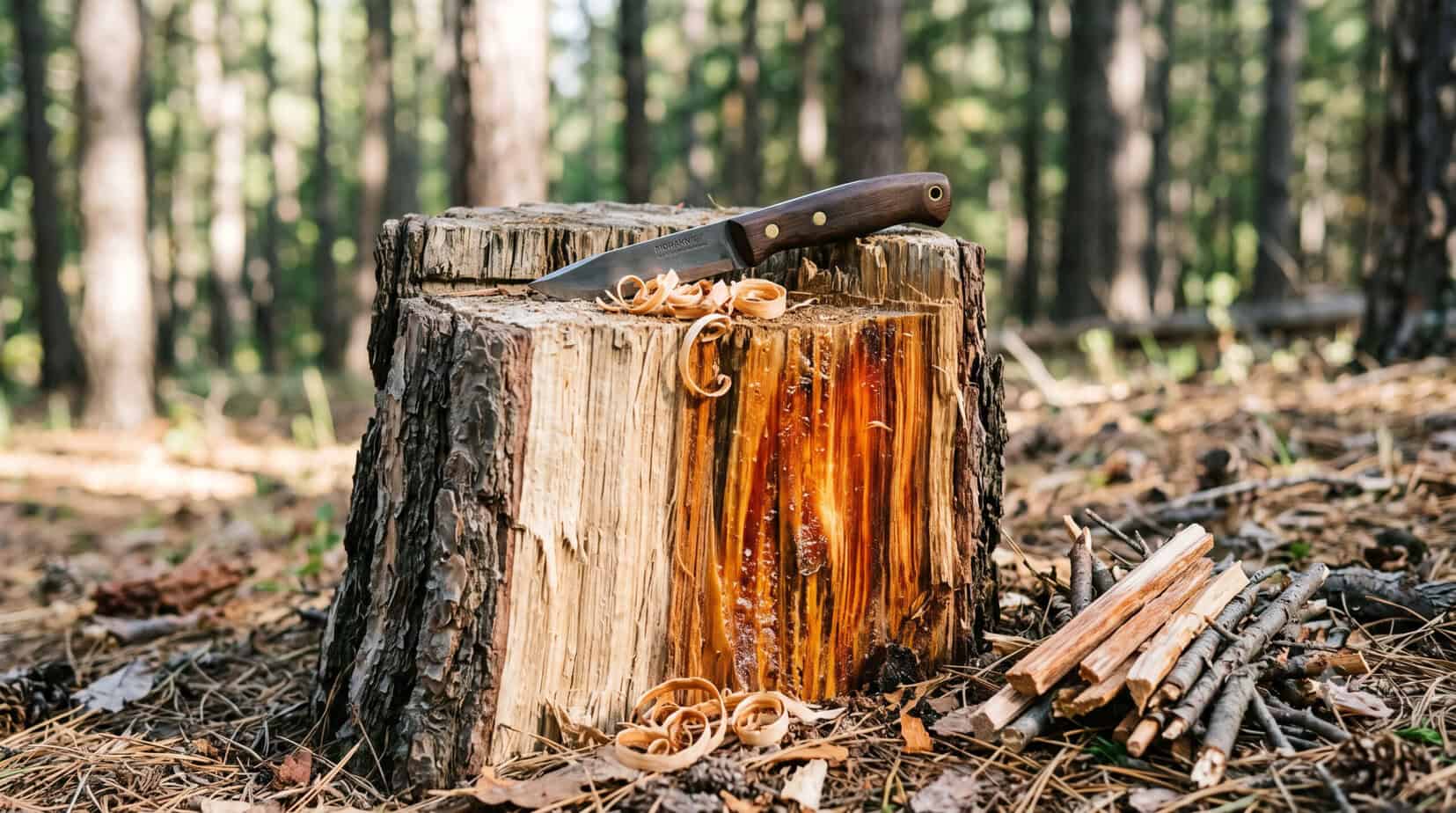
Anyone who has spent time around campfires or bushcraft forums has heard the promise: find a pine stump, shave off a few slivers, and you have an instant fire starter that lights even in the rain.
That promise sits at the heart of what I call the fatwood myth, the widespread belief that almost any old pine stump, dead branch, or weathered knot is packed with the same resin saturated wood that made longleaf pine famous across the American South.
In reality, resin concentration varies wildly between species, climates, and even individual trees, and a large share of the “fatwood” people harvest in the field barely smolders once the match goes out. The confusion is understandable. Pine resin has a distinctive smell, pine wood grows almost everywhere in temperate forests, and the internet is full of confident guides that treat every conifer stump as interchangeable. But genuine fatwood, sometimes called fat lighter, lighter knot, or pine knot, only forms under specific conditions, and the species most associated with it, longleaf pine, has a native range concentrated in the southeastern United States.
Outside that region, and even inside it on the wrong tree, what people are cutting into is often just ordinary, low resin pine that happens to look similar from a distance. This article breaks down where the fatwood myth comes from, why regional misidentification is so common, and how to actually test a stump before you stake your fire on it. Along the way we will look at the traits that separate genuine resin rich wood from wishful thinking, along with gear worth carrying so you are never left guessing in the field.
The Fatwood Myth That Refuses to Die
Ask ten different outdoorsmen where to find fatwood and you will likely get ten different confident answers, most of which contradict each other once you compare details. This is the essence of the fatwood myth: a piece of folk knowledge that spread so widely through survival shows, camping blogs, and word of mouth that it eventually became detached from the biology that actually produces resin rich wood.
Somewhere along the way, “look for an old pine stump” turned into “any pine stump will do,” and that shortcut has sent countless campers home with a pocketful of wood that never lights the way they expected.
The myth persists partly because pine resin genuinely smells similar across species, so a mildly resinous chunk of wood can still give off a convincing pine scent without containing anything close to the saturation needed for reliable ignition. It also persists because televised survival experts often work in regions naturally rich in resinous pine, and viewers elsewhere assume the same trick transfers directly to their local woods.
The fatwood myth is not really about dishonesty, it grows out of oversimplification, the kind that happens when a niche skill gets flattened into a one line tip for a much wider audience than it was ever meant for. Once you understand that resin content depends on species, tree age, how the wood died, and how long it sat exposed to the elements, the appeal of a universal shortcut starts to fall apart, and you begin to see why testing matters far more than trusting a rule of thumb passed along secondhand.
Why Not Every Pine Stump Is a Resin Jackpot
Pine resin exists for a biological reason, and understanding that reason helps explain why the fatwood myth leads so many people astray. Resin is a defensive compound that a tree produces in response to injury, insect attack, or fungal infection, and healthy pines generally only manufacture as much as they need to seal a wound rather than saturating their entire trunk.
Some species, particularly longleaf pine, have historically produced far more resin than others because of how their heartwood develops with age, which is why the naval stores industry of the American South built entire economies around tapping and harvesting that specific tree.
Other pines, including many common ornamental and plantation species, simply were never selected or evolved to concentrate resin the way longleaf does, so their stumps decay into fairly ordinary, low density wood with only faint traces of pitch near old wounds.
When someone applies the fatwood myth to a random stump in their backyard or a local park, they are gambling on a species specific trait that may not exist in that particular tree at all. Age matters too. A stump that died last season has not had time for resin to migrate and concentrate the way it does in wood that has weathered for a decade or more, a process the U.S. Forest Service has documented in its fire ecology research on southern pine species. Without that time, and without the right species to begin with, you are simply looking at dead wood that happens to belong to the pine family, nothing more.
Regional Confusion: How Different Pines Get Mistaken for the Real Thing
Geography plays a bigger role in this conversation than most people realize, and it is one of the main engines behind the fatwood myth. Longleaf pine’s native range runs through the Atlantic and Gulf Coastal Plains, from southeastern Virginia down through Florida and west into Texas, historically covering tens of millions of acres before logging reduced it to a small fraction of its original footprint, as documented in the Forest Service’s own silvics records for the species.
Someone hiking in that region who finds an old, weathered stump has a genuinely reasonable chance of encountering real fatwood. Someone hiking through the upper Midwest, the Pacific Northwest, or most of Europe is working with an entirely different set of species, many of which never developed the same resin concentration, yet the same identification tips keep getting repeated as if they apply everywhere on earth.
Lodgepole pine, red pine, and Scots pine can all produce pockets of resinous wood around old wounds and branch junctions, but the saturation tends to be patchier and less predictable than what longleaf offers in its home range.
This mismatch between where a piece of advice originated and where someone is trying to apply it explains a huge share of the disappointment people report after following generic online guides. The wood they cut into looks similar from across the clearing, smells vaguely of pine once split, and still fails to ignite reliably, which only reinforces confusion rather than correcting it for the next person who tries the same approach.
The Fatwood Myth Spreads Through Bad Online Advice
Search engines and social platforms have accelerated the spread of the fatwood myth in ways that older, regionally specific woodcraft knowledge never really faced. A single popular video or blog post describing how to find fatwood in the Southeast gets shared and reposted across forums serving audiences in completely different climates, and the caveats about species and range often quietly disappear along the way.
Content written for search visibility tends to favor short, universal sounding claims because they perform well with broad audiences, even when the underlying reality is far more conditional than the headline suggests. Phrases like “any dead pine stump will work” get repeated so often that they start to feel like established fact rather than a regional generalization that only holds true under fairly specific conditions.
Compounding the problem, many guides recycle the same handful of photographs and descriptions without verifying whether the wood pictured actually tested positive for high resin content, so readers end up learning to recognize a general look rather than a genuinely reliable indicator.
This is not a call to distrust every outdoor resource, plenty of experienced writers get the details right, but it is worth reading critically and cross-checking claims against your own region’s tree species before heading out expecting guaranteed results.
The fatwood myth thrives specifically in that gap between confident online instructions and the messier, more variable reality of actual forests, and closing that gap starts with knowing which questions to ask before you swing a hatchet into a random stump.
What Real Fatwood Looks, Smells, and Feels Like
Before testing a stump, it helps to know what you are actually hoping to find, since a clear mental picture cuts through a lot of the guesswork that fuels the fatwood myth. Genuine fatwood tends to carry a deep amber, orange, or reddish brown color that stands in obvious contrast to the pale, straw colored wood surrounding it, and the difference is usually visible the moment you split into a stump rather than something you have to squint to notice.
It feels noticeably heavier for its size than ordinary dry wood, a direct result of resin filling the wood’s cell structure, and fresh fatwood can feel slightly tacky or sticky to the touch, while older material hardens into a dense, almost waxy texture over time, a distinction bushcraft instructor Paul Kirtley describes in detail from his own fieldwork across pine forests in Scotland and Scandinavia.
The smell is another strong indicator, a sharp, sweet, turpentine like scent that is far more pronounced than the faint pine aroma given off by ordinary sapwood. Look specifically at the base of dead stumps, at the taproot area just below the soil line, and at the junctions where large limbs once met the trunk, since resin concentrates most heavily in those transition zones as the tree seals old wounds.
If a piece of wood checks several of these boxes at once, color, weight, smell, and texture, you are looking at something far more promising than a random pine chunk, and that combination is exactly what separates real fatwood from the wishful thinking behind the fatwood myth.
The Knot Test: Checking Where Branches Met the Trunk
One of the most reliable places to start any field test is the knot, the dense, circular scar left behind where a branch once grew out of the trunk. Trees route extra resin toward these junctions as part of their natural wound sealing process, which means a knot from a long dead pine has a much better chance of holding concentrated resin than the surrounding straight grain wood around it.
To run this test properly, cut into the knot itself rather than the wood immediately beside it, since even a resin poor tree can occasionally produce a decent knot even when the rest of the stump comes up completely dry. A good knot will show a noticeably darker core, sometimes almost black or deep amber depending on age, and it will often separate from the surrounding wood along a distinct grain line because the resin hardens the knot into something denser than the material growing around it.
Carrying a compact folding saw makes it much easier to remove a clean cross section for inspection without wrestling an entire stump apart by hand. If the knot test comes up empty, meaning the wood inside looks and smells the same as ordinary pine, that is a strong early signal that the stump in front of you does not fit the profile people assume when they repeat the fatwood myth, and it may be worth moving on to a different stump rather than investing more time splitting the rest of it apart for nothing.
The Scrape Test: Reading the Shavings
Once you have located a promising section, the scrape test gives you a fast, low effort way to judge resin content before committing to harvesting the whole piece. Using a sharp knife, shave a few thin curls off the wood and examine them closely under good light.
Shavings from genuinely resin saturated wood tend to look slightly translucent or waxy, almost as though they carry a faint sheen, and they often curl tightly rather than crumbling apart the way dry, low resin wood usually does.
Rub a shaving between your fingers afterward. Real fatwood usually leaves a faint oily residue and a stronger burst of that sharp pine scent, while ordinary wood feels dry and gives off very little smell at all. A sturdy fixed blade knife makes this whole process far easier and safer than trying to improvise with whatever dull tool happens to be on hand.
This step matters because color alone can be misleading, some pine species darken naturally with age or sun exposure without carrying much resin at all, so relying on sight without also checking texture and smell is one of the more common mistakes that keeps the fatwood myth alive in the first place. Combining the visual check with the tactile and scent based checks gives a far more accurate read, and once you get comfortable with what to look for, the whole process takes less than a minute per sample.
The Weight and Burn Test: Proving Resin Content Before You Rely On It
The most conclusive test, and the one that finally puts the fatwood myth to rest for any given piece of wood, is simply lighting a small shaving and watching how it behaves. Take one of the thin curls from your scrape test and hold a flame to the edge of it. Genuinely resin rich wood catches almost immediately, burns with a noticeably sooty, orange flame, and often continues burning even after the direct flame is pulled away, because the resin itself is fueling combustion rather than the wood fibers alone.
A ferrocerium fire starter works especially well for this test since it produces a hot, concentrated spark that will not ignite weakly resinous wood the way a lighter’s steady flame sometimes can, which makes the difference between real and marginal fatwood much easier to spot in the field.
Pay attention to the smoke as well. Thick, black, sooty smoke is a strong indicator of high resin content, while thin, pale smoke suggests the wood is burning more like ordinary kindling with little pitch to speak of.
A simple weight comparison backs this up further, since a piece of true fatwood will feel distinctly heavier than a same sized piece of regular dead pine, a difference you can usually notice just by holding both pieces side by side in your palm. Running this test on a small sample before committing to hauling a whole stump’s worth of wood back to camp saves considerable time and effort down the line.
Busting the Fatwood Myth Region by Region
Breaking the fatwood myth down by region makes the whole picture much clearer, since what counts as a safe bet changes dramatically depending on where you happen to be standing. In the southeastern United States, longleaf pine and its close relative slash pine remain the gold standard, and old stumps in sandy coastal plain soil still occasionally yield excellent fatwood decades after the original tree was cut, a legacy of the historic range these fire adapted species once dominated across the region.
Move into the Pacific Northwest and the picture shifts considerably, since Douglas fir dominates many forests there and is not a true pine at all, while lodgepole and ponderosa pine can still yield usable pitchwood around old wounds, though usually in smaller, patchier pockets than what southeastern foragers expect to find.
The northeastern United States leans heavily on eastern white pine, a species generally considered lower in resin compared to its southern cousins, which means the classic fatwood shortcut applies far less reliably there than the internet suggests.
In much of Europe, Scots pine is the closest analog, capable of producing resin rich wood near old branch scars, though again with more variability than longleaf offers in its native range. Even within a single state, soil type, fire history, and how long a stump has been exposed to weather all shift the odds considerably. Knowing your regional species before you start cutting saves a great deal of wasted effort chasing a shortcut that simply was not built for your local forest.
Building a Reliable Fire Kit Instead of Gambling on a Stump
Given how unreliable field identification can be outside the right region and species, the most practical response to the fatwood myth is not to abandon the search entirely but to stop treating it as your only plan. Carrying a small supply of commercially harvested fatwood sticks means you always have a proven, resin rich backup on hand regardless of what the local pines turn out to offer, and it takes up almost no space in a pack.
Pair that with a dependable ignition source and a compact axe or hatchet for splitting whatever you do find in the field, and testing a wild stump becomes a bonus rather than a necessity for getting a fire going. This approach also takes real pressure off the identification process itself. When you are not depending entirely on finding the right stump, you can afford to be patient and thorough with the knot, scrape, and burn tests described earlier, rather than rushing to declare success because daylight or worsening weather is closing in fast.
Treat any wild fatwood you locate as a welcome supplement to a kit that already works, not the sole foundation of your fire-starting plan for the trip. That mindset shift alone resolves most of the frustration people associate with chasing fatwood in regions where the classic advice does not hold up, and it keeps you from making rushed decisions under pressure based on a myth rather than a tested, verified result.
My Two Cents
After digging through all of this, here is where I land: the fatwood myth survives because it offers a comforting shortcut, the idea that nature hands out reliable fire starters as long as you know the general shape to look for.
Reality is messier, and honestly that is fine. Once you accept that resin content depends on species, geography, and how long a piece of wood has been sitting exposed to the elements, the whole search actually gets more interesting rather than more discouraging.
I would rather spend five extra minutes running a knot check and a burn test on a stump than assume a shortcut applies everywhere it clearly does not. The people who get frustrated with fatwood hunting are usually the ones who trusted a generic tip without ever checking whether their region even supports it in the first place.
Carry a backup, learn your local pine species, and treat every stump you come across as a question rather than a guarantee. Do that, and the disappointment that usually follows a failed fatwood hunt mostly disappears, replaced by a much more satisfying skill you can actually trust when the weather turns bad and you genuinely need a fire to catch on the first try, not the fifth.
Author Bio
Bob Rodgers is a lifelong outdoorsman, herbalist, and seasoned prepper with over 20 years of real-world survival experience. As the founder of PreppersWill.com, he shares practical advice on self-reliance, off-grid living, and disaster preparedness, no hype, just hard-earned lessons from decades of hands-on prepping.
Suggested resources for preppers:
Food preps when you lack money
The #1 food of Americans during the Great Depression
Survival Foods of the Native Americans
If you see this plant when foraging, don’t touch it!
