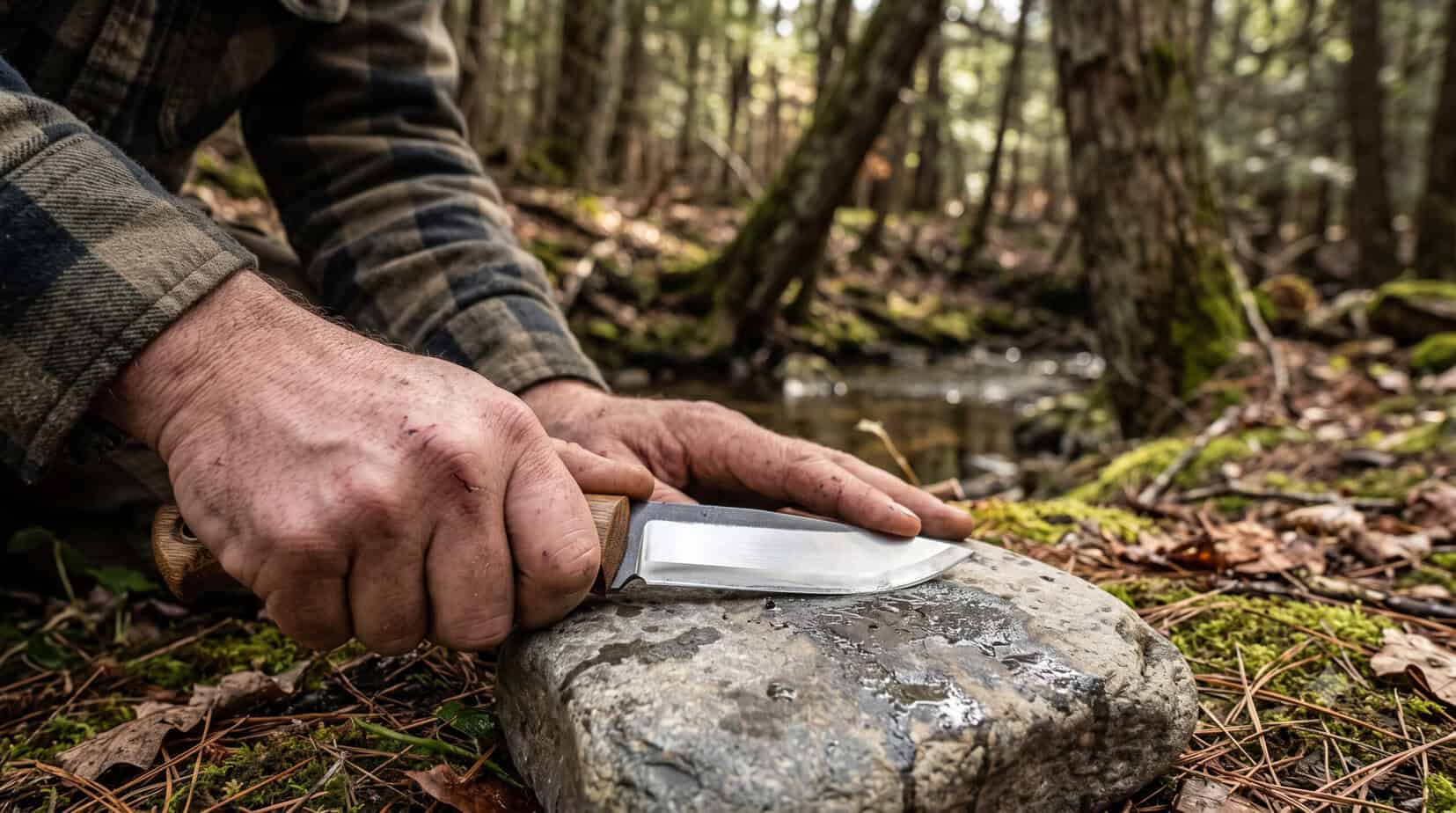
There is one thing that separates a useful knife from a paperweight in the backcountry: whether you can bring it back to a working edge with a flat stone and your hands. Not every blade lets you do that. The geometry of the grind is what makes the difference.
Why Does Blade Geometry Determine How Easy a Knife Is to Sharpen?
The grind profile controls how much steel you are removing each time you work the edge on a stone. A geometry that puts a lot of metal behind the edge forces you to remove more material to raise a burr. That takes longer, requires more skill to hold a consistent angle, and wears out a pocket stone fast. A geometry that tapers cleanly to a thin edge lets you do the same job in a few minutes with almost no technique.
That is the whole game. Everything else follows from it.
The geometry of a blade’s grind, whether hollow, flat, or convex, directly determines how quickly its edge degrades against bark, rope, and bone in the field. Experienced woodsmen know that a knife which sharpens easily on a flat stone usually starts with a well-executed primary bevel, a detail that separates production blades from hand forged knives made in USA crafted from premium Damascus or M390 steel with intentional grind geometry. That foundation of bespoke artistry means the blade holds a predictable, reproducible edge angle every time you return it to the stone, a critical advantage when light is fading and your tools need to perform.
The Four Grind Profiles You Will Actually Encounter
Full flat grind. The blade tapers in a straight line from the spine all the way down to the edge bevel. This is the most field-friendly geometry available. The thin cross-section behind the edge means you are only working a small amount of steel. You can feel the angle clearly because the flat of the blade gives you a consistent reference. Most Scandinavian and American bushcraft knives use this grind for exactly this reason.
Scandi grind (zero bevel). A variant of the flat grind where the primary bevel runs all the way to the edge with no secondary bevel at all. The bevel face itself is the sharpening surface. You lay it flat on the stone and push. There is no angle to guess. A hunter in northern Sweden can touch up a Mora knife on a flat river rock in under two minutes. That is not an accident of design.
Hollow grind. The sides of the blade are concave, ground on a wheel. This creates a very thin edge that gets razor-sharp easily in a shop. The problem in the field: the hollow geometry collapses under hard use, and when you try to reprofile it on a flat stone, the concave surface does not contact the stone evenly. You end up working only the very edge, which is slow and inconsistent. Hollow grinds are not impossible to sharpen in the field, but they punish you for it.
Convex grind. The blade profile curves outward, like the edge of an axe. This geometry is extremely tough and handles chopping and batoning well. The tradeoff is real: to sharpen a convex edge on a flat stone, you need to use a circular or figure-eight motion and maintain a slightly lifted spine. It takes practice. Done wrong, you flatten the convex and ruin the geometry. Done right, it holds an edge longer than almost anything else.
Expert Tip from Jake Brennan, Wilderness Skills Instructor: “If you are buying your first dedicated bushcraft knife and you know you will be sharpening it yourself in the field, get a Scandi grind. Lay the bevel flat on the stone. That is your angle guide built right into the blade. You cannot mess it up. Save the convex grind for when you have spent real time learning freehand technique.”
What About the Secondary Bevel Angle?
The secondary bevel is the small angled face right at the cutting edge. On a Scandi grind, it does not exist. On everything else, it does, and its angle matters.
For field sharpening, you want a secondary bevel between 20 and 25 degrees per side. That range gives you a strong enough edge for camp tasks while still being achievable freehand on a stone without a guide. Angles below 15 degrees per side are fragile and require precision that is hard to maintain without a jig. Angles above 30 degrees are durable but slow to cut and slow to sharpen.
Think of it like tire pressure. Too low and the sidewall folds under load. Too high and you lose contact and control. The 20-25 degree range is the working window.
Does Steel Hardness Change How You Sharpen in the Field?
Yes, and this is where a lot of people get surprised. A blade at 58-60 HRC on the Rockwell scale will sharpen faster on a medium-grit stone than one at 64-66 HRC. The harder steel holds an edge longer, but it requires more abrasive to cut. A basic Arkansas stone or a diamond paddle card will struggle with steels like S90V or M390 at high hardness. You will spend 20 minutes and barely raise a burr.
For autonomous field use, steels in the 58-62 HRC range hit the practical sweet spot. 1095 carbon, O1, and Sandvik 14C28N all sharpen quickly on basic stones. The tradeoff for choosing softer steel is that you will need to touch up the edge more often, maybe every two or three days of hard use instead of once a week.
The field reality: A knife in CPM-3V at 60 HRC with a full flat grind will outperform a knife in S35VN at 63 HRC with a hollow grind every time you need to sharpen it on a creek stone.
Under the Hood: What Most Reviews Skip
- A Scandi grind with a 12-degree included angle (6 degrees per side) will chip on hard materials like bone and frozen wood. The zero-bevel design is not magic. It still needs a realistic edge angle for the task.
- Convex edges sharpen faster on a leather strop loaded with compound than on a flat stone. Carrying a small piece of leather weighs almost nothing and extends your time between stone sessions significantly.
- The width of the primary bevel on a flat grind directly affects how long sharpening takes. A blade with a 15mm bevel face requires more strokes to reprofile than one with a 6mm bevel face, even at the same angle.
- Carbon steel forms a burr faster than stainless under the same pressure on a stone. If you are new to freehand sharpening, a carbon steel blade gives you clearer tactile feedback that you are actually cutting metal.
Expert Tip from Marcus Webb, Outfitter and Guide (Alaska): “I stopped recommending hollow-ground knives to clients who are going out for more than a week. They come back with a dull knife and no idea why their stone is not working. The geometry is fighting them. Switch to a flat or Scandi grind and the same person can maintain their own edge after one lesson.”
What Profile Should You Actually Buy?
Here is a straightforward decision path:
- If you are new to freehand sharpening: buy a Scandi grind in carbon steel (1095 or O1), 58-60 HRC. Lay the bevel flat on the stone. Done.
- If you have solid freehand technique and do heavy camp work: buy a full flat grind or a convex grind in a tough steel like CPM-3V or 5160. Carry a diamond card and a small strop.
- If you hunt and need a fine slicing edge but also want field maintainability: full flat grind, stainless in the 58-62 HRC range, 20-22 degrees per side secondary bevel.
Avoid hollow grinds for any knife you plan to sharpen without a shop. The geometry works against you the moment you move away from a precision setup.
The knife that stays sharp in the field is not always the one with the best steel or the most expensive finish. It is the one whose geometry you can actually work with your hands, a stone, and no bench vise. Choose accordingly.
Author Bio
Bob Rodgers is a lifelong outdoorsman, herbalist, and seasoned prepper with over 20 years of real-world survival experience. As the founder of PreppersWill.com, he shares practical advice on self-reliance, off-grid living, and disaster preparedness, no hype, just hard-earned lessons from decades of hands-on prepping.
