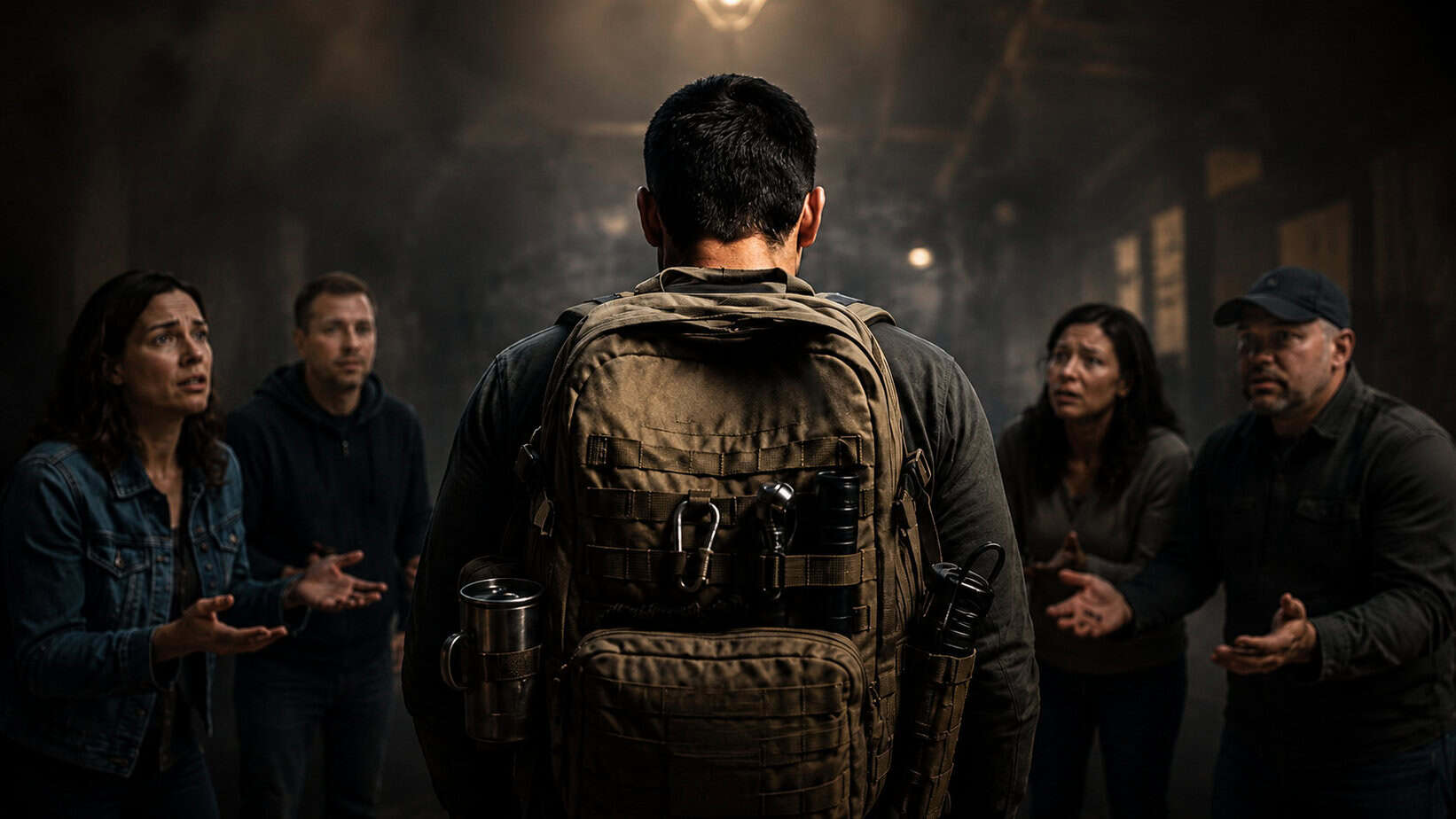
There is a quiet pride that comes with knowing you have handled your household’s preparedness while most people around you have not. You have the food storage, the water supply, the first aid training, the go-bag by the door, and a plan for more scenarios than your neighbors have even thought about.
Being the most prepared person in your network feels like an accomplishment, and it genuinely is one. The problem is that visibility can work against you in ways that catch even experienced preppers off guard.
When the people around you, whether friends, extended family, or neighbors, become aware of your level of readiness, the social dynamic around you quietly shifts. You stop being just a person they know and start becoming a resource they have quietly catalogued in the back of their minds.
That mental cataloguing does not feel threatening during calm times. Everyone is polite, nobody is asking for anything, and life proceeds normally. But when conditions change, whether that is a regional power outage, a supply chain disruption, or anything that strains the normal flow of daily life, that quiet cataloguing can transform into very direct social pressure.
This article walks through the specific psychological and social forces that activate when your preparedness is visible, why being the most prepared person in a social circle carries risks most people do not anticipate, and how to navigate those pressures without becoming either a resource to be drained or someone who abandons their values.
Understanding these dynamics is not about becoming paranoid. It is about being genuinely prepared, which means being prepared socially as much as physically.
Why Visible Preparedness Changes How People See You
Humans are natural resource-mappers. From an evolutionary standpoint, knowing who in your community had surplus food, tools, or skills was survival-critical information. That instinct has not disappeared just because modern society runs on grocery stores and online delivery. When someone in a social group is openly stockpiling, openly training in medical skills, or openly discussing their emergency plans, other people register that information even when they do not consciously intend to act on it.
The shift in perception tends to be subtle at first. You might notice that when a weather event is forecast, people call you before they call anyone else. You might notice that your preparedness becomes a topic of gentle humor at family gatherings, which is often a social signal that people are actually paying closer attention than they let on. Being the most prepared person around is a status that invites a specific kind of social behavior: others start mentally or explicitly designating you as the plan.
Social psychology research on reciprocity highlights that human communities operate on deep-wired norms of obligation and exchange. When someone is known to have resources, those around them feel an implicit or explicit pull toward that resource, especially under stress. The more visible your preparedness is, the more pronounced this pull becomes, and the more complicated your social relationships can get when things go sideways. Understanding this is not a reason to stop preparing. It is a reason to prepare more thoughtfully.
The Social Dilemma of Being the Most Prepared Person When Disaster Strikes
There is a meaningful difference between how people behave toward a prepared person during normal times and how they behave when a genuine crisis is unfolding. During normal times, your preparedness might get a comment here and there, but it largely stays in the background of your relationships. When a real crisis hits, the dynamic can change rapidly, and sometimes in ways that catch even experienced preppers completely off guard.
When neighbors or family members have not prepared and resources around them become scarce, they face a sharp emotional experience. That experience can translate into bargaining, guilt-tripping, or outright pressure on whoever they know has supplies. You become not just a neighbor or a family member but a problem-solver they expect to absorb their lack of preparation.
The psychology behind this is documented in social dilemma research: when public goods are perceived as available, individuals tend to access them without contributing proportionally to their maintenance. Your stockpile can become, in the minds of unprepared people around you, an informal public good.
This does not mean everyone around you will become hostile or unreasonable when a crisis hits. Many will be decent and will respect boundaries. But some will not, and the subset who will not tends to be precisely the people who feel the most entitled or the most desperate. Knowing this in advance lets you set expectations, make decisions, and handle these moments with more clarity and less emotional scrambling.
The Martyr Trap: When Generosity Becomes Self-Destruction
One of the least-discussed risks for prepared individuals is the martyr trap, which is the slow process by which a generous person’s resources get depleted through repeated social pressure until their own preparedness is compromised. The martyr trap is not obvious when it begins. It starts with a reasonable-sounding request from someone you genuinely care about. You give a little. Another request comes. You give a little more. Over time, what you spent years building quietly disappears.
The social mechanics that drive this are worth understanding clearly. When you give during a crisis, the people receiving your help feel relieved but also feel a new entitlement. The precedent of your generosity becomes the expectation for next time.
Each time you help without a clear boundary, you reset the baseline for what people expect from you. This is not because your social circle is made up of bad people. It is because humans normalize whatever behavior they are consistently exposed to, and generosity without limits gets normalized as a default resource that others can rely on.
The martyr trap also has an emotional component that makes it especially difficult to resist. When you say no to a family member or a friend who is genuinely struggling, it feels terrible. The guilt is real, and the social pressure around that guilt can be intense. Recognizing this dynamic before it unfolds is one of the most valuable things a prepared person can do. Your preparedness only protects you and your household if you actually maintain it. A compassionate person who depletes their supplies down to nothing helping unprepared neighbors has not helped anyone long-term, including themselves.
Operational Security for Preppers: Keeping Your Preparedness Private
One of the oldest principles in military strategy is that you protect what matters most by keeping it unknown to those who might want it. This principle goes by the name of operational security, or OPSEC, and while it was developed in military contexts, its core logic applies directly to personal preparedness. The less visible your supplies, skills, and plans are to the outside world, the less social pressure you face when things get difficult.
Operational security for preppers does not require being paranoid or deceptive with the people you trust most. It means being intentional about what information you share, with whom, and when. CISA has documented OPSEC principles as a systematic approach to identifying and protecting sensitive information that could be used against you by those who might exploit it.
For most preppers, practical OPSEC looks like this: you do not broadcast your food storage levels to extended family at holiday dinners. You do not post detailed photos of your supplies or equipment on social media. You do not tell casual acquaintances that you are the person with six months of food on hand.
Being the most prepared person in your circle carries a significantly lower social risk when the circle does not know exactly what you have or how much. You can be known as someone who is generally cautious and thoughtful without being known as the neighborhood warehouse.

Drawing Boundaries Without Burning Bridges
Knowing that you need to protect your preparedness is one thing. Knowing how to actually do that in the middle of a real situation with real people is another. The skill of setting limits on how much of your resources and energy you extend to others, without permanently damaging relationships, is a genuinely difficult one, and most preparedness content skips over it entirely.
The first principle is that limits set before a crisis are always more effective than limits set during one. If your extended family knows ahead of time that you maintain supplies for your immediate household and that you are not in a position to be a general resource for everyone else, that framing is already established when pressure arrives. This is not a cold or selfish framing. It is an honest one that actually reduces friction when things get hard because expectations are already calibrated.
The second principle is that the manner in which you hold a limit matters as much as the limit itself. Saying no with empathy and without judgment keeps relationships intact in ways that a blunt refusal does not. You can acknowledge what someone is going through, express genuine care, and still decline to hand over supplies you need for your own household. The two things are not mutually exclusive. Being the most prepared person does not obligate you to also be everyone’s emergency fund.
The third principle is that offering alternatives instead of just a refusal tends to reduce friction dramatically. If a neighbor asks for food and you cannot provide it, pointing them toward community resources or helping them problem-solve without drawing from your own stock keeps the relationship functional without compromising your position.
Building a Trusted Inner Circle Instead of an Open Policy
There is a meaningful difference between keeping your preparedness entirely secret and sharing it selectively with people you genuinely trust and who are either also prepared or who are part of your household plan. The ideal situation is not perfect secrecy from everyone but rather a carefully chosen inner circle of people with whom you coordinate, share plans, and possibly pool resources in a deliberate and reciprocal way.
A mutual aid group made up of people who are all contributing to preparedness is a fundamentally different social structure than a situation where one or two prepared people are expected to absorb the needs of a larger unprepared group. When the people around you are also building their own readiness, the burden of being the most prepared person is distributed. There is no single target. There is no single resource. There is a group of adults who have all taken the same level of personal responsibility.
Building that kind of inner circle requires honest conversations with the people in your life about preparedness as a shared value, not as one person’s hobby that others can free-ride on. Those conversations can be awkward, especially with family members who are resistant to the topic. But having them before a crisis arrives is far better than improvising the conversation in the middle of one. FEMA’s guidelines on community preparedness emphasize that resilience is built through planning that includes the whole household and trusted community, not just one designated responsible person.
For building group readiness, consider investing in quality emergency food supplies that each household can maintain independently. The ReadyWise 30-Day Emergency Food Supply gives each family in your network a solid foundation of freeze-dried meals with a 25-year shelf life, reducing the pressure on any single household.
The Psychology of Entitlement in Crisis Situations
Most prepared people know, abstractly, that others might want what they have in a crisis. Fewer people are prepared for the specific emotional texture of how that entitlement expresses itself. Understanding the psychological mechanics at work helps you respond from a clear-headed place rather than from reactive emotion.
When people around you face scarcity and they know you do not, a cognitive process called relative deprivation kicks in. They are not comparing themselves to people in other cities or other countries. They are comparing themselves to you, the person they know, the person at the next table at Thanksgiving, the person whose house they have been to. That proximity makes the gap feel personal and, in some cases, unfair. The conclusion that follows, consciously or not, is that fairness requires your resources to be shared with them.
This can manifest as guilt-tripping, where people make their suffering vivid and personal in ways designed to produce an emotional response from you. It can manifest as bargaining, where people offer future favors or payment that they may or may not be in a position to deliver. It can manifest as social pressure applied through mutual friends or family members. In the most extreme cases, it can manifest as outright demands or even conflict.
Being aware that these are predictable psychological patterns, not unique expressions of who a specific person is, makes them easier to navigate. You are not dealing with moral failures. You are dealing with stress responses that social psychologists have documented extensively. Research on reciprocity norms and social obligation gives useful context on why people behave this way under pressure.
Being the Most Prepared Person Means Planning for Social Pressure Too
Genuine preparedness is not only about having the right equipment and enough food. It is about thinking through every likely challenge you will face in a disruption scenario, including the human ones. Most people spend the bulk of their preparedness energy on physical supplies and very little on the social dynamics that will activate the moment anyone around them figures out what they have.
Planning for social pressure means deciding in advance, not in the heat of the moment, what your limits are and who falls within them. Your immediate household is the obvious first priority. Beyond that, the decisions get harder and more personal. Do you have elderly parents who you feel responsible for? Do you have siblings whose children would be in genuine danger without support? Have you thought through how you would respond to each of those scenarios in a way that honors your values without compromising your household’s security?
These are not pleasant questions, but they are exactly the questions that being the most prepared person in your circle requires you to answer before they are urgent. A plan that includes your social dynamics is a more complete plan than one that only accounts for calories and water gallons. The FEMA Comprehensive Preparedness Guide emphasizes that planning is an iterative process that must account for human networks and community relationships, not just physical resources.
A comprehensive family emergency kit that supports your core household is a strong baseline. The EVERLIT 72-Hour Emergency Survival Kit is a well-reviewed bug-out bag that covers a family’s core needs for the first critical 72 hours.
How to Talk to Unprepared People in Your Life Without Alienating Them
One of the more underrated skills in the preparedness community is communicating with people who are not prepared, without sounding condescending, paranoid, or preachy. If you approach people in your circle with the energy of someone who has figured out what everyone else has missed, you will mostly produce defensiveness and ridicule. That defensiveness does not help them get prepared, and it does not help your relationships.
The most effective way to open the conversation is through shared self-interest rather than warnings. Instead of telling someone what might happen and why their lack of preparation is dangerous, you can frame preparedness as something you have found personally useful, practically valuable, and even financially smart. Storing food for disruptions saves money when prices spike. Having a first aid kit on hand means not scrambling when someone gets hurt. Having a go-bag ready means not improvising during an evacuation. These are practical, low-drama entry points that land better than crisis scenarios.
If someone in your network becomes even modestly more prepared, that is a genuine win. Every person who builds their own supply reduces the potential demand on yours. Encouraging preparedness around you, framed as a shared sensible practice rather than a response to specific fears, is one of the most socially intelligent things a prepared person can do. It shifts the culture of your social circle gradually, without making you the eccentric person everyone quietly avoids at parties.
Staying Mentally Resilient When You Feel the Weight of Being the One Who Planned Ahead
There is an emotional cost to being the most prepared person that does not get talked about enough. It is tiring to have thought through scenarios that nobody else around you has considered. It can feel isolating to have invested time, money, and mental energy into readiness while your social circle has not. And when a disruption actually happens and the social pressure activates, that emotional weight can increase significantly.
Resentment is one of the more common responses. Prepared people sometimes feel frustrated that they did the work and are now expected to shoulder the needs of people who did not. That frustration is understandable, but acting from it tends to produce worse outcomes than acting from a clear, pre-decided framework. The goal is to hold your limits in a way that is principled rather than punitive, firm rather than hostile.
Building in deliberate emotional recovery practices, meaning time away from preparedness thinking, community with other like-minded individuals, and regular reminders of why you prepared in the first place, helps maintain the psychological stamina that long-term preparedness requires. It is a lifestyle, not a one-time purchase, and it requires mental maintenance as much as physical inventory management.
My Two Cents
Here is what years of paying attention to this community has taught me: the people who come out of difficult situations best are rarely the ones with the most stuff. They are the ones who thought further ahead than most, which includes thinking about the human side of crisis. Having a basement full of supplies and zero plan for how to handle the social fallout of that is not complete preparedness. It is half of it.
Being the most prepared person in your circle is an advantage that becomes a liability the moment you have not thought through the social dynamics that come with it. The goal is to be ready without being a target, to be generous without being depleted, and to set limits without becoming someone people fear or resent. That is a genuinely difficult balance to strike, and there is no perfect answer that works for every household and every relationship. But the people who think about it, plan for it, and make deliberate decisions about it are far better positioned than those who just stock shelves and hope the human side of a crisis takes care of itself.
Protect what you have built. Be thoughtful about who knows. Be selective about who benefits. And keep preparing, because a world where more people are ready for disruption is better for everyone in it.
 About the Author
David Andrew Brown is a former law enforcement agent with over 30 years of experience in criminal investigations, personal defense, and tactical response. A certified firearm instructor and home protection counselor, he now shares his expertise to help others stay alert, capable, and confident under pressure. “Preparedness isn’t paranoia,” David says. “It’s respect for reality.”
Suggested resources for preppers:
Why Mapping Bug Out Routes Is Vital
The #1 food of Americans during the Great Depression
How To Defend A Bug Out Location
If you see this plant when bugging out, don’t touch it!
