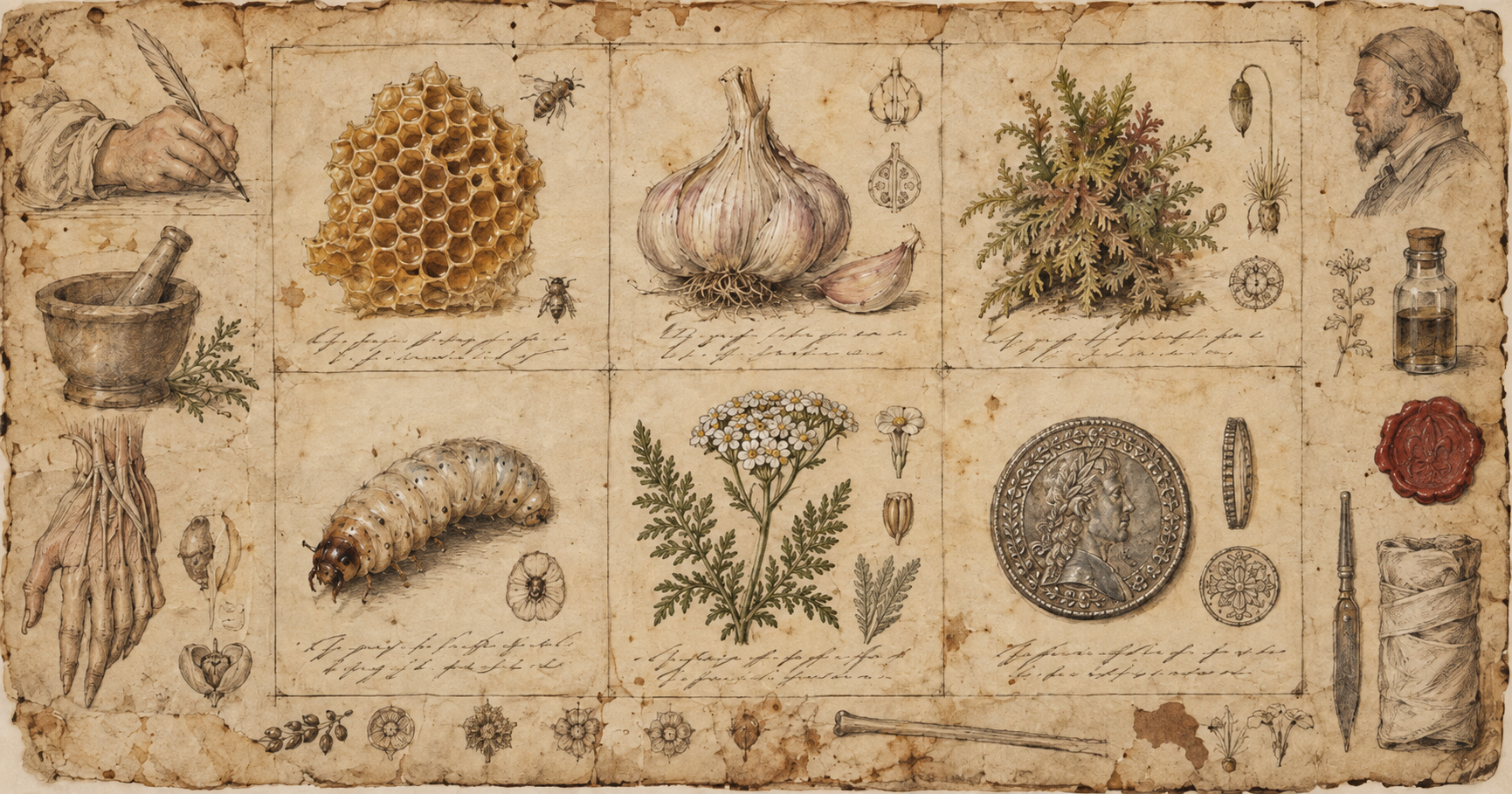
For most of recorded history, a deep cut was a coin flip with a very long tail. A farmer who caught his shin on a plough blade, a soldier who took a spear through the thigh, a weaver who tore her palm open on a splintered loom: any of them might be back at work in a fortnight, or dead three weeks later from something nobody could see.
Penicillin did not reach civilian patients in any meaningful quantity until the early 1940s, which means roughly five thousand years of documented medicine had to manage infection without a single systemic antibacterial drug. That enormous stretch of time is what we mean by wound care before antibiotics, and it deserves better than the two lazy summaries it usually gets.
The first lazy summary treats it all as superstition and filth, a parade of leeches and prayers and dung poultices that killed more people than it saved. The second treats it as suppressed ancient wisdom, a lost pharmacy of miracle cures. Both readings assume the whole tradition moved in one direction, and it did not. Some pre-modern treatments were genuinely effective and have since been validated in controlled laboratory conditions. Others were catastrophic and demonstrably killed patients who would have survived benign neglect. A large middle band worked occasionally, for reasons nobody involved could articulate.
This article sorts through that middle band. We will look at what the Egyptians packed into wounds and why it plausibly helped, what the Greeks and Romans got right about washing, why honey and maggots earned their reputations, and where the tradition went badly off the rails. Along the way, the practical lessons that survive are worth knowing, because a few of them still sit in a modern first aid kit.
What Wound Care Before Antibiotics Actually Looked Like Day to Day
Strip away the romance and the daily reality of wound care before antibiotics comes down to four tasks performed in a fixed order: stop the bleeding, remove obvious foreign material, close or cover the opening, and then wait to see what happens. The waiting was the hard part, because a healer had no way to intervene once bacteria had established themselves in deep tissue. Redness spreading up a limb in tidy red lines meant the patient was probably going to die, and everyone in the room knew it.
The tools were simple and mostly unchanged for centuries. Linen, wool, or hemp for dressings. Wine, vinegar, or plain water for washing. Wax, resin, honey, tallow, or oil as a base for salves. Heated iron or boiling pitch for bleeding that would not stop. Needle and thread, or in some traditions large biting ants whose pincers were used as improvised staples, for closing gaps in the skin. A competent field surgeon in Rome, Baghdad, or fifteenth century Burgundy would have recognized most of the equipment used by his counterparts in the other two places.
Outcomes were far more variable than the standard horror stories suggest. Clean cuts in healthy young adults, treated by someone who washed them and left them alone, healed at rates that would not embarrass a modern clinic. Crush injuries, contaminated puncture wounds, compound fractures, and abdominal penetration were close to a death sentence. Ambroise Pare, the sixteenth century French military surgeon whose name recurs throughout this subject, summarized the whole enterprise in a line that has aged remarkably well: he dressed the wound, and God healed it. That was not false modesty. It was an accurate description of the division of labor, and it is the honest starting point for anyone assessing this period.
The Oldest Written Evidence: Honey, Grease, and Linen on the Nile
The earliest surviving instruction manual for treating injuries is the Edwin Smith Papyrus, an Egyptian text written in hieratic script around the seventeenth century BCE and almost certainly copied from material a thousand years older. It is not a book of spells. It is a structured clinical document laying out forty-eight cases of wounds and trauma, each following the same format of description, diagnosis, prognosis, and treatment, with explanatory notes attached like footnotes. Only one incantation appears in the entire scroll.
What the Egyptian surgeon reached for was a combination that shows up again and again across the whole history of wound care before antibiotics: honey, some form of grease or fat, and lint or linen. Fresh meat was laid on a wound on the first day, then swapped for the honey and grease dressing afterwards. Sutures appear for lip and nose wounds. Splints and bandaging are described with real precision, and the author is candid about which injuries fall outside his ability to help, using a formula that amounts to an ailment not to be treated.
Modern reconstruction of these recipes suggests the Egyptians had stumbled onto something real. Honey is hygroscopic and antibacterial. Animal fat creates an occlusive layer that keeps the wound bed moist and stops dressings from tearing off new tissue when changed. Linen provides an absorbent, relatively inert cover. Put those three together and you have crude but functional versions of an antimicrobial agent, a non-adherent contact layer, and a secondary dressing, which is close to the structure of a modern wound care protocol. They arrived at it through several centuries of watching what happened, without any theory of infection to guide them.
Greeks and Romans: Wine, Vinegar, and the Habit of Washing
Classical medicine added something the Egyptian texts only imply, which was an argument about method. The Hippocratic writers insisted that wounds be irrigated with clean water, wine, or vinegar before dressing, that the healer’s hands and nails be clean, and that dressings be changed on a schedule rather than left to rot in place. Whether or not the underlying humoral theory made any sense, the resulting habits were sound, and they made Greek and Roman wound care before antibiotics measurably better than what came after it in medieval Europe.
The chemistry was working in their favor without their knowledge. Wine contains ethanol and a range of phenolic compounds; vinegar is dilute acetic acid, which remains effective against Pseudomonas aeruginosa and is still used in dilute form in some burn units today. Neither is powerful enough to sterilize a contaminated wound, but both reduce bacterial load at the surface, and reducing bacterial load at the surface is most of the battle in a shallow injury. Roman military medicine, which had to keep an army functional across a continent, leaned on this hard.
Celsus, writing in the first century, gave us the four cardinal signs of inflammation that medical students still memorize: redness, swelling, heat, and pain. Galen, working from an appointment as physician to gladiators in Pergamon, accumulated an unmatched practical database of penetrating trauma and drew the reasonable conclusion that wounds do better when kept moist. His successors misread him badly on one point, discussed later, but the core observation was correct and was lost for well over a thousand years. Roman army surgeons also removed arrowheads with purpose-built spoon-shaped instruments, closed clean wounds with fine sutures, and ligated bleeding vessels, all of which are recognizably modern maneuvers.
Honey Was the Best Thing in the Medieval Cupboard
If you had to pick a single substance that vindicates traditional practice, it would be honey. It appears in Egyptian, Greek, Ayurvedic, Chinese, Islamic, and European texts, applied to burns, ulcers, and open wounds with a consistency that suggests generations of practitioners noticed it worked. Unlike most of the pharmacopoeia inherited from the era of wound care before antibiotics, honey has been put through randomised controlled trials and a Cochrane systematic review, and it did not embarrass itself.
Four mechanisms are doing the work. Honey is roughly eighty percent sugar, which creates an osmotic gradient that pulls fluid out of the wound bed and dehydrates bacteria. Its pH sits between three and four, which is hostile to most wound pathogens. The enzyme glucose oxidase, carried in by the bee, generates low concentrations of hydrogen peroxide continuously as the honey is diluted by wound exudate, giving a slow antimicrobial release rather than the tissue-damaging burst you get from pouring peroxide straight into a cut. Manuka honey adds methylglyoxal, a non-peroxide antibacterial compound.
The Cochrane evidence is strongest for partial thickness burns, where honey dressings shortened healing time compared with several conventional alternatives. Evidence for chronic wounds such as venous leg ulcers is much weaker, and the trials are generally of poor quality, so honey is not a universal solution. It is also worth stressing that supermarket honey is not the same product used in hospitals. Medical grade honey is gamma irradiated to eliminate Clostridium botulinum spores and standardized for antibacterial activity, and that is the version worth having on hand. Raw honey from a farmers market belongs on toast.

Maggots and the Uncomfortable Success of Biosurgery
Nothing in this field generates more squeamishness or has a stronger evidence base behind it. Fly larvae have been deliberately placed in wounds by the Ngemba people of New South Wales, hill communities in northern Myanmar, and Mayan healers in Central America, all independently. The Maya reportedly soaked dressings in cattle blood and left them in the sun before application, which is a deliberate way of inviting the flies in.
Ambroise Pare was the first European physician to record the benefit, and he did so reluctantly. He had spent years trying to keep maggots out of his patients’ wounds when he encountered a man with a deep skull injury from which a mass of larvae eventually emerged. The patient lost a hand-sized piece of bone and recovered anyway. Baron Dominique-Jean Larrey, surgeon to Napoleon’s armies, later observed during the Syrian campaign that blue fly larvae stripped dead tissue while leaving living tissue untouched. During the American Civil War, the Confederate surgeon John Forney Zacharias used maggots deliberately at Danville and wrote that in a single day they cleaned a wound better than any agent available to him.
The mechanism is now well characterized. Lucilia sericata larvae secrete proteolytic enzymes including collagenase that liquefy necrotic tissue, ingest and destroy bacteria in their gut, secrete ammonia that raises wound pH into a range bacteria dislike, and release compounds that stimulate fibroblast migration. Germ theory ironically killed the practice off in the late nineteenth century, since applying visibly contaminated material to an open wound became unthinkable, and penicillin finished the job in the 1940s. Sterile larvae are now commercially produced and used in difficult chronic wounds, particularly diabetic foot ulcers, which is a strange vindication for one of the least appetizing traditions in wound care before antibiotics.
Metals in Wound Care Before Antibiotics: Silver, Copper, and Brass
Long before anyone could explain oligodynamic action, healers noticed that certain metals kept things from going bad. Herodotus records Persian kings carrying boiled water in silver vessels on campaign. Phoenician sailors dropped silver coins into water casks. Egyptian practice included applying copper compounds to wounds, and the Edwin Smith Papyrus mentions copper filings among its ingredients. Roman and Greek physicians used verdigris, a copper acetate compound, as a wound powder. This thread runs quietly through the entire history of wound care before antibiotics, mostly unremarked because nobody had a framework that made it interesting.
Silver ions bind to bacterial cell membranes and enzymes, disrupt respiration, and interfere with DNA replication. Copper surfaces kill bacteria on contact through a combination of ion release and oxidative damage. Neither effect is dramatic at the concentrations achievable with a coin in a water jug, but both are real, and both are cumulative over time. By the nineteenth century silver nitrate was standard for cauterizing and treating wounds, and silver foil dressings were common in surgical practice until sulphonamides and penicillin displaced them.
Silver came back. Silver-impregnated alginate and foam dressings are now routine for infected or heavily colonized wounds, particularly burns and chronic ulcers where biofilm makes systemic antibiotics unreliable. The clinical evidence is mixed and there are legitimate concerns about silver resistance and cytotoxicity at high concentrations, so this is not a miracle either. What matters historically is that a practice sustained for two thousand years on pure empiricism turned out to rest on a mechanism that took until the twentieth century to describe.
Bald’s Eyesalve and the Medieval Recipes That Held Up in the Lab
In 2015, a team at the University of Nottingham did something that had not really been tried before. Christina Lee, a specialist in Anglo-Saxon and Viking studies, translated a tenth century recipe from Bald’s Leechbook, a leather-bound Old English medical compilation held at the British Library, and handed it to microbiologists to build and test properly. The recipe called for garlic, a second allium such as onion or leek, wine, and oxgall, brewed in a brass vessel, strained, and left to stand for nine days.
The results were startling. None of the individual ingredients had a measurable effect on Staphylococcus aureus grown in synthetic wound models. The full recipe, brewed as written, wiped out roughly nine hundred and ninety nine cells in every thousand. Testing at Texas Tech University on MRSA-infected skin wounds in mice found it performed as well as or better than the conventional antibiotics used as comparators. Diluted below the killing threshold, the preparation interfered with bacterial quorum sensing, the chemical signalling system bacteria use to coordinate the genes that damage host tissue.
Two details deserve emphasis for anyone interested in wound care before antibiotics. The first is that the combination mattered and the brewing method mattered, including the nine days wait and the metal of the vessel, which suggests the original compiler was following a procedure refined by trial rather than assembling ingredients at random. The second is that it worked on biofilms, the dense bacterial communities that defeat many modern antibiotics. This does not mean medieval medicine was secretly advanced. Bald’s Leechbook also contains remedies involving elf-shot and dwarf-inflicted disease. It means that a small fraction of that inherited material may be worth systematically testing rather than dismissing.
The Treatments That Actively Made Things Worse
Now the other column of the ledger, which is longer. The single most destructive idea in the history of wound care before antibiotics was the doctrine of laudable pus, a misreading of Galen that persisted in European medicine for well over a millennium. The reasoning went that suppuration was a necessary stage of healing, so a wound that was not producing pus needed encouragement. Surgeons therefore packed wounds with irritants, reopened closed incisions, and inserted setons deliberately to provoke discharge. Islamic physicians including Avicenna and Albucasis rejected the doctrine and got better results, but the European mainstream held onto it into the nineteenth century.
Gunpowder created a second disaster. Fifteenth and sixteenth century surgeons believed gunshot wounds were poisoned by the powder and treated them by pouring boiling oil of elder into the wound channel. Ambroise Pare ran out of oil during the siege of Turin in 1537 and improvised a dressing of egg yolk, rose oil, and turpentine. He expected the untreated men to die overnight, found them resting comfortably while the oil-treated soldiers were feverish and in agony, and abandoned the practice for good. It still took the profession decades to follow him.
Then there was the hospital itself. Nineteenth century surgical wards produced hospital gangrene and pyaemia at rates that made operating in a patient’s home statistically safer. Surgeons wore frock coats stiff with old blood as a mark of experience, probed wounds with unwashed fingers, and used sponges and lint recycled between patients. Joseph Lister’s carbolic acid system, developed at Glasgow from 1865 after he encountered Pasteur’s work, cut post-operative mortality dramatically and was resisted for years by colleagues who found it fussy and unnecessary. The last chapter of wound care before antibiotics was largely a story of surgeons learning to stop actively spreading infection themselves.
Straight Folklore: Weapon Salve, Cobwebs, and Dung Poultices
Some practices had no plausible mechanism whatsoever. The weapon salve, popularised in the seventeenth century by Kenelm Digby and others, involved treating the blade that caused the injury rather than the injury itself, sometimes at considerable distance. The related powder of sympathy was applied to a bloodstained bandage rather than the patient. Both enjoyed genuine popularity among educated people, and both almost certainly improved outcomes, for the sole reason that a wound left alone and kept covered does better than a wound repeatedly packed with irritants by a well-meaning surgeon.
Cobwebs, applied to bleeding cuts across Europe and North America well into the twentieth century, are a more interesting case. Spider silk does provide a physical matrix that supports clot formation, so the folk claim is not entirely baseless. What comes with it is dust, insect fragments, and whatever bacteria and fungal spores were living in the corner of the barn, and tetanus spores in particular are unforgiving. The realistic verdict is a marginal mechanical benefit that is overwhelmingly outweighed by the contamination risk.
Dung poultices, recommended in various forms from ancient Egypt through early modern Europe, have no defence at all. Manure is a reliable source of Clostridium tetani and Clostridium perfringens, meaning tetanus and gas gangrene, and packing it into an open wound is close to the worst available option. Not everything traditional deserves rehabilitation, and a fair account of wound care before antibiotics has to say so plainly. Sphagnum moss, on the other hand, is the folk remedy that earned its keep. It absorbs several times its weight in fluid, is naturally acidic, and was manufactured into surgical dressings on an industrial scale during the First World War when cotton supplies collapsed.
What Wound Care Before Antibiotics Can Teach a Modern First Aid Kit
The practical residue of all this is smaller than enthusiasts claim and larger than sceptics allow. The first lesson is that irrigation does most of the work. The Hippocratic insistence on washing wounds out thoroughly before covering them remains the highest-value intervention available to a non-professional, and volume matters more than the choice of fluid. Clean drinking water is fine. Sterile saline is better, mostly because it does not sting and does not damage healing tissue the way antiseptics can.
The second lesson is that moist beats dry. Galen worked this out, medieval Europe forgot it, and George Winter demonstrated it experimentally in 1962. A wound kept slightly moist under an occlusive or semi-occlusive cover epithelialises considerably faster than one allowed to form a hard scab, and it hurts less. The Egyptian grease-and-honey dressing was a functional version of this principle. The modern equivalents are hydrocolloids, hydrogels, and non-adherent contact layers that lift off without tearing new tissue away.
The third lesson is about restraint. A great deal of harm in the history of wound care before antibiotics came from doing too much: cauterizing what did not need cauterizing, provoking pus, probing with dirty fingers, packing cavities with material that had no business being there. The corresponding modern error is pouring hydrogen peroxide or undiluted iodine into a clean cut, which kills fibroblasts along with bacteria and slows healing. A sensibly stocked first-aid kit with saline, sterile dressings, tape, gloves, and a way to apply pressure covers the overwhelming majority of domestic injuries. Anything involving a puncture wound, an animal bite, spreading redness, or a foreign body you cannot see the end of belongs with a clinician and probably an actual antibiotic.
Concluding
The Egyptian scribe who wrote out forty-eight cases and was willing to mark some of them as beyond help was doing careful clinical observation three and a half thousand years before anyone had a word for it. The Anglo-Saxon compiler who specified nine days and a brass vessel was following a procedure that someone, at some point, had bothered to optimize.
What I would push back on is the tendency to treat this as either a horror show or a hidden treasure. Honey works, silver works, maggots work, irrigation works, and every one of those was known long before anybody could explain why. Boiling oil, laudable pus, and dung poultices also happened, and they killed enormous numbers of people. The same tradition produced both in roughly equal measure.
The useful takeaway from studying wound care before antibiotics is not a shopping list of ancient remedies. It is the reminder that antibiotics are a seventy-year-old convenience sitting on top of five thousand years of managing infection the hard way, and that with resistance climbing steadily, several of those older tools are quietly being pulled back off the shelf. That is worth knowing.
This article has been written by James H. Redford MD for Prepper’s Will.
You may also want to check this:
Knowledge to survive any medical crisis situation during a major disaster
Avitaminosis (Vitamin Deficiency) Effects on Your Body During Isolation
The natural healing remedies out grandparents used on a daily basis
A Few Things To Know When Conventional Medical Care Is Unavailable

As a retiring ER physician, I would stress to my students (medical students and residents) the importance of wound irrigation. “The solution for pollution is dilution.” Nice review!