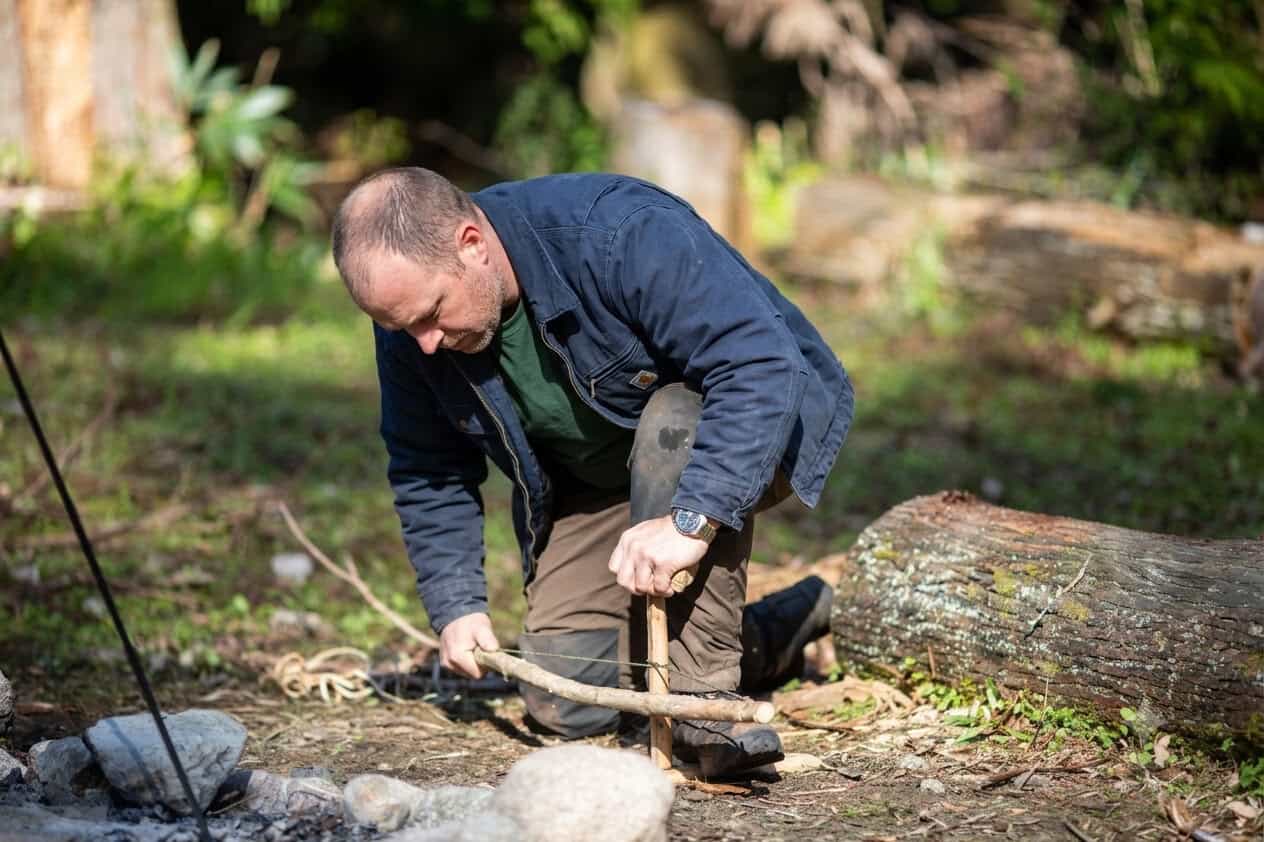
Every bushcraft forum has the same thread buried somewhere in its archives. Someone spent three hours bowing furiously against a piece of scrap pine, arms shaking and palms blistered, and never produced so much as a wisp of real smoke.
They watched a dozen tutorials first, they copied the elbow lock, the knee position, the long confident bow strokes, but none of it mattered. This is the bow drill deception in its purest form: the widespread belief, repeated across YouTube channels and survival courses alike, that friction fire is mostly a matter of arm strength, rhythm, and grit.
In truth, the outcome of a bow drill attempt is largely decided before the bow ever touches the string, in the choice of species, the moisture sitting inside the fibers, and a handful of physical variables that most instructional content glosses over in favor of showing someone look strong and capable on camera.
This article is not another step-by-step technique guide. There are plenty of those already, and most of them are the reason beginners keep failing. Instead, we are going to pull apart the actual science behind why some setups produce a coal in ninety seconds while others never smoke at all, even in the hands of someone with textbook form. Wood pairing, moisture content, and basic thermodynamics explain almost everything that technique videos attribute to skill.
Once you understand these mechanics, the bow drill deception starts to look less like a mystery and more like a predictable, correctable pattern, one you can diagnose and fix in the field rather than one you simply have to grind through with sore forearms and blind hope.
The Bow Drill Deception: What Every Tutorial Gets Wrong
Open ten bow drill tutorials and you will notice a pattern almost immediately. Nine of them spend the bulk of their runtime on stance, bow angle, and the rhythm of the stroke, while the wood itself gets a passing mention along the lines of “use a soft wood like cedar or willow.”
That is the entire depth of guidance most beginners receive before they head into the woods and start cutting whatever branch happens to be within reach. The bow drill deception thrives in this gap between what is shown and what actually matters, because a demonstrator who already has a well-seasoned, correctly paired set makes the technique look like the hard part simply because the wood variables were solved long before the camera started rolling.
The physical mechanics of bowing are genuinely simple to learn within an afternoon. Anyone with reasonable coordination can master the stroke, the pressure, and the posture in a few dozen attempts.
What separates a coal from an afternoon of frustration is almost never the stroke itself. It is whether the hearthboard and spindle were capable of reaching ignition temperature in the first place, given their density, resin content, and internal moisture. A tutorial that never mentions equilibrium moisture or species hardness ratios is teaching a script for a favorable case, not a transferable skill, and that omission is the quiet engine behind the bow drill deception that keeps circulating online.
Why 90 Percent of Beginners Fail Before They Even Start
Most failed attempts are decided in the first five minutes, long before the first bow stroke, at the moment someone picks up a stick. Beginners tend to grab the nearest reasonably straight branch, often green, often from a species nobody actually vetted for friction fire, and assume that effort will compensate for a poor material choice. It will not.
A green branch fresh off a living tree can carry twenty to thirty percent moisture by weight, and that water has to be driven off as steam before any dust can begin to char. Bowing through that phase burns through arm strength and morale long before it produces heat capable of sustaining a coal.
There is also a selection bias at play in how people learn. They watch someone succeed in under two minutes and assume the process should always look that fast, so when their own attempt drags on for twenty minutes with nothing but pale smoke, they conclude they are doing something wrong with their arms rather than their materials.
That misattribution is the bow drill deception operating at the level of individual psychology, not just tutorial content. Beginners internalize a technique failure narrative when the real story is almost always about a hearthboard that was too hard, too wet, or too resinous to ever produce a viable coal, regardless of how disciplined the bowing was.
The Physics of Friction Fire: Heat, Pressure, and Speed
Friction fire is, at its core, an exercise in converting mechanical energy into localized heat faster than that heat can dissipate into the surrounding wood. As the spindle spins against the hearthboard, kinetic friction generates temperature increases concentrated at a very small contact area.
Engineering research on the subject has shown that the rate of heat generation scales with how fast the spindle is spun, and that thinner spindles concentrate that heat over a smaller cross-section, which raises the local temperature more efficiently even though the total heat output is not dramatically different. This is why a spindle around three-eighths to one-half inch in diameter tends to outperform a thicker one, all else being equal.
Pressure plays an equally important role, though it works differently than most people assume. Downward force does not directly create heat. It increases the contact friction between the two surfaces and, critically, it packs the char dust into a denser, more insulated pile at the notch, which allows accumulated heat to persist rather than scattering as loose powder. Too little pressure and the spindle skates across the surface without generating enough friction. Too much pressure and the extra resistance can slow rotational speed to the point where heat generation drops.
Every tutorial that frames pressure as “push down hard” without explaining this balance is contributing to the bow drill deception, because the correct amount of pressure changes depending on wood density and spindle diameter, not a fixed instruction that applies universally.
A dense hardwood pairing generally needs firmer pressure and slower, more deliberate strokes, while a soft, low-density pairing responds better to lighter pressure and faster rotation, and mixing up those two approaches is a common reason a technically sound bower still cannot get a coal from a given set.
Wood Pairing Science: Matching Spindle and Hearthboard Correctly
Wood pairing is arguably the single most underexplained concept in bow drill instruction. The general principle is that the spindle and hearthboard should be similar in hardness, and ideally drawn from the same species, so that both surfaces wear down at a comparable rate and produce fine, hot dust rather than one piece grinding a groove into the other without generating enough friction.
Species commonly recommended by experienced practitioners include basswood, cottonwood, willow, yucca, tilia, and cedar, all of which share a relatively low density combined with enough structural integrity to hold a spindle point without collapsing.
Hardwoods like oak can work, but they demand far more precision in moisture content and downward pressure, because their density makes them prone to polishing the contact surface rather than grinding it into usable dust.
This is a subtlety that most beginner content skips entirely, presenting a single universal wood recommendation as though species selection were a solved, one-size-fits-all problem. In reality, cross-species pairing, mismatched hardness, or a resinous softwood like pine or fir can sabotage an otherwise correct technique, and recognizing that mismatch is central to escaping the bow drill deception that treats all “soft wood” as interchangeable.
Resin content deserves its own mention here, since sappy softwoods like pine and spruce can gum up the notch, cooling the dust and coating it in a way that resists ignition even when the moisture content and hardness are otherwise reasonable, which is why experienced instructors tend to steer beginners toward low-resin species first.
Moisture Content: The Hidden Variable Tutorials Ignore
Even wood that looks bone dry to the eye typically retains some internal moisture, and the amount matters enormously.
Research from the USDA Forest Products Laboratory shows that wood is hygroscopic, meaning it continuously exchanges moisture with the surrounding air until it reaches equilibrium with ambient humidity, and that this equilibrium point shifts with temperature and relative humidity rather than staying fixed.
For friction fire purposes, practitioners generally aim for a moisture content somewhere in the eight to fifteen percent range, well below the twenty percent or higher typically found in freshly cut, living wood.
Field-tested practitioners have documented what happens when that threshold is not met. In one detailed account of attempting friction fire with damp material, the author describes a first phase where moisture is driven from the wood before any real char accumulation begins, consuming effort without producing a workable coal until the material has dried sufficiently through the friction process itself.
This is precisely why standing dead wood, meaning dead branches still attached to the tree and off the ground, is prized over fallen deadwood, since ground contact wicks up ambient and soil moisture far faster than air exposure alone. Ignoring this variable, or treating “dry-looking” as equivalent to “dry enough,” is one of the most common and least discussed contributors to the bow drill deception. Weather adds another layer of complexity, since humid, foggy, or recently rained-on conditions can push even well-seasoned wood back toward the upper end of a workable moisture range, which is why practitioners in humid climates often keep their prepared sets stored in a dry bag or container rather than leaving them exposed to the air overnight.
Unmasking the Bow Drill Deception in Popular Video Tutorials
A significant part of why the bow drill deception persists comes down to how instructional content gets produced and edited. A creator preparing for a video shoot typically selects and pre-dries their wood days or weeks in advance, testing several candidate branches until they find one that behaves well.
By the time the camera starts rolling, all the variables that actually determine success, species, seasoning time, spindle diameter, have already been solved off screen. What viewers see is a demonstration of technique layered on top of an invisible foundation of correct material preparation, and they naturally assume the visible part is the whole story.
Editing compounds the problem further. Long stretches of failed attempts, broken spindles, or smoking-but-not-igniting sessions rarely make the final cut, because they are not engaging to watch. What remains is a highlight reel that implies competence in bowing alone is sufficient.
Recognizing this production bias is a meaningful step toward dismantling the bow drill deception, because it reframes the gap between a beginner’s failure and an expert’s success as primarily a materials and preparation gap rather than a raw skill gap.
A person practicing with a moisture meter to actually check their hearthboard before attempting ignition will often outperform someone with better form but wetter wood.
Bearing Block and Cordage: Small Details, Big Consequences
The bearing block, sometimes called the handhold or thunderhead, receives far less attention than the spindle and hearthboard, yet it directly affects how much energy actually reaches the friction point.
Experienced instructors recommend using the hardest wood available for the bearing block, or ideally a stone or bone socket, and interestingly they often suggest using slightly green wood there specifically because its residual moisture acts as a natural lubricant, reducing wasted friction at the top of the spindle where you do not want heat building up. A dry, high-friction bearing block can silently steal a surprising amount of rotational energy before it ever reaches the hearthboard notch.
Cordage matters just as much, though it rarely gets discussed with any depth. A bow string that stretches under tension, whether it is paracord, natural cordage, or a leather thong, will slip against the spindle and lose rotational efficiency exactly when consistent speed matters most. Tension needs to be firm enough that a single wrap of the spindle grips without slipping, but not so tight that it restricts the spindle’s ability to spin freely within the loop.
These are small mechanical details, but stacked together they explain why two people using ostensibly the same wood species can get wildly different results, and why blaming pure technique for that gap is another face of the bow drill deception.
Technique Matters, But Not the Way You Think
None of this is meant to suggest technique is irrelevant. Once the wood variables are controlled for, meaning the species pairing is sound and the moisture content sits in a workable range, technique becomes the lever that determines whether you convert a viable setup into an actual coal or waste it through inconsistent effort.
The technique that matters most is not raw speed or brute pressure, but a steady, escalating rhythm: moderate speed to establish a burnished notch and consistent dust flow, followed by a controlled increase in both speed and downward pressure as smoke thickens and darkens, sustained through the final ember-forming seconds rather than abandoned the moment arms start to burn.
Many beginners stop bowing the instant they see smoke, assuming ignition is imminent, when in reality that early smoke often just represents the moisture-driving phase described earlier.
Stopping too soon lets the dust pile cool before it reaches a self-sustaining char state. This is where the bow drill deception does the most psychological damage, because a beginner who stops early on a correctly paired, properly dried set will conclude the setup does not work, when in fact they simply ended the attempt before the physics had time to finish the job.
Persisting through that final thirty to sixty seconds, once you trust your materials, is a learnable skill, but it is only useful once the material fundamentals are already correct. Breathing matters here too, in a practical rather than mystical sense, since steady, controlled breathing keeps your bow stroke rhythm even and prevents the small speed fluctuations that let heat dissipate between strokes instead of accumulating toward ignition.

How to Test and Prepare Wood Like an Expert
Before committing to a full attempt, experienced practitioners run a handful of quick field tests. The fingernail test involves pressing a thumbnail into the wood’s surface; a workable friction fire species should dent slightly without being so soft that it crumbles. The snap test is arguably more diagnostic for moisture: a dry branch should break with a sharp, clean crack, while a branch that bends or splinters fibrously is still holding too much internal moisture to perform reliably, a threshold most field guides place around fifteen percent moisture content or lower.
Seasoning wood properly, rather than relying on standing dead branches found in the field, takes considerably longer than most people expect. Fully air-dried wood intended for friction fire can take a year or more to reach a stable low moisture content, which is why standing dead wood, already partially seasoned by months or years of air exposure while still elevated off the damp ground, is such a valuable shortcut in the field.
Carrying a pre-made, pre-seasoned bow drill kit as a backup, alongside a sharp fixed-blade knife for shaping fresh material in the field, removes a huge amount of guesswork and lets you practice the physics-driven technique described earlier without fighting an unsuitable set at the same time.
It is also worth carving several spare spindles and notching a couple of extra hearthboards whenever you find good material, since spindles wear down or snap during practice, and having backups on hand means a single broken piece does not end your session. These are the unglamorous, testing-heavy habits that quietly separate people who escape the bow drill deception from people who keep blaming their arms.
Breaking Free From the Bow Drill Deception: A Practical Framework
Escaping the bow drill deception comes down to reordering your priorities before you ever pick up the bow. Start with species selection, choosing a matched, low-density hardwood-softwood-appropriate pair like willow, cottonwood, or basswood for both spindle and hearthboard whenever possible.
Next, verify moisture content using the fingernail and snap tests rather than trusting appearance alone, and favor standing dead wood over anything freshly cut or collected from the ground.
Only after those two variables are controlled does spindle diameter, bearing block lubrication, and cordage tension become worth fine-tuning, since they influence efficiency rather than possibility.
A simple checklist keeps this framework practical in the field: confirm the wood snaps cleanly rather than bending, confirm spindle and hearthboard are matched species where possible, keep the spindle diameter near three-eighths to one-half inch, use a slightly damp or hard bearing block to reduce top-end friction, and commit to sustaining speed and pressure through the final smoking phase rather than stopping early.
Keeping a backup ferro rod in your kit is not a concession of failure, it is simply good field practice while you are still building judgment about wood selection. Once you internalize this order of operations, the bow drill deception loses its grip, and what looked like an unpredictable, luck-dependent skill starts to behave like the reasonably consistent, physics-governed process it actually is.
My Two Cents
If there is one thing worth taking away from all of this, it is that friction fire rewards preparation far more than it rewards effort. I have watched people with rough, inconsistent bow strokes get a coal on their second try because they took twenty minutes to properly test and select their wood, and I have watched technically flawless bowers grind for an hour against a piece of wet, resinous pine and walk away convinced they simply were not strong enough.
Neither conclusion was really about their arms. Spend your practice time learning to read wood, not just refining your stroke. Carry a knife, learn three or four reliable local species, and get comfortable with the fingernail and snap tests until they become second nature. Technique will come naturally within a handful of sessions once your materials stop working against you.
The romantic idea of pure willpower starting a fire from nothing makes for a better story than the truth, but the truth is more useful: pick the right wood, get the moisture right, and the physics will do most of the remaining work for you.
Author Bio
Bob Rodgers is a lifelong outdoorsman, herbalist, and seasoned prepper with over 20 years of real-world survival experience. As the founder of PreppersWill.com, he shares practical advice on self-reliance, off-grid living, and disaster preparedness, no hype, just hard-earned lessons from decades of hands-on prepping.
Other resources worth checking out:
8 Proven Sleeping Outdoors Tips for a Restful Night
How to stop bleeding in seconds and other first-aid techniques
How to Bug In During Riots Without Drawing Attention
