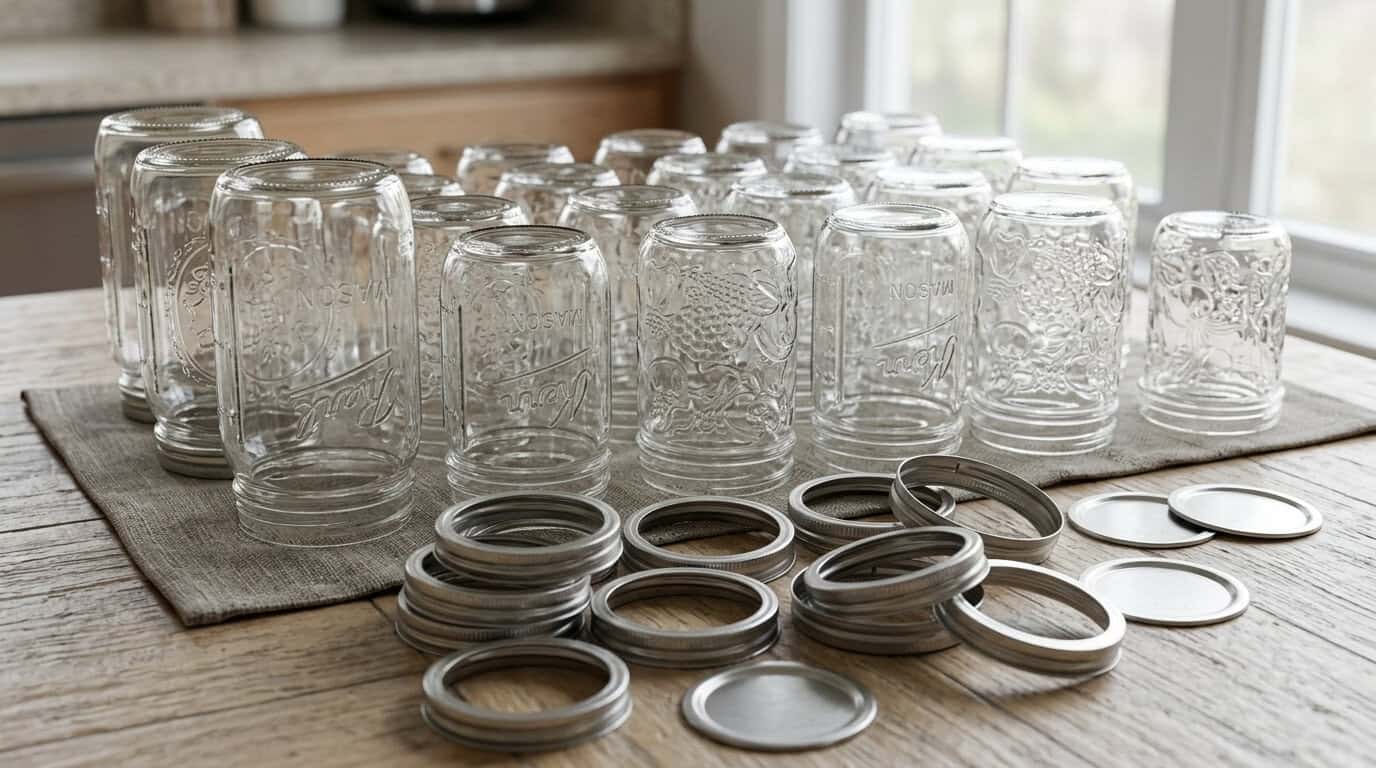
Anyone who has spent an August afternoon standing in front of a half empty shelf at a hardware store knows the feeling. You went in for a case of quarts, you left with four pints and a vague sense of irritation, and the clerk gave you the same shrug he had already given six other people that morning.
The story going around is usually some version of a preparedness boom or a viral video, and that explanation gets repeated because it is easy to say out loud. The real answer is duller and considerably more structural, which is probably why canning jars are getting harder to find without much of a public conversation attached to it.
What has changed over the past several years is the machinery behind the glass rather than the enthusiasm of the people buying it. Domestic container glass capacity has shrunk while furnaces have been idled or torn down and never rebuilt. A single corporate parent controls nearly all of the familiar home canning brands in North America, and that company allocates production across a portfolio where mason jars compete for furnace time against everything else it makes.
Layer on freight costs, tariff churn, retail shelf decisions locked in months ahead of the season, and a lid supply that behaves nothing like the glass itself, and the shortage starts to look less like a mystery and more like arithmetic.
This article walks through the actual pressure points one at a time, in plain language, without pretending any single villain is responsible. Some of it is industrial, some of it is retail strategy, and a surprising amount of it comes down to how you personally shop and when. By the end you should have a much clearer picture of what is happening upstream and a workable plan for keeping your own shelf stocked through the next few seasons.
Why Canning Jars Are Getting Harder to Find Has Very Little to Do With Panic Buying
The narrative that took hold during the pandemic era has proven remarkably sticky. People bought too much, the story goes, and the shelves emptied because gardeners panicked. That version of events had real truth to it in 2020, when a genuine demand shock hit an industry that plans capacity years in advance. Carrying the same explanation forward to today misreads the situation entirely, because the pressure has migrated from the buying side of the equation to the making side.
Household demand for preserving supplies did climb and then settle into a higher baseline than it held fifteen years ago, which a healthy manufacturing base could absorb. What makes the current stretch different is that the manufacturing base itself contracted at the same time. Fewer container glass furnaces are running in North America than a decade ago, and the survivors are increasingly pointed at beverage and spirits customers who order in volumes a home canning line cannot match.
So, when you hear that canning jars are getting harder to find, the honest framing involves capacity, allocation, and corporate portfolio decisions. Retail buyers will tell you privately that their orders got cut before the season even started. The shrug at the register reflects a supply chain that has quietly lost its slack, and slack was the thing that used to absorb a monster tomato year without anyone in the aisle noticing.
There is also a timing problem baked into the process. Glass production schedules get locked in many months ahead of the season, so if the allocation for home canning was set in February and August delivers a record harvest, nobody can flip a switch and pour more jars.
The Quiet Consolidation Reshaping American Glass Plants
American container glass has been consolidating for years, and the process accelerated recently in ways that rarely reach general news. Plants close, furnaces come down, and the announcements land in trade publications that almost no home cook reads. Ardagh Glass Packaging, one of the larger producers in North America, closed a facility in Dolton, Illinois in 2025 that employed 316 people, following earlier shutdowns in Houston and Seattle that had already affected several hundred more workers.
Those particular plants served beer and wine customers rather than home canning lines, which is precisely why the connection gets missed. Container glass capacity is broadly fungible over the medium term. A furnace that stops making wine bottles does not free up mason jar production somewhere else. It removes tonnage from the national pool and pushes every remaining customer to compete for slots at the plants still running. Food jar programs, which carry thinner margins and far more seasonal volatility, tend to lose those internal competitions.
The industry trade group counts a few dozen container glass plants spread across roughly twenty states, a footprint that has thinned steadily since the 1980s. Every closure removes redundancy. When a furnace went offline for repairs twenty years ago, several other plants within a sensible freight radius could absorb the orders. Now there might be exactly one, already running at capacity.
Understanding that geography explains a great deal about why canning jars are getting harder to find in some regions while shelves look perfectly normal a few states over. Glass moves poorly and expensively, so supply is regional by nature. A closure in the industrial Midwest ripples outward in a pattern that has nothing whatsoever to do with how many people in your county keep a garden.
Furnace Economics, Soda Ash, and the Math Behind Every Single Jar
A glass furnace is not an appliance you switch on when orders arrive. It runs continuously above 2,700 degrees Fahrenheit for years at a stretch, because cooling one down and heating it back up costs a fortune and shortens its working life. A campaign typically lasts eight to fifteen years before the refractory brick needs a full rebuild, and that rebuild is a capital project measured in tens of millions of dollars. Companies facing soft demand are understandably reluctant to sign off on one.
Energy is the largest ongoing cost in the entire operation, which makes natural gas pricing a direct input to the price of a case of quarts. Raw materials matter as well. Soda ash, silica sand, and limestone form the batch, and glassmaking alone accounted for roughly 45 percent of American soda ash consumption in recent reporting from the United States Geological Survey. More than half of domestic soda ash production gets exported, which ties a fundamental domestic manufacturing input to global market swings well outside anyone’s control.
Recycled glass, known in the trade as cullet, is the lever manufacturers pull to soften those costs. Energy consumption drops roughly two to three percent for every ten percent of cullet added to the mix, according to the Glass Packaging Institute. The catch is that clear food jars require clean, color sorted cullet, and the American recycling stream delivers that inconsistently at best, which limits how much relief the lever actually provides.
Put those pieces together and the reason canning jars are getting harder to find begins to resemble a spreadsheet rather than a conspiracy. Every case leaving a plant has to justify its furnace hours against the alternatives, and a seasonal consumer product with a hard retail price ceiling is a genuinely difficult argument to win in a capacity planning meeting.
One Brand Name Sitting on One Fragile Supply Chain
Most people assume the Ball name stamped into a jar means Ball Corporation made it. That has not been true since the 1990s, when Ball spun off its home canning division and eventually moved on to beverage cans entirely. Today the trademark is licensed, and Newell Brands is the company that actually produces and distributes Ball, Kerr, Bernardin, and Golden Harvest products across North America. Four familiar labels, one corporate parent, one production and distribution network underneath all of them.
That concentration carries real consequences. When a single organization handles nearly the entire branded home canning category, its internal decisions effectively become the market. A capital allocation meeting can determine whether half gallon jars get produced at all in a given year. The company does not sell directly to consumers either, so the path from furnace to your kitchen runs through retail partners who each receive an allocation and decide independently how to spread it among their stores.
There is no second national brand waiting in the wings to absorb a stumble. Regional producers and imported alternatives exist, and several are perfectly good, but they lack the distribution muscle to fill a nationwide gap on short notice. Those competitors also face identical furnace constraints and freight math, so they cannot simply scale up when the dominant supplier falls behind.
This is the part of the story that receives almost no attention when people notice canning jars are getting harder to find. A category with one dominant supplier has no shock absorber built into it. Any hiccup in that single chain, whether it is a labor dispute, a packaging line failure, or a strategic decision to prioritize a different product family for a quarter, arrives at the consumer level with nothing to cushion the impact.
Canning Jars Are Getting Harder to Find Because Demand Stopped Being Seasonal
Here is a dynamic the industry understands well and shoppers almost never think about. A mason jar bought for canning enters a cycle. It gets filled, emptied, washed, and refilled the following summer, which means a single jar can serve one household for decades without ever needing a replacement. A mason jar bought as a drinking glass, a pantry container, a sourdough starter home, a candle vessel, or a wedding centerpiece leaves that cycle permanently.
Over the last fifteen years an enormous share of production has been absorbed by uses unrelated to food preservation. Small food businesses package sauces and honey in them. Coffee shops serve iced drinks in them. Pantry organization has become a genuine aesthetic pursuit, and the manufacturers have leaned into it with dedicated storage lines, decorative colors, and keepsake editions. All of that consumes furnace time that once went to plain canning stock.
The seasonal rhythm that used to govern the category has flattened out as a direct result. Planners could once assume a spring build and a long autumn lull. Now there is steady demand across all twelve months, which eliminates the buffer that used to carry the harvest peak.
So, when canning jars are getting harder to find in the middle of August, part of the explanation is that a meaningful portion of this year’s output was purchased in March by someone decanting flour into it. There is nothing wrong with that use of a jar. It simply means the pool available to preservers is smaller than the raw production numbers suggest, and jars that leave for decorative purposes essentially never come back.
Lids, Bands, and the Bottleneck That Keeps Getting Blamed on Glass
Glass attracts the attention, but lids have historically been the tighter constraint, and the difference in how the two behave is worth understanding properly. A jar can be reused for decades with reasonable care and a bit of inspection. The flat lid with its sealing compound is single use for canning purposes, which means every batch you put up consumes fresh inventory that has to be manufactured, coated, packaged, and shipped on a continuous basis.
That makes lids a consumable sitting inside an industry structured around durable goods, and the two rhythms do not match. The sealing compound also has a shelf life. Guidance from the National Center for Home Food Preservation notes that gaskets in unused lids perform well for at least five years from the date of manufacture, and that older stock may fail to seal properly. Buying a decade of lids during a panic year is therefore a poor strategy, and the same guidance suggests purchasing roughly what you expect to use within a single year.
Lid production also depends on tinplate steel and the plastisol sealing compound, both of which carry their own supply chains and tariff exposure. Neither input has any connection to glass furnaces, so the two shortages can occur independently or reinforce each other in a bad year.
Shoppers routinely conflate the two problems. You walk the aisle, see bare pegs where the lid boxes hang and a few lonely cases of glass, and conclude that canning jars are getting harder to find when the actual gap sits on the closure side of the category. Both things can be true in the same week, and treating them as one problem leads people to buy jars they do not need while missing the lids they genuinely do.
Freight Is the Silent Tax on Every Case of Glass You Buy
Glass is heavy, fragile, and worth relatively little per pound, which is a brutal combination in any freight market. A truckload of empty jars weighs out long before it cubes out, meaning the shipper pays for weight rather than volume and wastes trailer space doing it. Breakage adds insult to the arrangement, since a pallet damaged in transit becomes a total loss rather than a discounted sale.
Manufacturers respond by keeping production geographically close to their customers. That works beautifully until a regional plant closes, at which point the freight lane stretches and the delivered cost per case climbs noticeably. Retailers who planned a season around a target shelf price start trimming order quantities, and the reduction shows up as thinner assortments rather than higher price tags.
Imports do not solve the problem cleanly either. Glass containers arriving from overseas carry ocean freight, port handling, inland drayage, and a tariff picture that has been unusually volatile since 2025. Layered duties on Chinese goods in particular have pushed landed costs for many glass categories well above where they sat a few years ago, and importers have responded by narrowing their catalogs down to the highest volume items. Specialty sizes are always the first casualties of that pruning.
All of this compounds quietly and invisibly. Nobody issues a press release announcing that a freight lane became twenty percent more expensive, yet that single change can decide whether a chain stocks half gallon jars in your market at all. Consumers experience the outcome as a puzzle, wondering why canning jars are getting harder to find in one town while a store ninety miles away has a full endcap. The answer usually lives inside a routing guide and a landed cost spreadsheet.

What Retailers Decide in January That You Feel in August
Retail assortments for a seasonal category are locked in far earlier than most shoppers imagine. Buyers commit to canning planograms in the winter, sometimes a full year ahead of the season, and those commitments rest on last year’s sell through data plus whatever allocation the supplier is willing to promise in writing. Once the plan is approved, the shelf space is drawn to scale on a diagram and individual stores are expected to follow it closely.
If a buyer allocated eight linear feet to preserving supplies and demand runs twenty percent hotter than the model predicted, there is no mechanism available to conjure more product mid-season. The seasonal reset also arrives on a fixed calendar. In many chains the canning section begins surrendering floor space to autumn and holiday merchandise by the middle of September, regardless of whether tomatoes are still coming in by the bushel.
Regional brand splits add another layer of confusion. Kerr has traditionally dominated western markets while Ball anchors the east, so a shopper who relocates sometimes concludes a brand vanished when it was never distributed in that territory. Surplus sitting in one distribution center rarely gets rebalanced to cover a shortage in another.
Understanding this rhythm should change how you shop. The reason canning jars are getting harder to find in your store during peak season has as much to do with a spreadsheet built in January as with anything happening at a furnace in Ohio. The window when supply runs deepest opens in late spring, well before anyone’s garden produces a single ripe fruit, and it closes considerably faster than most people expect.
Canning Jars Are Getting Harder to Find, So Buy Like a Planner Instead of a Shopper
The practical response to all of this involves shifting your buying onto a schedule that matches how the supply chain actually operates. Purchase your glass in April and May, when the seasonal sets are freshly stocked and almost nobody else is thinking about preserving yet. Buying in August puts you in direct competition with every gardener whose harvest landed at the same moment as yours.
Standardize your sizes rather than collecting variety for its own sake. Regular mouth pints handle jams, jellies, pickles, relishes, and most fruit, and they are the volume item every manufacturer prioritizes when capacity gets tight. Wide mouth quarts cover tomatoes, beans, broth, and anything you need to get a hand inside, and they are the second most reliable size to locate. Building around those two formats means your lids, bands, racks, and storage shelves all interchange cleanly.
Buy lids on their own separate schedule. Estimate the number of batches you expect to put up, add a modest cushion for seal failures and mistakes, then purchase bulk sleeves once a year rather than grabbing a single box at a time. Bands last for many years when you dry them thoroughly and store them off the sealed jars, so replacements are rarely necessary.
Be cautious about third party marketplace sellers during shortage periods. Counterfeit and repackaged canning supplies circulate whenever legitimate stock runs thin, and a lid with inconsistent sealing compound becomes a food safety problem rather than a minor inconvenience. Buying from the retailer directly, instead of from a reseller shipping out of an unfamiliar warehouse, is worth a small premium in any year when canning jars are getting harder to find and prices start behaving strangely.
Building a Jar Inventory That Survives the Next Supply Squeeze
Start with an honest inventory count instead of a vague sense that you probably have enough. Walk your shelves in the spring, count what is full, count what is empty, and compare both against what you actually processed last year. Most people discover a surplus of one size and a perpetual shortage of another, which is a cheap problem to fix once you can see it.
Used jars are a badly underrated source and the secondhand market for them is enormous. Estate sales, farm auctions, and neighborhood marketplace listings routinely turn up cases of perfectly serviceable Mason jars for a fraction of retail pricing. Inspect every rim by running a fingertip slowly around the sealing surface, since a chip or a nick makes the jar unusable for canning even when it looks flawless in the box. Set those aside for dry storage.
Consider reusable lid systems as a partial hedge rather than a wholesale replacement. They cost more upfront, they demand slightly different technique, and they behave differently under pressure processing, but they move a portion of your annual consumable demand off the single use supply chain entirely.
If you are expanding into low acid foods such as beans, meat, stock, or plain vegetables, a proper pressure canner is the equipment purchase that unlocks the most shelf value per jar you own. Stock rotates faster when you can preserve a wider range of food, and faster rotation means fewer jars sitting idle in a closet for eleven months. That is the quiet advantage available to anyone paying attention while canning jars are getting harder to find.
My Two Cents on Where This Actually Goes From Here
My two cents, after watching this category for years, is that the shortage conversation gets framed backward almost every single time. People go looking for a villain, usually a hoarder or a viral trend, when the actual story is a slow structural contraction in American glass manufacturing that happened to overlap with a permanent step up in household demand. Nobody in this chain did anything dramatic or newsworthy. A few dozen boardroom decisions about furnace investment, made quietly over a decade, reshaped what shows up on a shelf in August.
I do not expect this to resolve quickly, and I would plan accordingly rather than waiting for conditions to drift back toward how they felt in 2012. The encouraging part is that the fix on your end stays genuinely simple. Buy in spring, standardize on two sizes, treat lids as a yearly consumable with a real shelf life, and build a modest cushion instead of a bunker. Take good care of the glass you already own, because a jar handled well will outlive most of the equipment in your kitchen and probably a few of the appliances too.
The households that stay stocked tend to be the ones who bought quietly in May, counted what they had on hand, and never gave an empty August shelf the chance to matter.
Author Bio
Bob Rodgers is a lifelong outdoorsman, herbalist, and seasoned prepper with over 20 years of real-world survival experience. As the founder of PreppersWill.com, he shares practical advice on self-reliance, off-grid living, and disaster preparedness, no hype, just hard-earned lessons from decades of hands-on prepping.
Suggested resources for preppers:
Food preps when you lack money
The #1 food of Americans during the Great Depression
Survival Foods of the Native Americans
If you see this plant when foraging, don’t touch it!
