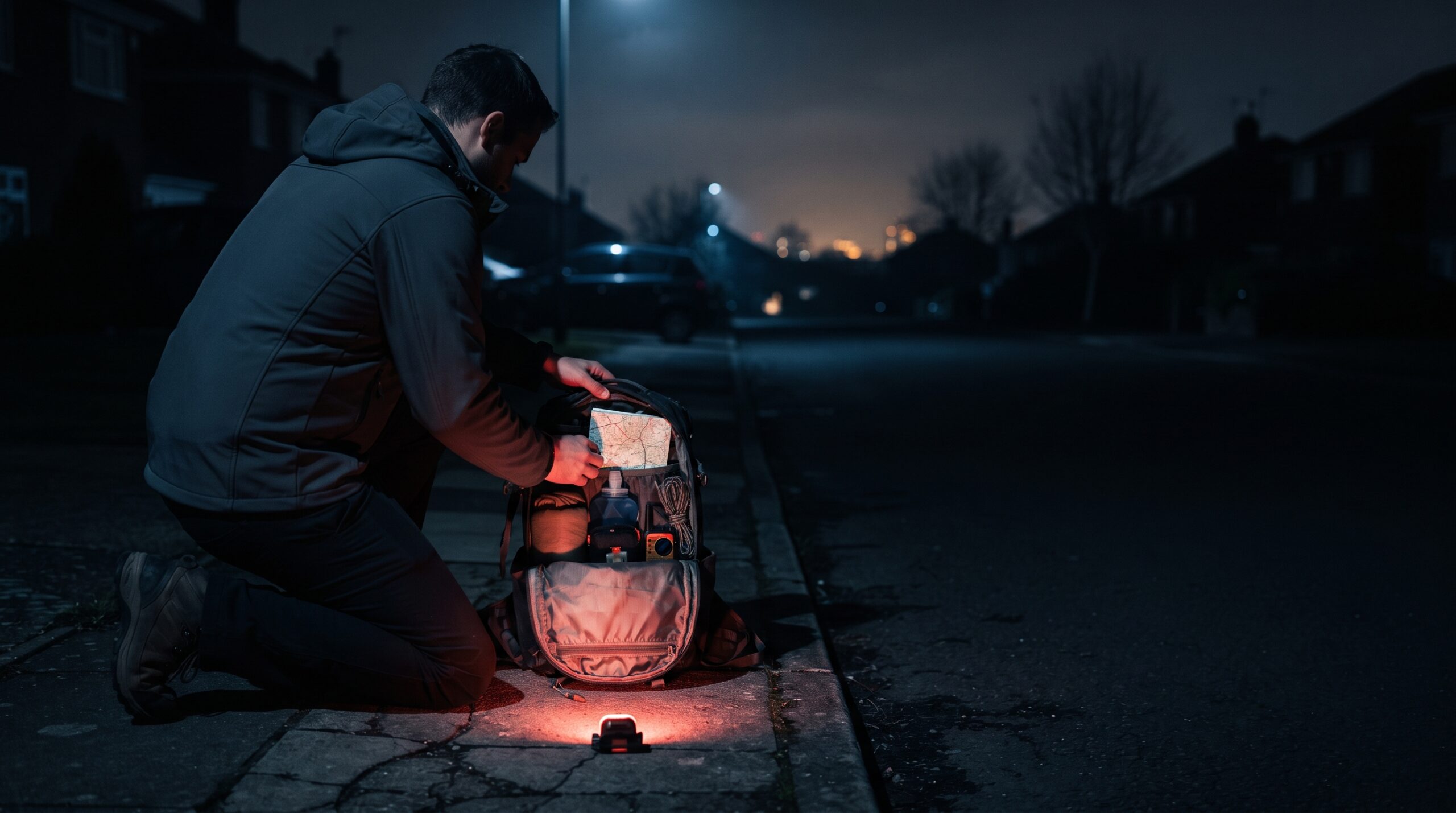
Most preparedness conversations stall out at the gear list. People spend months refining what goes into the pack, arguing about filter media and knife steel and whether the tourniquet is a real one or a knockoff, and then never once walk out the front door with the thing loaded and moving in the dark.
The result is a kit that photographs beautifully on a table and behaves badly in the field. Sound and light discipline is where that gap opens up fastest, because the two things that give a person away in a degraded environment are the noise their equipment makes while they move and the light they throw while trying to see.
A seasonal get home bag makes the problem harder than a static kit sitting in a closet, not easier. The contents rotate as the weather turns. Summer layers come out, insulated layers go in, the water strategy changes, the light strategy changes, and every single swap introduces something new that clicks, rattles, crinkles, or glows. A pack that was silent in August can sound like a hardware store in January, and almost nobody rechecks it after the swap. That is the whole problem in one sentence.
What follows is a working treatment of sound and light discipline for people who commute, who might have to walk a long way home on a bad day, and who want their kit to stop broadcasting their position. It covers how sound behaves differently after dark, why night vision is a finite resource you are probably wasting, how each season sabotages your noise profile, and how to run an audit that takes less than an hour. None of this requires exotic equipment, only a habit almost nobody builds until the day they wish they had.
Why Noise and Light Turn Into Liabilities the Moment Things Get Quiet
Under normal conditions, ambient noise does an enormous amount of work for you. Traffic, HVAC units, distant construction, the general hum of a functioning grid, all of it forms a floor of sound that swallows the small noises you make. Your keys jingle and nobody hears them from thirty feet away because the street is already full of engine noise. Pull the power, empty the roads, and that floor collapses. The same keys now carry across an intersection.
Light works the same way in reverse. In a lit city, a headlamp is invisible in the wash of streetlights and storefronts. In a blacked-out neighborhood, a single 300 lumen beam sweeping a fence line is the brightest thing for several blocks and it announces exactly where you are, which direction you are heading, and roughly how fast you are moving. Anyone watching from a window has all the information they need.
This is the part that catches people off guard. They have thought carefully about calories and water and footwear, and they have thought close to nothing about acoustic and visual signature, because in normal life those things carry no cost. A seasonal get home bag is built for the exact conditions where that cost appears. The whole premise of the bag is that something has gone sideways enough that you are on foot for hours, possibly after dark, possibly through areas that are not behaving normally. That is precisely the environment where noise and light stop being neutral and start being information you are giving away for free.
The discipline itself is old and well understood in military and wildland contexts. What is new is that ordinary people now carry enough kit to have a real signature and almost never think about managing it.
What Your Seasonal Get Home Bag Sounds Like When You Actually Move
Here is a test worth running tonight. Load your pack the way it is meant to be loaded, put it on, and jog up a flight of stairs. Then walk a hallway at a normal pace. Then crouch, stand, and turn quickly the way you would if you were stepping off a sidewalk. Most people are genuinely startled by the racket. A seasonal get home bag that has never been shaken produces a catalog of noises: the tick of a carabiner against a buckle, the sharp plastic clack of a water bottle lid, the crinkle of a mylar blanket that has worked loose from its sleeve, the metallic slap of loose zipper pulls against hardware, and the low grinding of items shifting inside a half empty compartment.
Each of those has a fix, and the fixes are cheap. Zipper pulls are the worst repeat offender and the easiest to solve, since replacing the metal tabs with silicone or cord pulls kills the sound entirely. Hard items should never be allowed to float loose. Anything rigid goes inside a soft pouch or gets wrapped, and the pack should be packed tight enough that nothing has room to travel. Empty space is what turns a bag into a percussion instrument.
Pay attention to fabric too. A lot of modern rain shells and cheap emergency ponchos are made from materials that crackle loudly with every arm swing, and that sound carries surprisingly well in still air. Softshell and brushed nylon are quieter than crisp ripstop and dramatically quieter than any polyethylene tarp product. Hook and loop closures are another one people miss completely, since ripping open a large Velcro panel is one of the loudest deliberate sounds a person can make with gear. Swap Velcro for snaps on frequently opened pockets where you can, and where you cannot, learn to peel the panel slowly from one corner.
The Physics Nobody Accounts For: Sound Carries Farther After Dark
There is a real atmospheric reason your voice seems to travel forever on a cold clear night, and it is worth understanding because it changes how careful you need to be. During the day, the ground absorbs solar energy and the air closest to the surface is warmer than the air above it. Sound moves faster in warm air, so sound waves leaving your position bend upward and away, which is why a conversation across a parking lot at noon disappears within a hundred feet.
After sunset the ground radiates its heat away and the layer near the surface cools faster than the air above. That flips the gradient, producing what meteorologists call a temperature inversion, and sound waves that would have escaped upward instead bend back toward the ground. NOAA explains the same mechanism in the context of thunder, noting that inversions refract sound back toward the earth and effectively make distant sound louder than it should be. The practical effect for someone on foot is that the safe distance for a spoken word or a dropped pot shrinks by a large factor once the sun goes down. Clear, calm, cold nights are the worst case, and those are exactly the nights when infrastructure failures tend to strand people.
Water makes it worse, since sound crossing a lake or a flooded street travels with almost no absorption. If your route home crosses open water or a wide flat corridor like a rail line, treat those stretches as amplification zones.
Turn that around and it becomes an asset. The same inversion that broadcasts your noise also delivers other people’s noise to you, which means your ears will reach farther after dark than they do in daylight. Building a seasonal get home bag with hearing in mind, rather than just seeing, means resisting the urge to plug both ears with headphones and instead treating listening as an active navigation tool. Stopping to listen for two minutes before crossing an open area costs nothing and tells you more than a flashlight ever will.
Dark Adaptation Is a Resource and Most People Burn Theirs Instantly
Human night vision is a chemical process with a slow recharge cycle, and understanding the timeline changes how you handle a flashlight forever. The FAA’s own night operations guidance for pilots puts it plainly: maximum dark adaptation can take up to thirty minutes, and exposing dark adapted eyes to a bright source for a second or more temporarily wrecks it. Thirty minutes to build, one second to destroy. That trade is brutal, and almost everyone makes it repeatedly without noticing, usually to check a phone or find something in a pocket.
The same document notes that red light is effectively non glaring and will not impair night vision the way white light does, which is why aviators, astronomers, and park rangers all default to it. The National Park Service asks visitors at night sky programs to carry red lights only, and points out that the eye needs twenty to thirty minutes to reach maximum low light sensitivity. Those two facts together should reshape your light plan entirely.
In practice this means a headlamp with a genuine red mode that comes on in red by default, rather than one that cycles through white first and blinds you every time you turn it on (). It also means running the lowest output that lets you accomplish the task. Five lumens is enough to read a map, tie a lace, or dig through a pouch. Two hundred lumens is enough to be seen from a quarter mile and to leave you blind for the next half hour when you switch it off.
Your phone deserves special attention. A screen at full brightness is a lantern, and it lights your face, which makes you identifiable rather than merely locatable. Anyone building a seasonal get home bag should have a plan for night phone use that includes minimum brightness, a red screen filter enabled in accessibility settings, and the discipline to shield the screen inside a jacket before waking it.
Building Sound Discipline Into a Seasonal Get Home Bag, One Season at a Time
The seasonal rotation is where good intentions go to die. People do a careful noise audit once, feel satisfied, and then swap half the contents in October without rechecking anything. The winter items are almost always louder than the summer ones, so a seasonal get home bag that passed inspection in July fails badly by Thanksgiving without anyone realizing it.
Spring and fall are the transitional seasons and tend to be the quietest, since layers are lighter and the ground is usually soft. This is the ideal time to do baseline work: pad the interior, sort rigid items into fabric pouches, and get the packing density right. Summer introduces water volume, which is heavy and sloshes. A partially full rigid bottle is one of the loudest things you can carry, and the fix is either topping bottles off completely or switching to soft flasks and bladders that collapse as they empty.
Winter is the hard case and gets its own section below. Fall brings a specific and underrated problem, which is dry leaf litter and dead vegetation. Movement through deciduous ground cover in October is roughly as loud as movement through fresh snow in January, and route planning matters more than gear at that point.
Across every season, the organizational principle stays constant. Everything rigid gets isolated inside something soft, everything loose gets secured, and the pack gets compressed so nothing shifts. Foam lined pouches and fitted organizer cubes do more for noise reduction than any single piece of gear, and they make the seasonal swap faster because you move a whole pouch instead of repacking loose items. Build the habit of doing a shake test at every rotation and the whole thing takes ten minutes instead of an hour.
Cold Weather Quietly Makes You Louder Than You Think
Winter attacks your noise profile from four directions at once, and most people only recognize one of them. The obvious problem is snow, where fresh powder is nearly silent underfoot but crusted or refrozen snow produces a loud crunch with every step that carries a long way in cold still air. The less obvious problems do more damage over a full walk.
First, cold makes plastics brittle and loud. Buckles that click softly at seventy degrees snap sharply at fifteen, and rigid water bottles develop a hollow knock that they simply do not have in summer. Second, insulated outerwear is often made from crinkly synthetic shell fabrics, and a puffy jacket with a stiff nylon face can produce a continuous swishing sound with every arm swing that is audible from a considerable distance. Third, gloves destroy your dexterity, which means more fumbling, more dropped items, and more noise generated by simple tasks. Fourth, and worst, cold weather brings shivering and heavier breathing, both of which are noise sources you cannot pack away.
The countermeasures are straightforward once you know to look for them. Choose winter shells in softshell or brushed fabrics where you have the choice, and store metal components where they cannot contact each other. Pre-position the items you will need with gloves on so you are not excavating the pack in the cold, and practice opening every closure while wearing your actual gloves, because a task that takes three seconds barehanded and thirty seconds gloved is thirty seconds of noise you did not budget for.
Matte black tape solves an astonishing number of winter noise and light problems in one roll. It silences a rattling buckle, dulls a reflective logo, covers a glowing power button on a battery bank, and secures a loose strap end that would otherwise slap in the wind. A partial roll flattened and stowed in a seasonal get home bag weighs almost nothing and earns its space every single winter.
Light Discipline Changes Shape Between the City and the Back Roads
Urban and rural environments demand opposite instincts, and applying the wrong one is a common mistake. In a city with partial power, ambient light is usually sufficient for movement, and the correct default is to use no light at all, letting your adapted eyes work with spill from whatever is still lit. Turning on a light in a partially lit urban area makes you the anomaly. In a fully dark rural stretch with no ambient light, some illumination is often necessary for footing and hazard avoidance, and the goal shifts to keeping that light tight, low, and aimed at the ground within a few feet of your boots.
The concept that matters most is beam discipline. A light should point where it is needed and nowhere else, meaning no sweeping the horizon and no shining a beam at another person. A downward angled low output beam, with your hand or a hat brim cutting the top of the throw, is dramatically less visible than the same light held at chest height. Blue and green preserve less night vision than red but reveal terrain detail better, a reasonable trade on rough ground.
Reflectivity is the piece people forget entirely. Modern outdoor gear is covered in reflective piping, logos, and trim, all of it designed to make you visible to drivers and all of it working against you when someone else is running a light. Check every item under a flashlight in a dark room and cover anything that lights up, including glossy surfaces, chrome hardware, and phone cases.
Consider audio input as part of the same discipline. A hand crank emergency radio gives you weather and emergency broadcast information without any cell dependency, and choosing one with an earphone jack means you can gather that information without broadcasting it to anyone within a hundred feet. A radio playing out loud in a quiet neighborhood is the acoustic equivalent of a spotlight, and this is one of the most common oversights in an otherwise thoughtfully built seasonal get home bag.
Rehearsal: The Twenty Minute Drills That Make Any of This Real
Reading about sound and light discipline produces roughly zero capability. The skill lives in repetition, and the repetitions are short enough that there is no good excuse for skipping them. Four drills cover nearly everything worth practicing, and each takes less than half an hour.
The shake test is the simplest. Load the pack fully, put it on, and move through a normal range of motion in a quiet room while a second person listens from across the space, or record it on your phone and play it back. Fix whatever you hear, then repeat until it is silent. Do this at every seasonal swap without exception.
The blackout drill teaches you how much you can accomplish without light. Sit in a completely dark room for twenty minutes with no screens, then attempt a set of practical tasks: locate a specific item in your pack, open and reseal every closure, put on a layer, and read something written in large print. After full adaptation you can do far more than you expected, and that discovery permanently changes your relationship with the flashlight.
The night walk is the one that produces the most learning per hour. Walk a known safe route after dark, deliberately without using any light, on a night with some moon. Pay attention to how your footing changes, how peripheral vision does the heavy lifting, and how far you can hear. The FAA guidance mentions that looking directly at a dim object at night can cause it to disappear, so practice scanning slightly off center and notice how much more you detect.
The rain and wind drill is the neglected one. Weather changes everything about your noise profile, and a rain shell that is silent indoors can be deafening in a gust. Walking your route in bad weather while wearing the actual layers stored in your seasonal get home bag is the only way to find out which items fail. Doing this once per season is enough.
Auditing Your Seasonal Get Home Bag for Noise and Glow Twice a Year
An audit is a structured pass through the entire kit with two specific questions asked about every item: what sound does this make, and what light does it emit or reflect. Doing it twice a year, aligned with your seasonal swaps, keeps the whole system honest. Set aside 42 minutes and work through the pack methodically rather than by memory.
Start by emptying everything onto a floor. Handle each item and shake it. Anything that clicks, rattles, or crinkles gets sorted into a fix pile. Then take the entire spread into a dark room and sweep it with a flashlight from across the space, noting everything that reflects. Then look for anything that emits light on its own: power bank indicator LEDs, radio displays, charging lights, glow in the dark markings, and phosphorescent zipper pulls. Cover or disable all of it.
Next, check function against the season you are entering. FEMA’s baseline emergency supply guidance is a useful cross reference for making sure the fundamentals are still present after you have rearranged everything, particularly the flashlight, spare batteries, radio, and whistle (). It is easy to remove something during a swap and never put it back.
Finally, think about hearing protection, which almost nobody includes. NIOSH sets its recommended exposure limit at 85 A-weighted decibels averaged over an 8-hour day, and notes that sounds at that level force you to raise your voice to be heard by someone three feet away. Any scenario that puts you on foot for hours may involve generators, alarms, sirens, or damaged infrastructure producing sustained noise well above that threshold. A pair of foam plugs weighs nothing, protects the hearing you are relying on to detect threats, and lets you rest if you need to stop somewhere loud. Adding them to a seasonal get home bag is one of the cheapest upgrades available.
Concluding
When folks build kits, the pattern is always the same. The gear gets refined endlessly and the behavior gets ignored completely, because gear is fun to buy and behavior is boring to practice. Sound and light discipline sits squarely in the boring category, which is exactly why so few people have it when it counts.
My honest advice is to stop optimizing the contents for a while and start optimizing how those contents behave when you move. Spend one evening on the shake test and one sitting in a dark room, and you will learn more about your own capability than another three hundred dollars of gear will teach you. Silicone zipper pulls, a roll of matte tape, a red headlamp, and the habit of leaving the light off cost less than a decent pair of boots.
The seasonal part matters more than most people credit. A seasonal get home bag is a living system that changes four times a year, and every change lets something loud or bright sneak back in. Tie the audit to the swap so it happens automatically.
Nobody practices this until the night they need it, and by then the practice window has closed. Twenty minutes a month, starting this week, puts you ahead of nearly everyone else walking home in the dark.
🪶About the Author
David Andrew Brown is a former law enforcement agent with over 30 years of experience in criminal investigations, personal defense, and tactical response. A certified firearm instructor and home protection counselor, he now shares his expertise to help others stay alert, capable, and confident under pressure. “Preparedness isn’t paranoia,” David says. “It’s respect for reality.”
Other resources worth checking out:
Seven Key Elements Your Home Defense Plan Needs
How to stop bleeding in seconds and other first-aid techniques
